
Of all the products we sell, two-way mirrors generate more questions than the rest combined. Some of the questions are technical — how thick should it be, what’s the right reflectivity ratio, will it work in this particular lighting setup. Some are practical — can I cut this myself, will it work for a smart mirror project, how do I mount it.
We’ll walk through how the mirror actually works at the level of light and physics, what makes a good two-way mirror versus a poor one, the lighting setup that determines whether the effect succeeds or fails, and the specific applications where acrylic two-way sheets perform well. By the end, you should know enough to specify the right material for your project and avoid the common mistakes that produce disappointing results.
Before we begin, a note on terminology: “two-way mirror” and “one-way mirror” refer to the same product. Both terms are in use and are correct, depending on whether you are describing the function (a mirror that allows differing ratios of bidirectional light to pass through) or perception (appearing as a one-way mirror to an observer at a specific location). For consistency, we will use “two-way mirror” in this article, but the products you find under either name are functionally the same.
What a Two-Way Mirror Actually Is
A Partial Mirror
The first thing worth understanding is that a true one-way mirror — one that reflects light in one direction and transmits it in the other — doesn’t exist. It can’t exist, because it would violate the second law of thermodynamics. The Wikipedia entry on mirrors makes this point directly: a true unidirectional mirror without external energy input is physically impossible.
What a two-way mirror does instead is reflect part of the light that strikes it and transmit the rest. Both sides behave the same way at the level of physics. The “one-way” effect is created entirely by lighting differences between the two sides, not by any directional property of the mirror itself.
This is the conceptual point that most newcomers to the product miss. The mirror isn’t doing anything clever. The lighting setup is.
How the Coating Works
A regular bathroom mirror has a thick, opaque metal layer on the back — usually silver or aluminum — that reflects nearly all the light that reaches it. A standard mirror reflects approximately 95% of incident light. The remaining 5% is absorbed.
A two-way mirror has the same kind of metal coating, but applied much more thinly. The coating is sometimes called “half-silvered” because the metal layer is sparse enough to be partially transparent. How Stuff Works describes this clearly: the reflective molecules are scattered across the surface in an even film, but only about half the coverage of an opaque mirror is applied.
The exact reflection-to-transmission ratio varies by product. The typical range across commercial two-way mirrors is somewhere between 50/50 (half reflected, half transmitted) and 70/30 (more reflected than transmitted). Some specialty variants push to 80/20 or even higher reflection ratios. BFY Mirror’s technical overview cites a typical range of 50–70% reflectivity for standard two-way mirrors compared to 95% for regular mirrors.
The product we sell is generally in the 60/40 to 70/30 reflective range, which works well for most observation and smart mirror applications. Higher reflectivity makes the mirror look more like a regular mirror from the bright side; higher transmission makes the view from the dark side clearer. There’s a real trade-off between the two, and the right ratio depends on the application.
Why Acrylic Works Well for This
Most of the older two-way mirrors people remember — the ones in police interrogation rooms, the classic observation-room setup — were made from glass. Glass is still the premium choice for some applications, particularly anywhere optical clarity matters more than weight or breakage resistance.
But for a lot of modern uses, acrylic has taken over the category. The reasons:
Size availability. Acrylic two-way mirrors are produced in much larger panel sizes than glass equivalents. We can supply panels at sizes that simply aren’t available in glass two-way at any reasonable price.
Weight. A 4ft × 8ft glass two-way mirror is genuinely heavy and difficult to install. The acrylic equivalent weighs about half as much and can be handled by one person in most cases.
Cost. Glass two-way mirror is several times more expensive than acrylic at equivalent sizes. For applications where the optical difference doesn’t matter — and there are many — the cost gap is significant.
Customization. Acrylic two-way can be cut to size, drilled, and laser-cut without specialized glass-cutting equipment. For DIY projects, smart mirror builds, and custom installations, this matters.
The downside, which we mention to every customer who asks: acrylic two-way mirror has the same surface flatness limitation as standard acrylic mirror. Above roughly 24–32 inches in any dimension, the natural flexibility of the material produces visible waviness in the reflection, and slight distortion in the see-through view from the dark side. For applications where optical perfection matters — high-end smart mirrors, surveillance systems where image clarity is critical — glass is still the better choice. For the majority of applications, the acrylic version works fine and the cost and size benefits outweigh the optical compromise.
The Lighting Principle (And Where Most Installations Go Wrong)
The 10:1 Rule
The two-way mirror effect works because of a lighting differential between the two sides. Specifically, the side that should appear as a mirror needs to be much brighter than the side from which observation happens.
The standard rule of thumb is a 10:1 brightness ratio, minimum. The bright side needs to be at least ten times brighter than the dark side for the mirror effect to work properly. In practice, more is better. Professional observation rooms typically maintain 100:1 or higher ratios.
What this means physically: a viewer on the bright side sees mostly reflected light from their own surroundings, because that’s where the available light is coming from. The small amount of light leaking through from the dark side is overwhelmed by the reflection. They see a mirror. A viewer on the dark side sees mostly transmitted light from the bright side, because there’s very little light on their side to be reflected back at them. They see through the glass.
The same panel of two-way mirror is doing the same thing on both sides. The viewer’s experience is determined entirely by which side they’re standing on and how the lighting is set up.
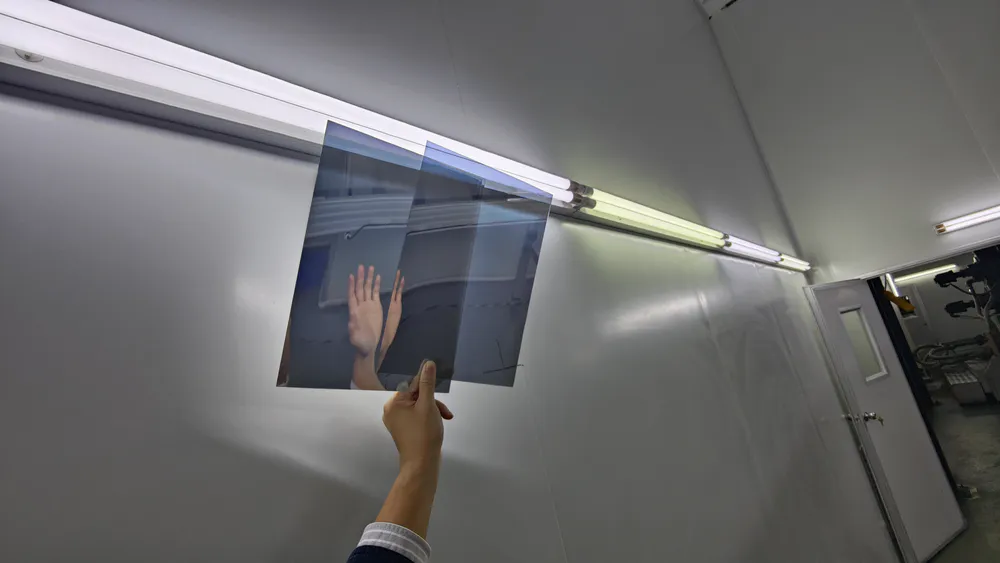
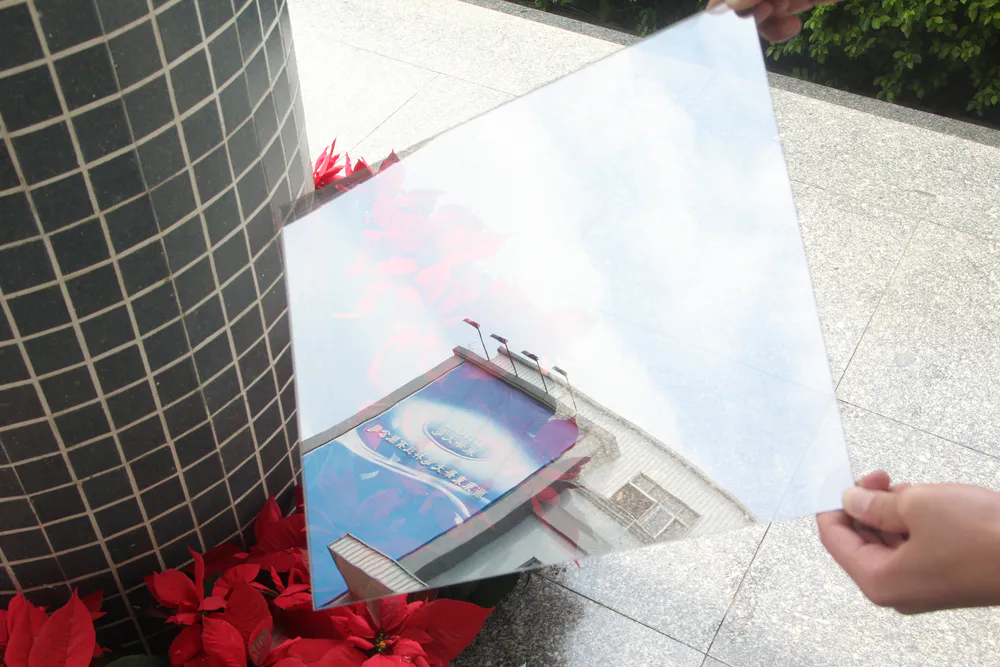
To prove this rule, we tested a piece of acrylic two-way mirror with 50% reflectivity and 50% light transmission. First, we observed its two-way effect in a weak natural light environment, and then we faced it directly towards strong natural light. From the pictures, you can see that the same side of the two-way mirror has a significantly reduced light transmission when facing strong natural light directly. This is not a rigorous test, but it is sufficient to illustrate the impact of light on a two-way mirror.

Why Installations Fail
The most common installation mistake is insufficient lighting differential. We see this regularly in customer questions and the photos people send when something isn’t working as expected.
A few specific failure modes:
The “dark” side isn’t dark enough. Any ambient light leakage on the observation side reduces the mirror effect proportionally. A door cracked open, a monitor screen, an indicator LED, a window with light bleed — any of these can break the effect. Professional setups use blackout doors and remove all light sources from the observation side.
The “bright” side isn’t bright enough. A two-way mirror in a dimly lit room won’t produce the mirror effect even if the other side is completely dark. The reflection has to be brighter than what’s transmitted from the other side, and that requires actual light on the bright side.
Lighting changes during use. The setup that works at noon might fail at dusk if the lighting is sun-dependent. Setups that rely on natural light tend to be unreliable. Artificial lighting that you control is much more dependable.
The viewer adapts to the dark. A dark observation room becomes effectively brighter once the viewer’s eyes adapt. What looked dark when you walked in produces enough reflected light off the viewer to be visible from the bright side ten minutes later. Sustained observation typically requires darker conditions than instantaneous testing suggests.
Practical Lighting Setup
For a working two-way mirror installation, we recommend:
- A bright side that’s intentionally well-lit — overhead lighting, side lighting, or both. The standard for observation rooms is 200–500 lux (broadly equivalent to a brightly lit office).
- A dark side that’s genuinely dark — under 50 lux, ideally under 20. No screens, no LED indicators, no light leakage from doorways.
- Solid walls and a sealed door between the two spaces, with no light gaps.
- If observers will spend time in the dark space, plan for eye adaptation. The space should still meet the differential requirement after observers have been there for ten minutes or more.
For smart mirror builds — where the “dark” side is a monitor displaying information behind the mirror — the lighting principle works in reverse from what you might expect. The monitor is the light source on the back side, and the room in front of the mirror needs to be dim enough that the monitor’s display is brighter than the reflection of the room. This is why most smart mirrors look great in a dim hallway and disappointing in a sunlit room.
The Smart Mirror Application
A meaningful percentage of the two-way mirror customers we work with are building smart mirrors. The category has grown substantially in the maker community over the past several years, driven mostly by Raspberry Pi-based projects and the various magic-mirror software platforms.
The basic build:
A monitor or screen sits behind the two-way mirror, displaying information (time, weather, calendar, news headlines, smart home controls). The mirror surface in front lets the user see the screen content where the screen is bright, while reflecting their own image where the screen is dark. The result is a mirror that displays information in the otherwise empty parts of the reflection.
For this build to work well, three things matter:
The reflection ratio of the mirror. Higher reflection (70/30 or 80/20) gives a better mirror appearance but makes the screen content harder to see. Lower reflection (50/50) makes the screen content brighter but the mirror look more like dark glass when the screen is off. Most smart mirror builds use something in the 60/40 to 70/30 range as a compromise.
The brightness of the screen. A dim screen will be invisible behind a high-reflection mirror. For most builds, you want a relatively bright monitor (LCD displays in the 250+ nits range are typically sufficient; OLED is generally better because of true blacks).
The room lighting where the mirror will be used. Bright rooms make the mirror effect dominate; dim rooms let the screen show through. The same smart mirror can look brilliant in one room and barely functional in another. This is worth testing before you commit to a permanent installation.
For DIY smart mirror builds, our standard recommendation is 3mm acrylic two-way mirror, sized to match the monitor with a small overlap on each side for mounting. The lightweight construction makes mounting straightforward, and 3mm has enough rigidity to look good at typical monitor sizes (usually 24–32 inches).
We have customers who’ve built smart mirrors that work beautifully and customers who’ve spent weeks fighting the lighting balance. The difference is almost always in the lighting setup, not the mirror itself.
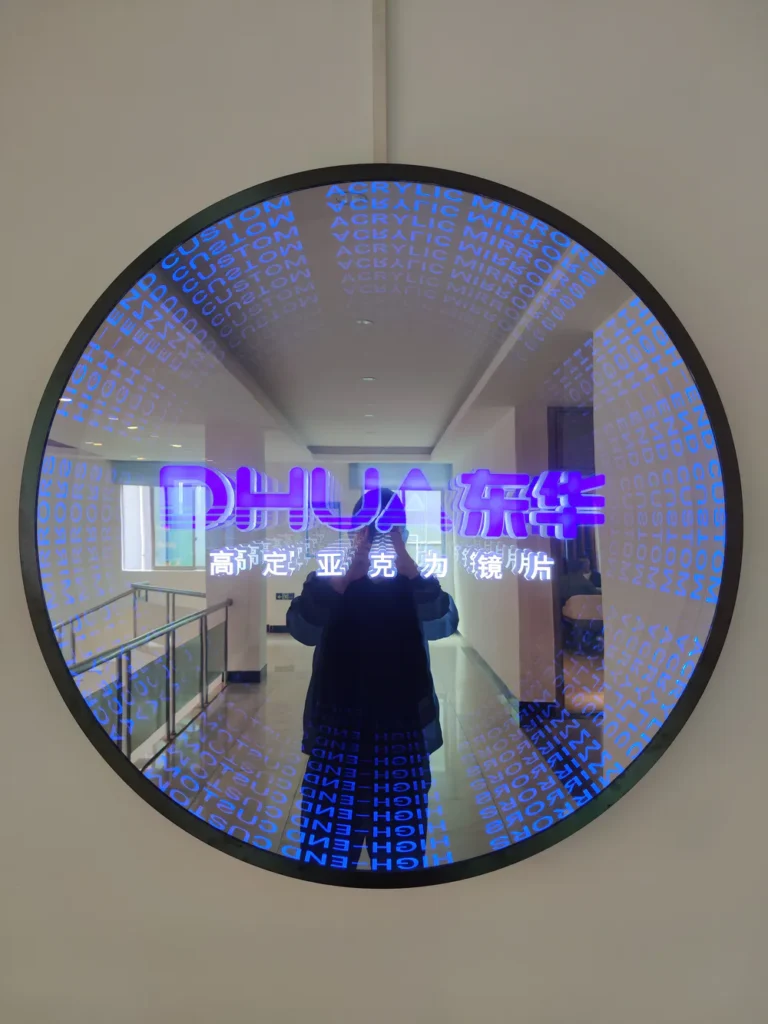
Another application is tunnel lights and layered mirrors. It is a product that places a double-sided mirror at the front, creating an effect that makes the front of the product look like it has a “deep sense of infinite depth.” This type of demand is also quite common among our customers, and the specific effect is shown in the image below.
Other Applications
Smart mirrors get the most attention, but the two-way mirror category covers a much wider range of uses. Some that come up regularly in our orders:
Observation Rooms
The classic application — used in psychology research, child behavior observation, focus groups, training facilities, and law enforcement. The setup is straightforward: a brightly-lit subject room and a darkened observation room separated by the mirror. Modern observation rooms typically also include audio recording, video capture, and sometimes one-way intercom systems, but the optical principle is unchanged from when the technology was first patented in 1903.
For these installations, the size matters. Observation rooms typically use mirrors in the 4ft × 6ft or larger range, and acrylic is increasingly the material of choice because the cost difference for those sizes is substantial. The reflection ratio is usually 70/30 or higher to ensure the subject room reads cleanly as a mirror to anyone in it.
Retail Loss Prevention
Some retail environments use two-way mirrors for unobtrusive monitoring of sales floors and dressing rooms (where local law permits — check the regulations in your jurisdiction). The mirror can be installed flush with the wall, and a small observation booth behind it allows staff to monitor the space without being visible.
The lighting setup here is the same as a traditional observation room. The monitored space stays brightly lit; the staff space stays dark.
Stage and Performance Effects
Theater, magic acts, and stage productions use two-way mirrors for various illusions and effects. The Pepper’s Ghost effect — a classic stage illusion — uses a tilted partially-reflective surface to make figures appear and disappear. Modern variations use two-way mirror panels for similar effects in attractions, escape rooms, and themed restaurants.
These applications often want lower reflection ratios (50/50 or even less) so that both the reflected and transmitted images are visible simultaneously. The goal isn’t a clean mirror effect; it’s a controlled overlay of two scenes.
Photography and Studio Use
Two-way mirrors are used for various photography techniques — periscope-style shots, mirror compositions, special effects. They’re also used in some studio teleprompter setups, where text scrolls on a hidden monitor and reflects up onto a tilted mirror in front of the camera.
For these applications, optical quality matters more than for general installations, and the size is usually small. Glass is sometimes preferred here because the optical clarity affects the final image directly.
Specialty Architecture
Some modern architectural installations use two-way mirror panels as decorative or functional elements — entryways with hidden viewing positions, two-sided display cases, art installations that change appearance based on lighting. These are less common but show up regularly in commercial fit-outs.
The general overview of our two-way mirrors product range covers the variants and sizes most commonly specified for these applications. However, it is important to note that whether it can actually be applied depends on the actual project requirements. Here, it only illustrates the applications that a two-way mirror can involve, and it does not mean that it is truly completely suitable. Sometimes, there are specific requirements for choosing a plastic two-way mirror versus a glass two-way mirror. Different materials play a decisive role in specific projects.
Specifying a Two-Way Mirror: What to Look For
A few practical points for buyers:
Size and thickness. For most applications, 3mm acrylic is the right specification. For larger installations or premium applications, 6mm gives better surface flatness. The same size considerations apply as with our standard large mirror sheets — above roughly 24 inches in any dimension, surface waviness in acrylic becomes increasingly visible.
Reflection ratio. Confirm the reflection-to-transmission ratio with the supplier before ordering. The “two-way mirror” label without a specified ratio is essentially incomplete — the same product label can describe materials with very different optical properties. Our standard is in the 60/40 to 70/30 range; specialty ratios are available on request.
Coating durability. The thinner reflective coating of a two-way mirror is more vulnerable to damage than a standard mirror’s coating. Solvents, abrasive cleaning, and edge moisture can degrade the coating over time. Mount with the protective backing intact, and clean only with mild soap and water on the front face.
Edge sealing. For installations where the mirror’s edges might be exposed to humidity (kitchens, bathrooms), edge sealing prevents moisture from creeping under the coating and causing localized failure. This is more important for two-way mirrors than for standard mirrors because the thinner coating fails more dramatically when moisture intrudes.
Mounting orientation. Two-way mirrors have a specific “front” and “back” — the side facing the bright space (mirror appearance) and the side facing the dark space (transparent appearance). Confirm orientation before mounting. Some products are clearly marked; others require careful inspection.
Lighting plan. Don’t order the mirror until you know your lighting setup will produce sufficient differential. We’ve had customers return mirrors that worked perfectly in our showroom and failed in their installation because the lighting plan didn’t match the requirement.
Common Misconceptions
A few things that come up regularly that are worth addressing:
“You can tell if a mirror is two-way by tapping on it.” This isn’t reliable. Both regular mirrors and two-way mirrors mounted to walls produce similar sounds when tapped. The genuinely useful test for whether a mirror is two-way is the fingernail test: touch your fingernail to the mirror surface. On a standard back-silvered mirror, there’s a visible gap between your nail and its reflection because of the glass thickness. On a front-silvered or acrylic two-way mirror, your nail and its reflection touch directly with no gap. This isn’t perfectly reliable either, but it’s better than tapping.
“Two-way mirrors are illegal in residential settings.” This depends entirely on your jurisdiction and how the mirror is used. Two-way mirrors themselves aren’t illegal — they’re sold openly across most markets — but their installation in dressing rooms, hotel rooms, and other private spaces is heavily regulated and often subject to disclosure requirements. The legality is about the use, not the product.
“A two-way mirror works the same regardless of lighting.” The most common misconception, and the one most likely to produce a disappointed customer. The product is genuinely useless without a proper lighting setup. We mention this several times during the buying process for two-way mirror customers because the failure mode is consistent.
“Two-way film and two-way mirror are the same thing.” Two-way mirror film — adhesive film applied to existing glass — produces a similar effect at lower cost but generally with poorer optical quality. For applications where the result matters, a purpose-built two-way mirror panel produces noticeably better results than retrofit film on regular glass.