
Among all the convex mirror products we sell, convex mirrors are undoubtedly the largest category. Their application scenarios far exceed the total of other categories—lanes, parking lots, warehouses, retail stores, factory workshops, behind cash registers, in baby car seats, and bubble mirrors used for wall decoration. The concept of the product itself is simple: a curved reflective surface that compresses a wide field of view into a smaller area. Choosing the right mirror for a specific application can sometimes confuse buyers.
This is a practical guide to the choices involved. We’ll walk through what convex mirrors actually do, the difference between buying a mirror (which you frame or mount yourself) and buying a finished product (which arrives ready to install), how to size the mirror for your viewing distance, and the specific finished products we stock most often — traffic and driveway mirrors, bubble mirrors, and child observation mirrors for car seats. By the end, you should know exactly which type and size to order for your application.
What a Convex Mirror Actually Does
The Physics, in Plain Terms
A convex mirror is a section of a reflective sphere, with the reflecting surface on the outside of the curve. When light hits the surface, it spreads outward as it reflects. The viewer sees a wide-angle image — wider than the actual width of the mirror — but the image appears smaller than the original objects.
This is a deliberate trade-off. You’re exchanging size accuracy for field of view. A flat mirror reflects what’s directly in front of it at one-to-one scale; a convex mirror reflects what’s in front of it plus a generous amount on either side, but everything appears smaller and slightly more distant than it really is.
The relationship between the curve and the optical behavior is straightforward. The radius of curvature (R) and the focal length (f) are related by f = R/2 — the focal length is half the radius of curvature, as covered in standard optics references like LibreTexts. For a convex mirror, the focal point sits behind the mirror surface (it’s a virtual focus), which is why convex mirrors always produce upright, reduced-size images that appear to be located behind the mirror plane.
The practical implication: a tighter curve (smaller radius) gives a wider field of view but more image compression. A gentler curve (larger radius) gives a narrower field of view but less distortion. Different applications need different curve geometries, which is why our mirror products are specified by diameter — the diameter and the curvature together determine what the mirror will do.
Why Acrylic Dominates the Category
Most of the convex mirrors we sell are made from acrylic, and almost all of the rest are made from polycarbonate. Glass convex mirrors exist but are uncommon in modern installations, for reasons that come up in nearly every customer conversation:
Impact resistance matters more than reflection quality here. Convex mirrors are typically installed in environments where impact is expected — driveway entrances, warehouse corners, retail loss-prevention positions, traffic intersections. Glass in these positions doesn’t just break; it creates secondary hazards from falling shards. Acrylic and polycarbonate handle the same impacts with at most a scratch.
The viewing distance is generous. Convex mirrors are designed to be seen from several feet away, often much further. The slight optical compromises that show up in acrylic mirrors at close range — the surface waviness we’ve discussed in earlier posts — are essentially invisible at typical convex mirror viewing distances of 10 feet or more.
Curvature is easier to produce in plastic than glass. Acrylic can be thermoformed into precisely curved shapes during manufacturing; glass requires more expensive processes to achieve the same result.
For applications where vandalism or extreme impact is a concern, polycarbonate is the upgrade. It’s about 250 times more impact resistant than glass, per National Safety Mirror’s published specifications, versus around 10–17 times for standard acrylic. Polycarbonate scratches more easily and yellows over long UV exposure, so the choice between the two depends on the specific environment.
Two Ways to Buy: Mirror vs. Finished Products
This is where most of the confusion in the convex mirror category comes from. We sell both formats, and they serve different customers.
Convex Mirror
A convex mirror is the curved acrylic disc itself, without a frame, backing, or mounting hardware. We sell these by diameter — 100mm, 150mm, 200mm, 300mm, and so on — because the diameter (combined with the curvature, which is matched to the size) determines the optical behavior.
These are typically ordered by:
- Fabricators building custom mirror assemblies for specific applications
- OEM manufacturers integrating mirrors into larger products
- Installers who want to specify their own mounting and framing
- Anyone replacing a damaged mirror in an existing installation
The advantages: more flexibility in mounting, better cost control for custom installations, and the ability to specify exactly the diameter and curvature you need rather than working around the standard sizes that come pre-built into finished products.
The trade-off: you handle everything beyond the mirror itself. Frame, backing, mounting hardware, edge protection, weatherproofing if needed. For a one-off home installation, this is usually more work than it’s worth. For a production environment or a project where you’re installing many mirrors, mirror orders make a lot of sense.
Finished Convex Mirror Products
These are complete mirrors — mirror, backing, frame, mounting hardware — sold ready to install. They come in fixed sizes because the entire product is engineered around a specific application.
The categories we stock:
- Traffic and driveway mirrors — large-format outdoor mirrors for road safety
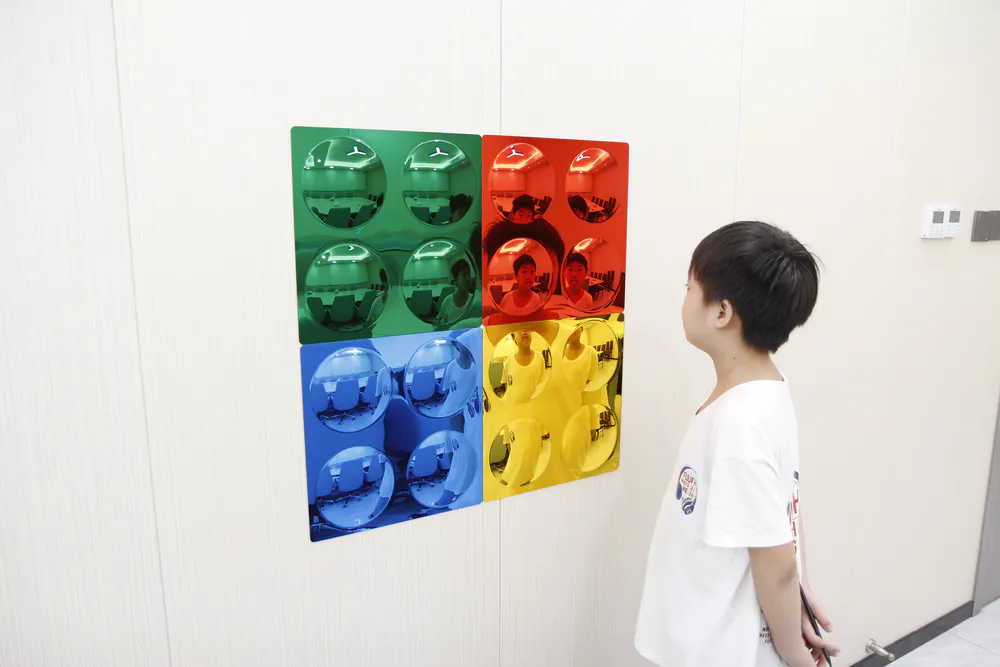
- Bubble mirrors — used for wall decoration, available in a variety of colors.
- Child observation mirrors for car seats — designed specifically for parents to monitor rear-facing infants while driving
We’ll cover each of these in detail below. The general rule: if you have a standard application, the finished product is almost always the right choice. If you have a custom requirement that the standard finished products don’t fit, you want a mirror insert.
Sizing: How to Match the Mirror to Your Viewing Distance
This is the question that drives the most ordering mistakes. The basic rule is straightforward, and once you have it, sizing decisions become much easier.
The Viewing Distance Rule
The standard industry rule of thumb: one inch of mirror diameter for every foot of viewing distance. Some suppliers use 1.5 feet of viewing distance per inch of mirror, which is closer to the upper end of usable range.
What “viewing distance” means here is the distance from where you’ll be standing or sitting when you look at the mirror, to the mirror itself. Not the distance you want to see; the distance from you to the mirror.
So:
- 12-inch mirror: works well at 12 feet of viewing distance, usable to about 18 feet
- 18-inch mirror: works well at 18 feet, usable to about 27 feet
- 24-inch mirror: works well at 24 feet, usable to about 36 feet
- 36-inch mirror: works well at 36 feet, usable to about 54 feet
In metric terms, Insight Security publishes maximum viewing distance figures that work out to roughly:
- 300mm diameter: 3 meters maximum viewing distance
- 450mm diameter: 5 meters
- 600mm diameter: 11 meters
- 800mm diameter: 20 meters
- 1000mm diameter: 25 meters
These figures are conservative — at the maximum distance, the image in the mirror is small but still useful for assessing oncoming traffic or movement.
Why Bigger Isn’t Always Better
A common mistake is assuming the largest mirror is automatically the best choice. It isn’t. Larger mirrors:
- Cost more to buy and ship
- Take up more visual space at the installation point (sometimes a problem in residential settings)
- Show more peripheral information that the viewer doesn’t actually need
- Often require more substantial mounting hardware
For a residential driveway with a 30-foot viewing distance, a 30-inch mirror is the right specification. A 48-inch mirror would technically work but provides more capability than the situation needs and costs significantly more.
The exception: traffic situations where you need to see fast-moving vehicles from a safe distance. In those cases, slightly oversizing the mirror gives you a few extra seconds of reaction time, which matters. National Safety Mirror’s recommendation for driveway-onto-public-road installations is a minimum of 26 inches in diameter, with the calculation being viewing distance × 1.5 to determine size requirement.
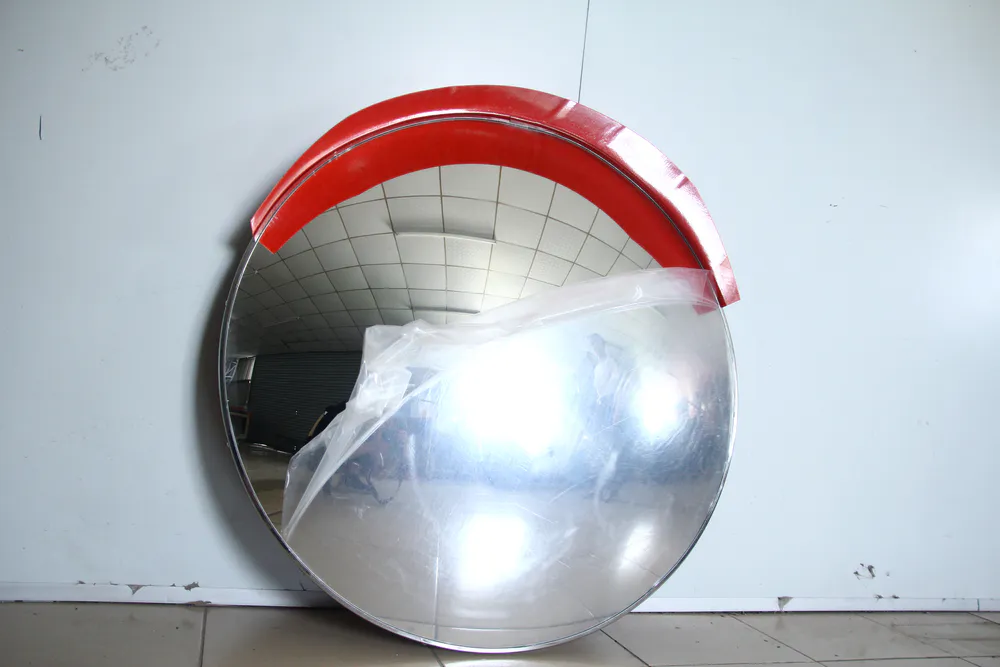
Traffic and Driveway Convex Mirrors
This is the largest category by sales volume. The use case is consistent: a position where a viewer (typically a driver) needs to see around an obstruction or blind corner before proceeding.
Common Applications
The patterns that come up most often in our orders:
- Residential driveways onto public roads, especially where vegetation, walls, or property lines block the driver’s direct view of approaching traffic
- Commercial driveways and parking lot exits onto streets
- Internal parking lot intersections, particularly in multi-level garages
- Warehouse and loading dock corners where forklifts, trucks, and pedestrians cross paths
- School parking lots and pickup zones
- Industrial sites with vehicle traffic
- Country roads where blind bends create visibility problems
Standard Sizes and Specifications
Our traffic and driveway mirrors are available in fixed sizes, typically:
- 18-inch (450mm) for short-distance applications
- 24-inch (600mm) for residential driveways and small parking lots
- 30-inch (750mm) for larger residential and small commercial use
- 36-inch (900mm) for commercial driveways and high-traffic positions
- 48-inch (1200mm) for major commercial and roadway installations
The mirror frame typically includes a highly visible red and black safety border to make the mirror itself visible in low light or busy backgrounds. Common backing materials on the market are galvanized steel (for outdoor weather resistance) or cardboard (for indoor and protected applications). However, our traffic mirrors uniformly use a fiberglass reinforced plastic back panel. An article discussing the advantages of this material used in traffic mirrors will be published separately.
Outdoor vs. Indoor Variants
The practical difference is in the backing material and the seal between mirror and backing.
Outdoor variants use weather-resistant materials throughout — typically galvanized steel or HDPE backing, fiberglass reinforced plastic back panel, and sealed perimeters that prevent moisture from creeping behind the mirror. These add cost but are necessary for installations exposed to rain, snow, and temperature variation.
Indoor variants use lighter, less expensive materials — hardboard backing is common, the seal is less critical, and the overall product weighs less. These are appropriate for warehouse interiors, indoor parking structures, and any sheltered installation.
For installations under a covered overhang where some weather exposure is possible, we generally recommend the outdoor variant as a safety margin. The cost difference is small relative to the inconvenience of replacing a failed indoor mirror.
Mounting and Installation
Traffic and driveway mirrors typically mount using a U-bolt clamp arrangement that fits standard pole sizes (usually 50–75mm or 2–3 inches diameter), wall brackets for fence or building mounting, or post-mount kits for installations where no existing structure is available.
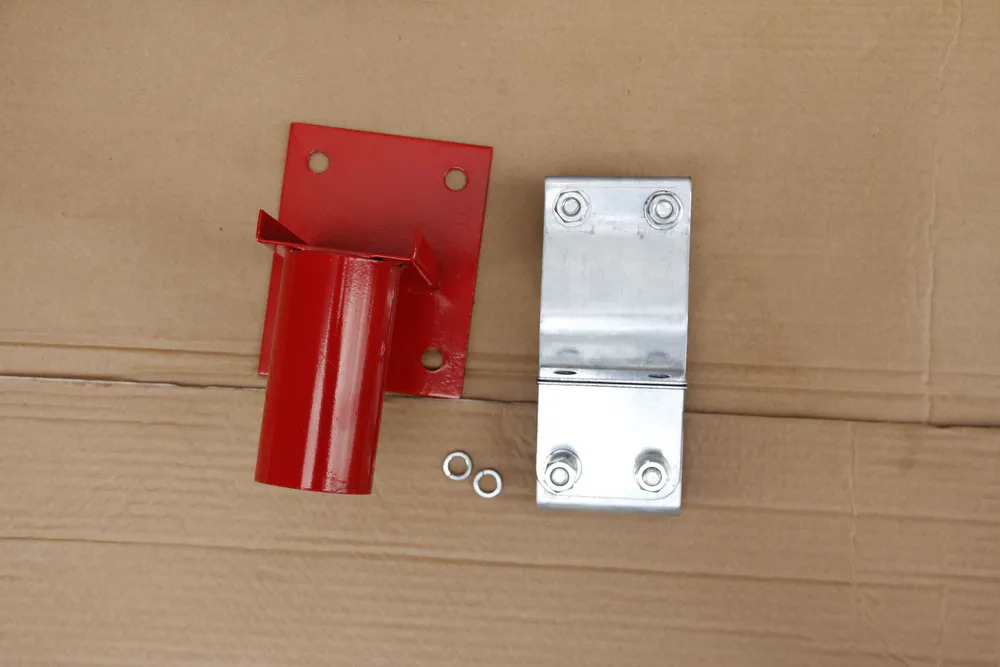
The mounting position matters as much as the mirror itself. The mirror should be:
- High enough to be visible from the driver’s seated position but not so high that the mirror surface is angled severely downward
- Aimed to capture the relevant blind spots, which usually means the mirror surface is tilted slightly outward from vertical
- Stable against wind loading (significant for larger mirrors in exposed positions)
- Positioned where the viewer has a direct line of sight without having to lean or turn
For driveway installations, we generally recommend mounting the mirror at a height that puts the center of the mirror roughly at the eye level of a seated driver in a typical sedan — usually around 4 to 5 feet above ground. Higher than this requires the driver to look up (which is uncomfortable for sustained use); lower than this is sometimes blocked by parked vehicles or pedestrians.
Bubble Mirrors
These products are completely different from large traffic mirrors, but they belong to the same category of convex mirrors.
Bubble mirrors are a type of small convex mirror—usually with a diameter of 140mm to 200mm—featuring edge processing and an adhesive back, designed to attach to wall surfaces. The most common application is wall decoration, and the most distinctive feature of bubble mirrors is their variety of colors, unlike conventional convex mirrors that are only silver. This is also why they are suitable for wall decoration.
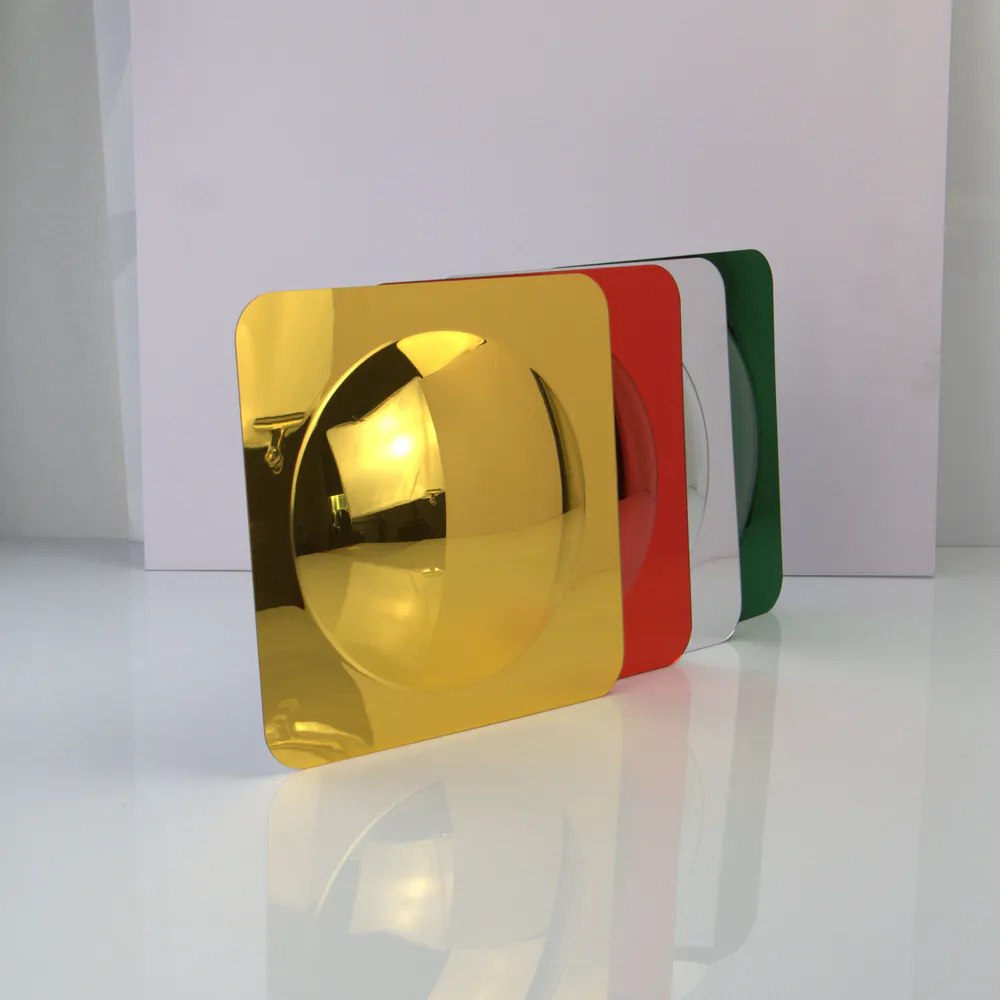
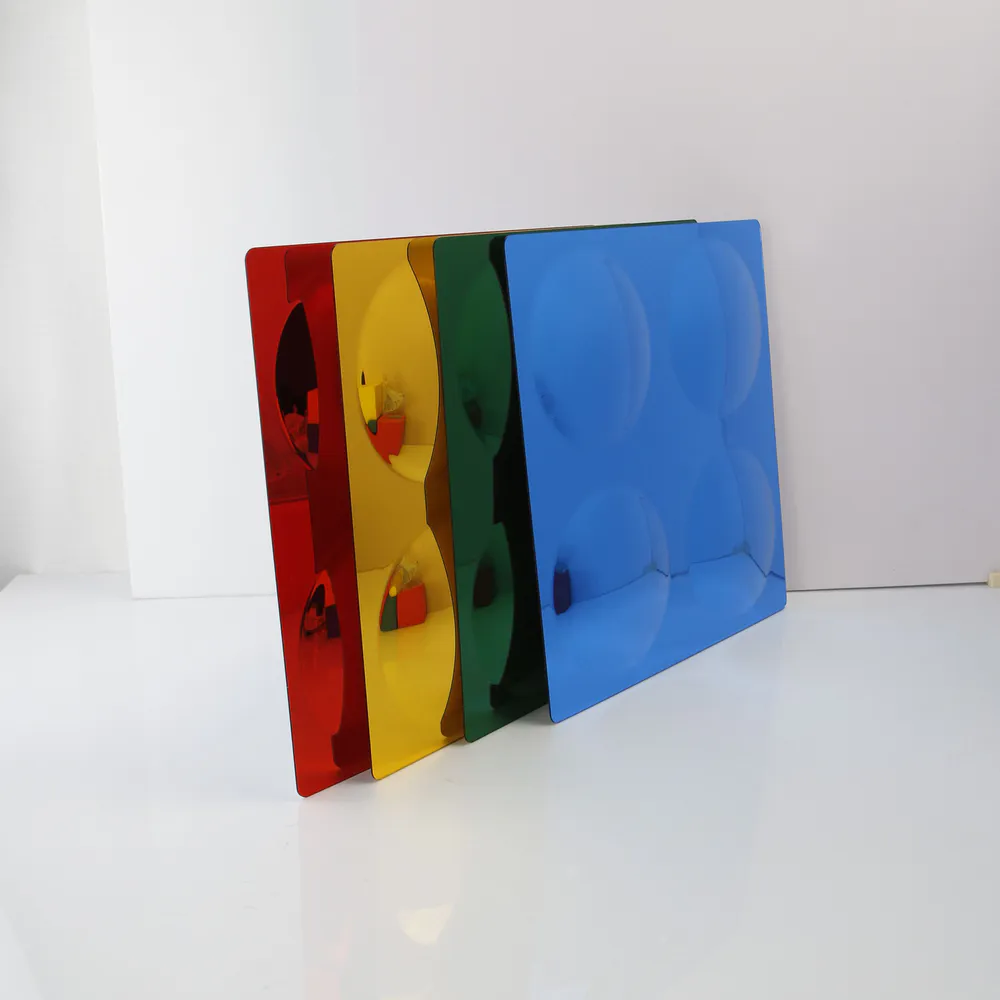
In addition, bubble mirrors usually have edge processing. Edge processing is for better arrangement and adhesion to the wall. However, it is important to note that wall adhesion mainly relies on the adhesive method on the back, whether it is single-point glue or full back adhesive, which can vary significantly in price. Generally, single-point glue is chosen, as full back adhesive increases costs.
Child Observation Mirrors for Car Seats
This is a professional product, but it plays an important role in our convex mirror sales—acrylic material is essential for safety and shatter resistance.
Usage scenario: Installing a child observation mirror on the sun visor allows the driver to see the baby in the back seat through the convex mirror on the visor, balancing the view of the baby and the vehicle’s rearview mirror.
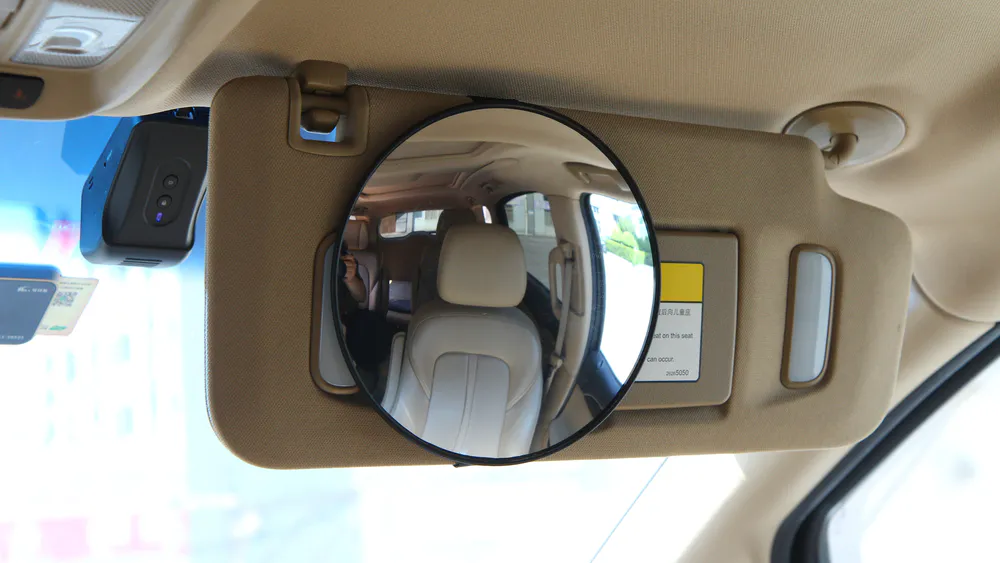
There is also another usage scenario: Installing a rear-facing child observation mirror on the front seat allows the mirror to attract the child’s attention during driving, catering to the curiosity that arises while driving.

Important product specifications:
Acrylic structure is essentially mandatory. Using glass mirrors in positions where they may fall off in an accident poses an unacceptable risk of injury to the driver or child. Therefore, acrylic is the standard material for this entire category.
Shatter-resistant frame and adjustable installation. The mirror needs to withstand normal vehicle vibrations and occasional impacts (such as toddler kicks or sudden stops) without loosening or breaking. High-quality products use a circular plastic frame and dual strap installation to prevent single point failure.
Wide field of view from convex curvature. The mirror needs to capture the entire child seat area and be positioned for visibility to the driver. This typically means a relatively wide curvature (smaller radius of curvature), producing a field of view of 160 degrees or wider.
We often receive questions from new parents about these products, with the most common confusion being whether the mirror is safe in a collision. The honest answer is: a properly installed acrylic car seat observation mirror is much safer than a glass mirror, adhering to the safety considerations for which these products are designed. A poorly installed mirror—falling off the headrest due to improperly secured straps—poses the real risk, regardless of the material. In this category, installation is more important than material specifications.
For broader context on safety-critical applications, our shatterproof acrylic mirrors safety guide covers the certification standards and impact resistance figures in more detail.
Concave and Dome Variants
This post focuses on convex mirrors specifically, but it’s worth knowing where the related categories sit.
Dome mirrors are essentially convex mirrors with a more aggressive curve — a quarter-dome, half-dome, or full-dome geometry that produces a much wider field of view (up to 360 degrees for full domes) at the cost of more image compression. They’re typically used in retail loss prevention, warehouse intersections, and other indoor applications where wide-angle observation matters more than image fidelity.
Concave mirrors curve the opposite direction — inward rather than outward — and produce magnified images at close range. They’re used for makeup, shaving, optical applications like telescopes and solar concentrators, and certain technical applications. The use case is fundamentally different from convex mirrors and doesn’t compete in the safety/visibility category.
Common Questions We Get
Can I cut a convex mirror to a custom size or shape? Generally, no. The curvature is set during manufacturing and depends on the diameter — cutting a smaller piece from a larger curved mirror produces a piece with the wrong optical behavior. If you need a non-standard size or shape, order a mirror at the closest standard diameter and mount it accordingly, or contact us about custom curvature for production-volume requirements.
Will a convex mirror work at night? Yes, but the effective range drops significantly because the image is smaller and lower-light conditions reduce the visibility of detail in the reflection. For nighttime traffic applications, slightly oversized mirrors and good ambient lighting at the installation help.
How long do these mirrors last? Quality acrylic convex mirrors with proper backing and weather sealing typically last 6–10 years in outdoor installations before noticeable degradation. The most common failure mode is moisture intrusion behind the mirror, which causes patchy “blackening” of the reflective coating from the edges inward. Polycarbonate variants are similar; the mirror material outlasts most other components.
Can I use a regular flat mirror instead? Only for applications where you want to see a specific small area at one-to-one scale. The wide-angle benefit of a convex mirror — seeing what’s around a corner before you reach it — isn’t replicable with a flat mirror at any reasonable size.