
Most of what we sell falls into one of two categories: flat acrylic mirror sheets, and curved acrylic mirrors. The flat category is what most buyers think of when they hear “acrylic mirror.” The curved category — convex, concave, and dome variants — is where the more interesting product range sits, and where buyers most often need help understanding which variant fits their situation.
In fact, acrylic flat mirrors are not as recognizable as acrylic curved mirrors. Flat mirrors tend to compete with glass mirrors, whereas curved mirrors are generally made of plastic materials.
Therefore, we’ll cover what makes a curved mirror different from a flat one, walk through the three main variants and what each is good for, address some of the questions that come up regularly when buyers are trying to choose between them, and provide a practical reference for matching the right curve to the right application. By the end, you should be able to identify which variant your project needs.
What Makes a Mirror “Curved”
A flat mirror reflects light straight back along the angle it arrived from. A curved mirror — any mirror with a non-flat reflective surface — does something more interesting. The curvature changes the relationship between the incident light and the reflected light, which means the size, position, and field of view of the reflected image are all different from what a flat mirror produces.
There are two ways a mirror can curve. The reflective surface can bulge outward, away from the viewer — this is a convex curve, and it produces a wide-angle reduced-size reflection. Or the reflective surface can curve inward, toward the viewer — this is a concave curve, and it produces a magnified image at close range and a focused or inverted image at greater distances. Both come from the same underlying geometry: a section of a sphere or a parabola, with the reflective coating on either the outside or the inside of the curve.
Beyond these two basic types, there are specialized variants. Dome mirrors are essentially aggressive convex curves — much more pronounced than a standard wall-mounted convex mirror, with the reflective surface wrapping around enough of a hemisphere to provide visibility in multiple directions simultaneously. Parabolic mirrors are concave mirrors with a specific mathematical curve (a parabola rather than a section of a sphere) used in specialized optical applications.
The practical implication of all this is straightforward. Different curves serve different jobs. Picking the right variant for your project starts with understanding what each one is designed to do.
Why Acrylic Works Well for Curved Mirrors
This is worth mentioning briefly because it’s the reason the curved mirror category is dominated by acrylic rather than glass. Acrylic can be thermoformed — heated to its softening temperature and shaped against a mold — which means producing curved acrylic mirrors is significantly easier and less expensive than producing curved glass mirrors. Glass requires either precision grinding (slow and expensive) or specialty bending processes that don’t achieve the same precision as ground glass. For most curved mirror applications, acrylic delivers what’s needed at a fraction of the cost.
The shatter-resistance and weight advantages of acrylic we covered in our acrylic vs glass mirror comparison also matter more for curved mirrors than for flat ones. Curved mirrors are often installed in places where impact is realistic — traffic positions, warehouse intersections, retail environments — and where the weight of a glass equivalent would create real mounting and safety problems. The combination of moldability, impact resistance, and weight makes acrylic the standard material across virtually the entire curved mirror category, with polycarbonate as the upgrade option for genuinely high-impact applications.
The trade-off, the same as with flat acrylic mirrors, is surface accuracy. Thermoformed acrylic doesn’t achieve the curve precision that ground glass does. For the applications curved acrylic mirrors actually serve — safety, surveillance, decoration, education — the precision is sufficient. For applications that need optical precision (telescopes, laser focusing, precision solar concentration), acrylic isn’t the right material regardless of curve type.
The Three Main Variants
Each of these has a dedicated post covering the specifics. This section is the overview — what each variant is for, when to choose it, and where the more detailed information lives.
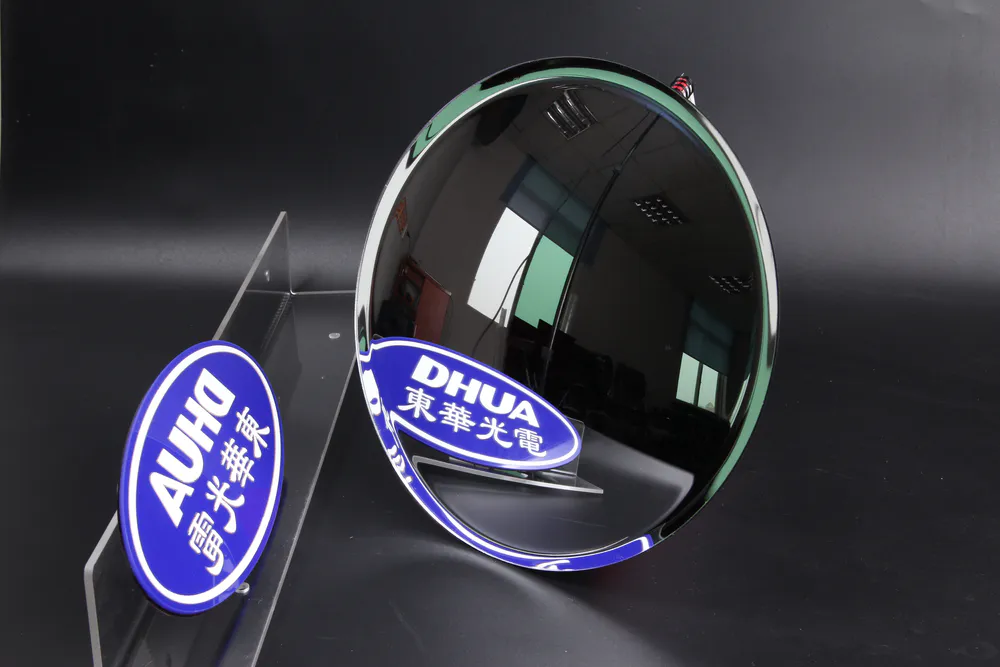
Convex Mirrors
Convex acrylic mirrors are the largest single category in our curved mirror range and probably the variant most buyers think of first when “safety mirror” or “blind spot mirror” comes up. The reflective surface bulges outward, producing a wide-angle compressed image — you see more of what’s in front of the mirror than a flat mirror at the same size would show, but everything appears smaller and slightly more distant than it really is.
The natural applications are situations where you need to expand your field of view from a fixed observation point in one general direction. Driveway entrances onto public roads, warehouse aisle ends, retail security positions, parking lot exits — anywhere a single-direction view of a wider-than-usual angle is what the situation requires.
We stock convex acrylic mirrors as both the mirror itself (sold by diameter, for fabricators and OEM installations) and as finished products. The finished products break down into three sub-categories: traffic and driveway mirrors for outdoor safety applications, bubble mirrors for decorative wall installations, and child observation mirrors for car seats. Each of these serves a genuinely different market.
For the full treatment of sizing, viewing distance calculations, the finished product options, and the practical decisions involved in specifying a convex mirror, see our acrylic convex mirror buying guide. Our convex mirrors product range covers all the variants we stock.
Concave Mirrors
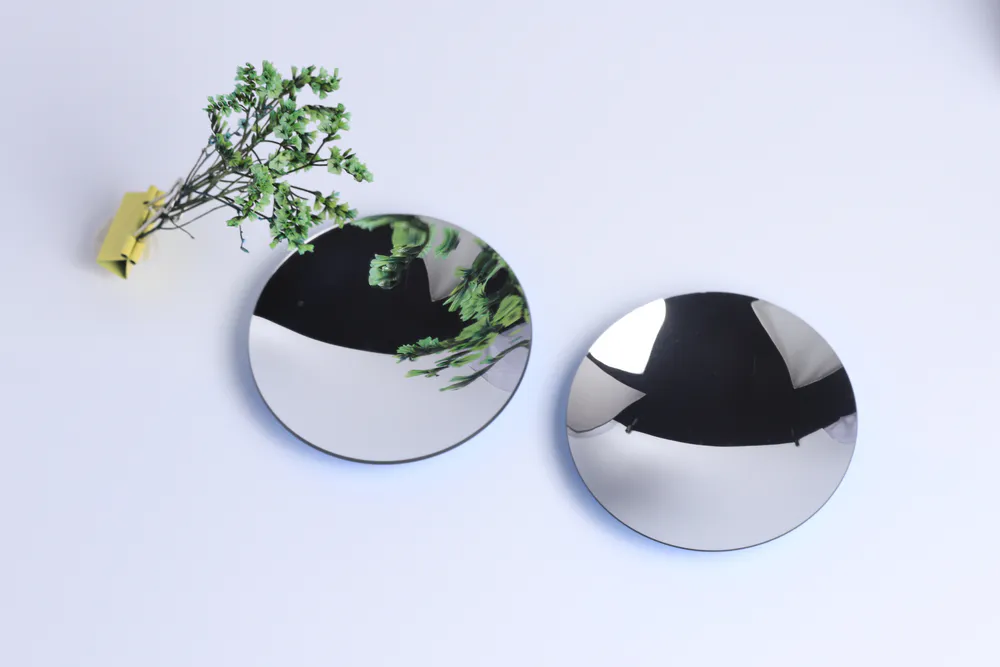
Concave acrylic mirrors curve inward — the reflective surface dishes back away from the viewer, producing magnification at close range and unusual optical effects at greater distances. This is the variant most likely to surprise buyers, because the optical behavior is more complex than convex or flat mirrors and the application range is narrower than buyers initially expect.
The honest framing on this category: acrylic concave mirrors are not precision optical instruments. They can’t substitute for telescope mirrors, can’t focus sunlight effectively for solar concentration, and don’t deliver the surface accuracy needed for laser focusing or scientific imaging. The applications where they genuinely work well are decorative (the distinctive curved reflection has real aesthetic value), educational (demonstrating basic optical principles in classrooms and science museums), retail and display (visual effects in commercial installations), light fixture reflectors for decorative fixtures, novelty and entertainment use (the classic “funhouse mirror” effect), and low-magnification cosmetic use.
We sell concave acrylic mirrors as the mirror itself rather than as finished products — customers handle frame, mounting, and installation according to their specific application. The dedicated acrylic concave mirror applications post covers what these mirrors can and can’t do in much more detail, including a frank discussion of which projects need a different product entirely. Our concave mirrors product range covers the standard diameters we stock.
Dome Mirrors
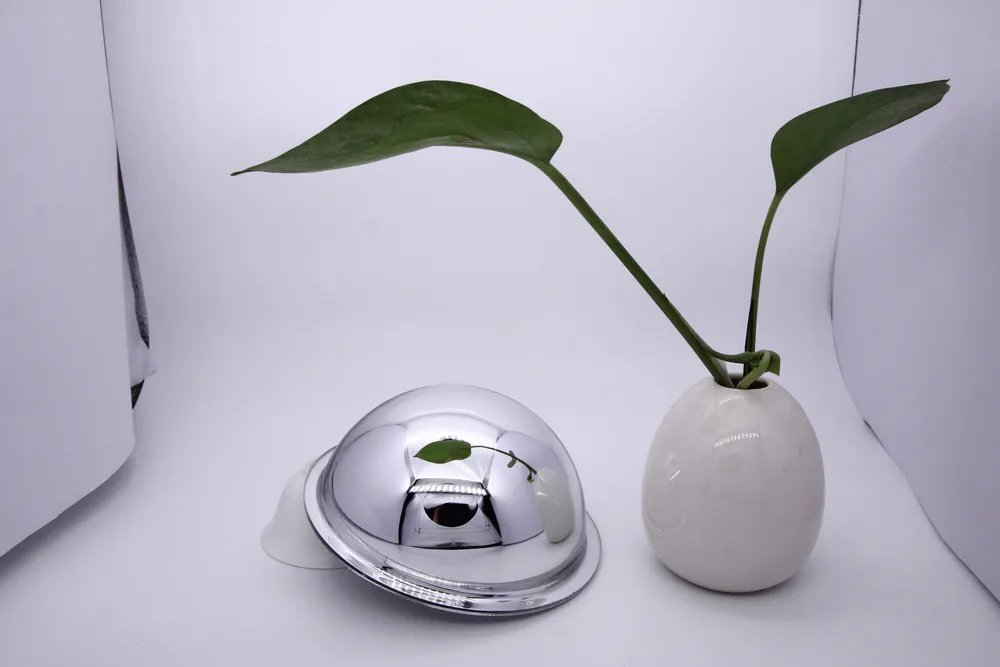
Dome acrylic mirrors are essentially aggressive convex curves — much more pronounced than the flat-mounted convex mirrors used for driveways and traffic positions. The aggressive curve means the reflective surface wraps around enough of a hemisphere to show what’s happening across multiple directions simultaneously, which is the key practical difference from standard convex mirrors.
The application set is fundamentally about multi-directional viewing from a single overhead observation point. Warehouse intersections, retail floor surveillance, hospital corridor T-junctions, school hallway intersections, industrial facility traffic management — anywhere that visibility in multiple directions from one fixed point matters more than visibility in one specific direction.
Dome mirrors come in four geometric variants: full domes (360-degree view, ceiling-mounted at intersections), three-quarter domes (270 degrees, mounted at outside building corners), half domes (180 degrees, mounted at wall-ceiling junctions for T-intersection visibility), and quarter domes (90 degrees, mounted at interior L-corners). Choosing between them depends on the specific geometry of the installation point.
For the full treatment of the four variants, sizing for viewing distance, and the choice between dome and standard convex mirrors, see our dome mirror vs convex mirror decision guide. Our dome mirrors product range covers all four configurations across the standard size range.
How to Choose Between the Three
For most projects, the choice between convex, concave, and dome comes down to a single question: what are you trying to do with the mirror? Once that’s clear, the right variant is usually obvious.
If you need to see around an obstruction in one direction — the most common situation for safety mirror buyers — you want a convex mirror. Driveway, warehouse aisle, parking lot, retail security position, anywhere the geometric problem is “I need to see what’s happening over there before I move,” and “over there” is in one general direction.
If you need to see in multiple directions simultaneously from a single overhead position, you want a dome mirror. Four-way intersection, T-intersection, L-corner, outside building corner — anywhere the geometric problem involves multiple directions converging at one point.
If you want to produce magnification, focus light, or create distinctive optical effects — and you’re not trying to do precision optical work — you want a concave mirror. Decorative installations, educational demonstrations, novelty applications, light fixture reflectors, retail display effects.
These three categories don’t overlap much in practice. Buyers occasionally ask about combinations (a convex mirror that does magnification, or a dome mirror that focuses light) but the underlying physics doesn’t support these hybrid behaviors. Each variant is suited to specific things; the right approach is matching the variant to the specific need.
The Specifications That Matter Across All Three
Some specifications apply across all curved mirror variants and are worth knowing about regardless of which type you’re ordering.
The material choice is essentially always acrylic versus polycarbonate. Acrylic is the standard for the vast majority of applications — it’s shatter-resistant, holds optical clarity over time, and works for indoor and most outdoor uses. Polycarbonate is the upgrade for genuinely high-impact or high-security environments — high-risk public installations. The cost difference is meaningful but justified when the environment warrants it. We covered the practical impact-resistance comparison in our shatterproof acrylic mirrors safety guide.
The backing and frame specifications depend on the variant and the installation environment. Indoor installations use lighter, less expensive backings (hardboard, masonite, foam coating). Outdoor installations need weather-resistant backings (galvanized steel, HDPE plastic, fiberglass-reinforced plastic). For convex traffic mirrors specifically, our finished products use fiberglass-reinforced plastic backing throughout — a more durable and weather-stable option than the steel or hardboard standards used elsewhere in the industry.
For full and half dome mirrors, the mounting hardware is part of the specification. Full domes typically include chain suspension kits for ceiling mounting; half domes include screw-mount hardware for wall or ceiling installation. Heavier installations or non-standard mounting situations may require custom hardware.
Sizing follows different rules for each variant. Convex sizing uses the standard 1-inch-per-foot of viewing distance rule we covered in the convex mirror guide. Dome sizing depends on which configuration: full domes have the most generous coverage per inch of diameter, half and quarter domes have progressively narrower coverage. Concave mirror sizing depends more on the desired effect than on viewing distance — decorative installations are typically sized for visual impact rather than for functional viewing range.
Common Questions That Come Up
A few questions that we get regularly across the curved mirror category, that are worth addressing here even though they touch on multiple variants.
Q: Can I get a curved mirror in a custom color?
A: For most variants, yes. Standard reflective silver is the default, but colored curved mirrors are available — gold, rose gold, bronze, smoked black, and custom Pantone matches for production-volume orders. The color affects only the reflection tint, not the optical behavior. Bubble mirrors specifically are commonly available in multiple colors as a defining feature of the product, and can be ordered in single colors or curated color combinations.
Q: Can curved mirrors be cut to non-standard sizes?
A: Generally no, for two reasons. First, the curvature is set during manufacturing and is matched to the diameter — cutting a smaller piece from a larger curve produces a piece with the wrong optical behavior. Second, the thermoforming process means the curve depends on the mold used, and custom mold work is only practical for production-volume orders. For non-standard sizes, the best approach is ordering at the closest standard diameter, or contacting us about custom production for larger orders.
Q: Will curved mirrors work outside?
A: Yes, but specify outdoor-rated. The combination of UV exposure, temperature variation, and moisture will degrade indoor-rated mirrors relatively quickly. Outdoor variants use UV-stabilized substrate, weather-resistant backing, and sealed perimeters. The cost difference is modest relative to the inconvenience of replacing a failed indoor mirror.
Q: How long do curved acrylic mirrors last?
A: For outdoor installations, quality acrylic curved mirrors typically last 6–10 years before noticeable degradation. The most common failure mode is moisture intrusion behind the reflective layer, causing patchy “blackening” from the edges inward. Indoor installations last significantly longer — 15+ years is normal for well-mounted indoor mirrors in stable environments.
Q: Are curved acrylic mirrors safe for children?
A: Yes, with the qualifications we covered in the safety guide. The shatter-resistance of acrylic compared to glass is meaningful for any application involving children. For mirrors specifically marketed for children’s products, the manufacturer should be able to confirm testing against ASTM F963 or the relevant regional standard for the intended market.
Q: Can I install a curved mirror myself?
A: For wall-mounted convex mirrors, generally yes — standard mounting hardware and basic installation skills are sufficient. For pole-mounted traffic mirrors, professional installation may be warranted depending on the pole work involved. For full dome mirrors, careful attachment to ceiling structure is important and the larger sizes may need professional mounting to ensure adequate anchoring. Bubble mirrors mount easily with adhesive backing — no tools required.
Curved vs. Flat: When Either Would Work
Most projects clearly call for one or the other, but occasionally a buyer is genuinely uncertain whether the application needs a curved mirror at all. A few quick considerations:
A flat mirror at the same size shows only what’s directly in front of it. For most visibility and safety applications, this isn’t sufficient — the whole point of the mirror is to see what you couldn’t see directly. Curved mirrors are the right choice when the situation requires a wider field of view than a flat mirror can provide at any reasonable size.
A curved mirror at the same size shows more area but with reduced size and some optical distortion. For applications where image accuracy matters (precise observation, detailed inspection, vanity use), a flat mirror is the better choice and curved variants would compromise the result.
For installations involving long flat surfaces — gym walls, dance studio walls, full-length entry mirrors — neither curved variant is appropriate, and the choice is between flat acrylic mirror sheets (with the size-distortion limitation we’ve covered extensively) or glass. Our large mirror sheets product range covers the flat sheet options for size-driven applications where curve isn’t appropriate.