
This is one of those questions where the right answer turns out to be more useful than buyers initially expect. People come to us asking for a “safety mirror” or a “blind spot mirror” without realizing there are two genuinely different categories, each suited to different situations. The difference is mainly about geometry — where the obstruction is, what direction you need to see in, and how the mirror will be mounted — but it determines which product actually works.
To answer this question, we’ll start with what each product physically is, walk through the situations where each one is the right choice, cover the dome mirror sub-variants (full, half, three-quarter, and quarter), and end with a clear decision tree you can use for your own application. By the end, you should know whether your situation calls for a flat convex mirror or one of the dome variants, and which specific configuration matches what you’re trying to see.
If you’ve already read our acrylic convex mirror buying guide, some of the basic optics will be familiar. This post focuses specifically on the choice between standard convex and dome variants.
What Each Product Actually Is
A metaphor will help you understand. A flat-mounted convex mirror is essentially a slice cut from the surface of a sphere — typically a relatively shallow slice, producing a curve that bulges outward from a flat backing. The mirror mounts vertically (or near-vertically) like any other wall or pole-mounted mirror, and the reflective surface faces in a single primary direction.
A dome mirror is a more pronounced section of the same sphere — a larger portion of the curve, formed into an actual dome shape that protrudes outward from the mounting surface. The reflective surface wraps around multiple directions simultaneously, allowing a single mirror to show what’s happening across a wider angular range than a flat-mounted convex can manage.
Both produce wide-angle reduced-size reflections. Both compress field of view. But because of the more aggressive geometry, a dome mirror can show what’s happening in multiple directions from a single mounting point, while a flat-mounted convex mirror is fundamentally directional.
The difference is: convex mirrors are best for situations where you need to see in one direction (or in a narrow arc), and dome mirrors are best for situations where you need to see in multiple directions simultaneously from a single fixed observation point.
This is the core decision driver. Once you understand which category your application falls into, the rest of the choice — size, mounting style, backing material — follows naturally.
When to Choose a Convex Mirror
The classic convex mirror application is the one most people think of first: a driveway exiting onto a public road. You’re approaching the end of your driveway and need to see oncoming traffic from one direction (say, your left, around a vegetation obstruction) before you pull out. A standard convex mirror mounted on a pole across the street, angled toward your driveway, shows you the road approaching from that direction.
This works because:
- You only need to see in one general direction (the road)
- The mirror can be positioned and angled specifically for that view
- Your observation point (the driver’s seat) is fixed and your viewing angle is consistent
The pattern repeats across most applications where flat-mounted convex mirrors are specified:
- Warehouse aisle ends where forklifts emerge — you need to see down the aisle from a fixed observation point
- Parking lot exits onto streets — you need to see oncoming traffic from a specific direction
- Retail security positions monitoring a specific aisle or department
- Behind cash registers, monitoring the area in front of the counter
- Loading bays where vehicles approach from a known direction
In each of these, the relationship between the observer, the obstruction, and the area of interest is geometrically fixed. The convex mirror can be angled once during installation, and the geometry doesn’t change after that.
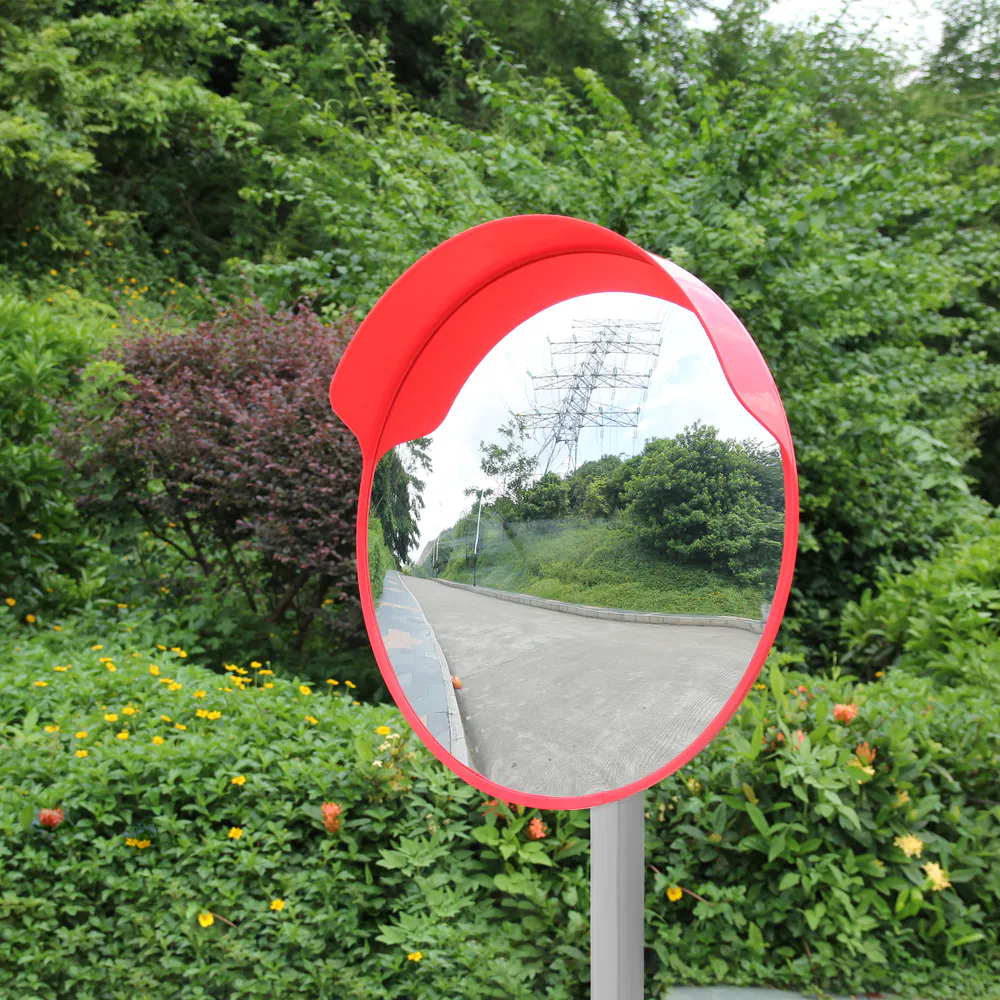
A convex mirror is not only used on traffic roads; smaller convex mirrors are also used on decorative items. However, in terms of overall proportion, its application in traffic roads is more common.
When to Choose a Dome Mirror
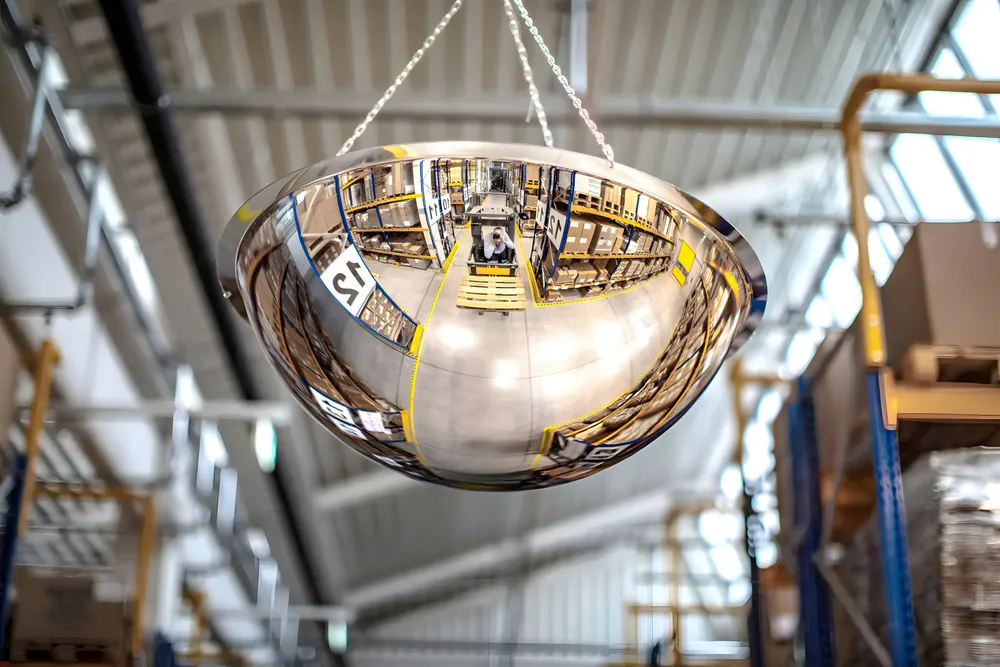
Dome mirrors win in situations where the geometry isn’t single-directional. The classic dome mirror application is a four-way intersection inside a warehouse, where forklifts, pedestrians, and equipment can approach from any of four directions. No single flat-mounted convex mirror can capture all four approaches simultaneously. A full dome mirror mounted overhead at the intersection, however, shows what’s coming from every direction in a single reflection.
The pattern across dome applications:
- Multi-direction warehouse intersections
- Retail floor monitoring where staff need to see multiple aisles simultaneously
- Hospital and care facility corridors where patients and staff move in multiple directions
- School hallway intersections where student traffic comes from several directions
- Industrial facility intersections with vehicle and pedestrian traffic
- Open retail floors where overhead surveillance covers a wide area below
The trade-off is mounting position. Dome mirrors generally need to be mounted overhead — either ceiling-mounted (full domes) or in the corner where wall meets ceiling (half and quarter domes). This means the installation has more vertical clearance requirements than a flat convex mirror, and the observation experience is slightly different — you’re typically looking up rather than directly forward.
As shown in the figure below, when the full dome mirror is placed at the center point of the warehouse intersection, forklift drivers can see approaching vehicles from all directions, which can thus reduce many accidents.
The Four Dome Variants
Within the dome mirror category, there are four standard configurations, each suited to a different geometric situation. Choosing among them is where most of the actual decision happens for dome mirror buyers.
Full Dome Mirrors (360°)
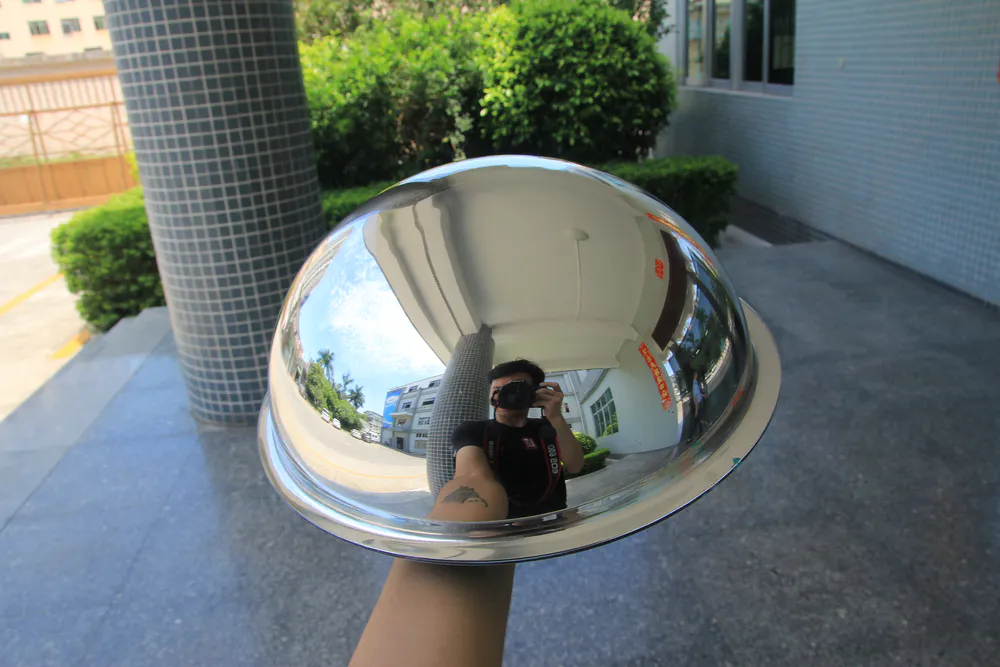
A full dome is essentially half a sphere — the reflective surface covers a full hemisphere, providing a 360-degree view of the area below. Full domes mount on the ceiling, typically suspended by chains or rigid hangers from the ceiling structure, and are positioned over the center of the area to be monitored.
According to Cisco-Eagle’s dome mirror reference, full domes are intended for use at four-way intersections and as overhead surveillance for wide-open areas.
The natural applications:
- Four-way intersections inside warehouses
- Open retail floors where central overhead surveillance is needed
- Large open spaces requiring all-direction coverage
- Industrial facilities with multi-direction traffic
- Some institutional settings (schools, hospitals) at major hallway junctions
Sizing for full domes is more generous than for other variants because the 360-degree coverage spreads across a larger viewing area. National Safety Mirror’s sizing reference notes that a 12-inch full dome can cover up to 20 feet of viewing distance, while a 48-inch full dome can cover up to 80 feet.
The standard installation height is roughly 2.5 meters (about 8 feet) from the floor. Lower than this, and the mirror becomes obstructive. Higher than this, and the reflected image gets too small to be useful.
Three-Quarter Dome Mirrors (270°)
A three-quarter dome covers 270 degrees of viewing angle, mounted at an outside corner where three walls or three directions meet. This is the less common dome variant, but it has its specific niche.
The natural application is an outside corner of a building or structure where traffic approaches from three directions and you need to see all three from a single mounting point. Some retail and industrial configurations also use three-quarter domes at intersections where one direction is permanently blocked (a wall or fixed structure occupying one quarter of what would otherwise be a 360-degree view).
This configuration is less commonly stocked than full, half, and quarter variants. For applications that genuinely need 270-degree coverage, the three-quarter dome is the right specification; for less specific applications, a full dome with one quarter facing into a wall typically works fine.
Half Dome Mirrors (180°)
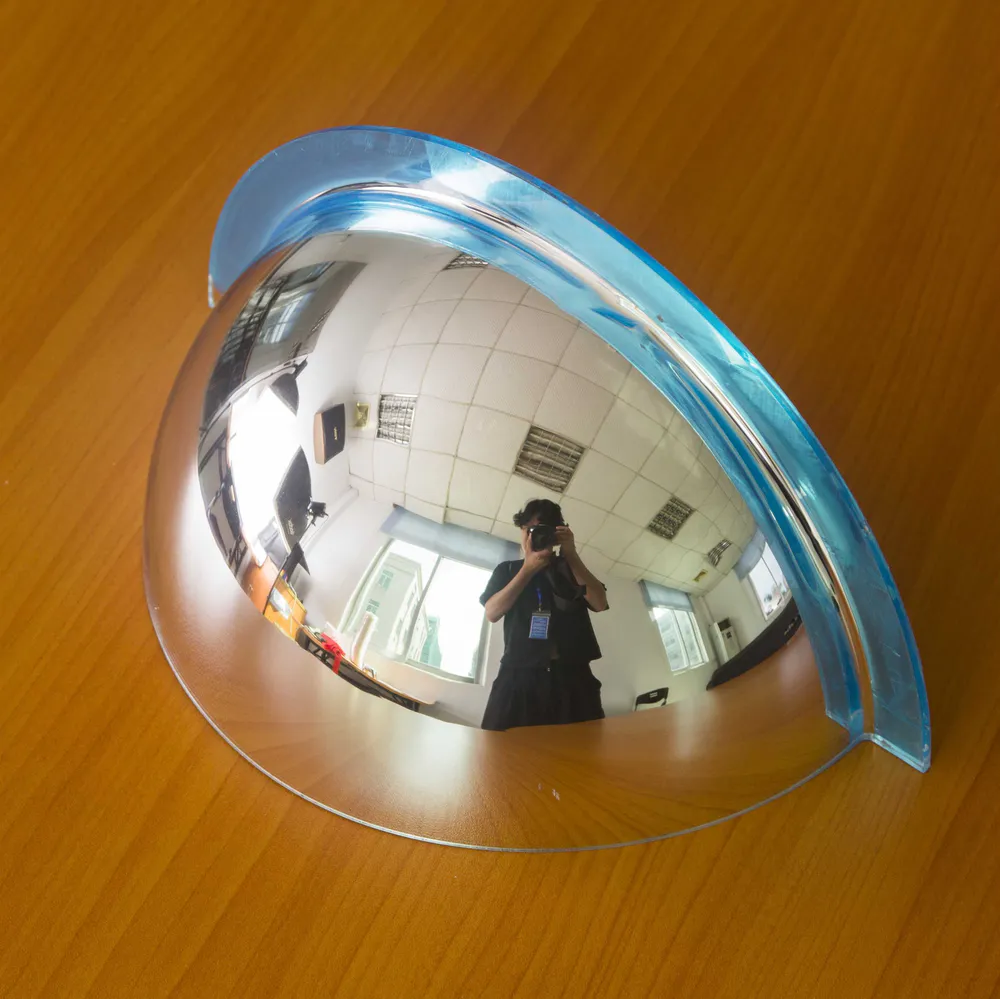
A half dome covers 180 degrees of viewing angle, typically mounted at the junction of wall and ceiling where the mirror provides visibility of two opposite directions. The natural application is a T-intersection in a hallway or corridor — where a side passage meets a main corridor and traffic could approach from either direction along the main corridor.
The mounting position determines what the mirror shows. A half dome mounted high on a wall at a T-intersection shows the main corridor in both directions, allowing someone emerging from the side passage to see oncoming traffic from either side simultaneously.
Half dome applications:
- T-intersections in hallways (the most common use)
- Long corridor monitoring from a single observation point
- Areas where wall-mounted overhead surveillance is preferred over ceiling mounting
- Retail aisle ends where traffic comes from both directions of the cross aisle
Half domes can also be mounted between wall and ceiling (flush-mounted in the corner where they meet), or as standalone wall-mounted units. The flush-mounted installation is more secure and protects the mirror’s edges, but requires the right wall-ceiling angle.
SafeGear’s sizing reference gives metric viewing distances for half domes: a 45cm dome covers up to 5 meters, 60cm covers up to 8 meters, and 80cm covers up to 16 meters. These are conservative figures; effective range depends on lighting and observer position.
Quarter Dome Mirrors (90°)
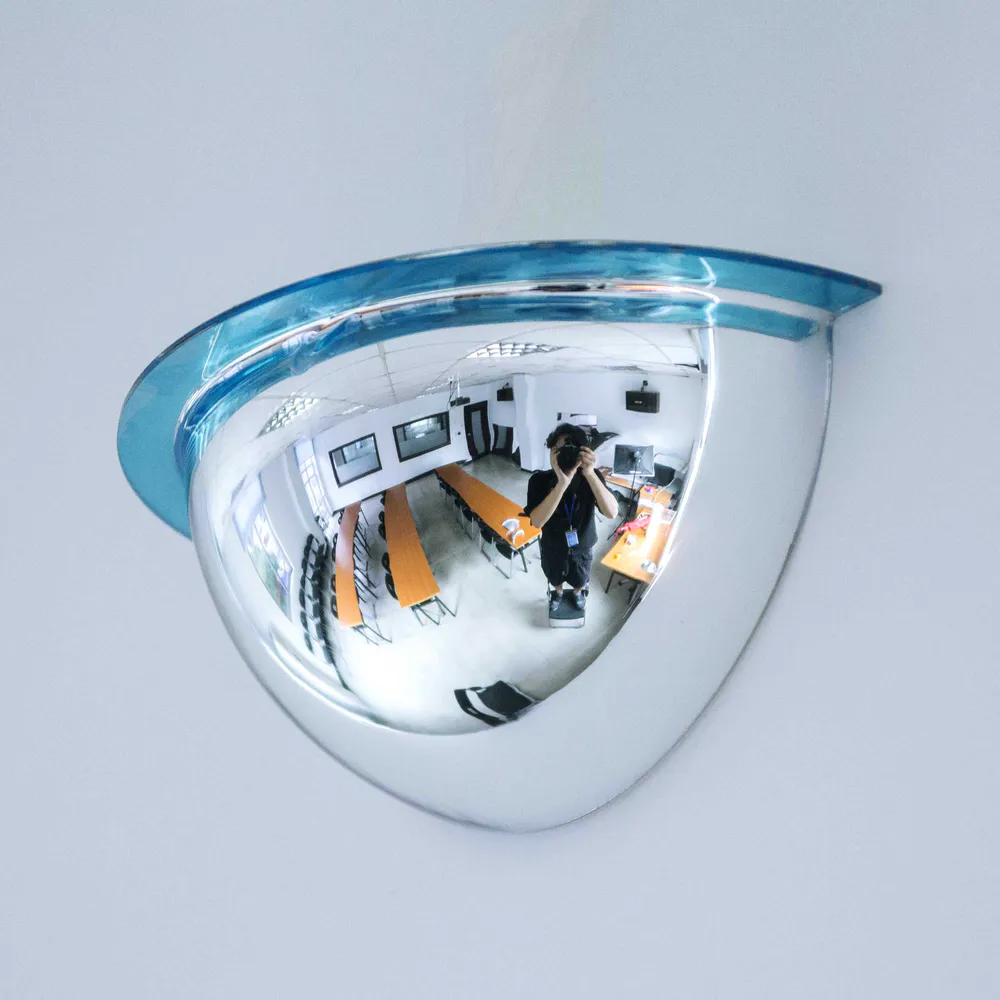
A quarter dome covers 90 degrees, mounted at an interior corner where two walls meet. This is the dome variant most commonly used in tight spaces and inside corners — situations where you need to see what’s coming around a single corner from two directions converging at right angles.
Quarter dome applications:
- L-shaped corner intersections (the classic use)
- Elevator lobbies where elevators discharge into corridor corners
- Inside corners of buildings where two corridors meet at right angles
- Tight retail spaces with corner blind spots
- Stockroom intersections in compact warehouse layouts
Quarter domes are the smallest dome variant by viewing area but the most commonly stocked for retail and small commercial applications. The mounting hardware fits flush into a corner, and the installation footprint is minimal.
A note on terminology that comes up regularly: quarter domes are sometimes confused with “corner mirrors” or “blind spot mirrors” — different products that serve similar purposes but use different geometries. A quarter dome is a hemisphere section providing a true 90-degree wraparound view; a flat corner mirror is two flat panels mounted at right angles. Both work for L-corner applications; the dome variant generally provides a smoother reflection without the visible seam that flat corner mirrors show.
Other Selection Factors
Once you’ve chosen between flat convex and dome, and identified the dome variant if applicable, a few other factors matter.
Acrylic vs. Polycarbonate
Both dome and convex mirrors are typically available in acrylic and polycarbonate variants. The choice depends on the impact environment.
Acrylic is the standard specification for most installations. It’s shatter-resistant, lightweight, holds optical clarity well over time, and works for the vast majority of safety and surveillance applications. National Safety Mirror’s product overview confirms acrylic as the standard material for indoor and standard outdoor dome mirror installations.
Polycarbonate is the upgrade for high-impact and high-security environments. According to Fred Silver’s product reference, polycarbonate mirrors are specified for “high security areas” because of their substantially higher impact resistance — approximately 250 times that of glass, versus 10–17 times for standard acrylic.
For most warehouse, retail, and institutional applications, acrylic is the right choice. If your actual application scenario requires stronger convex mirrors or dome mirrors, then you should consider using polycarbonate materials.
Indoor vs. Outdoor Rating
Outdoor-rated dome mirrors use weather-resistant materials throughout — sealed perimeters, weather-resistant mounting hardware, and corrosion-resistant frames. These are necessary for installations exposed to rain, snow, temperature extremes, and direct sunlight.
Indoor-rated mirrors use lighter, less expensive components — typically with masonite or hardboard backing for full and half domes, and similar lightweight backing materials for quarter domes. These work fine in warehouse interiors, retail spaces, and other sheltered environments but fail relatively quickly if exposed to weather.
For installations under covered overhangs or in partially-exposed positions, the outdoor variant is usually the safer specification. The cost difference is small relative to the inconvenience of replacing a failed indoor mirror.
Backing Materials
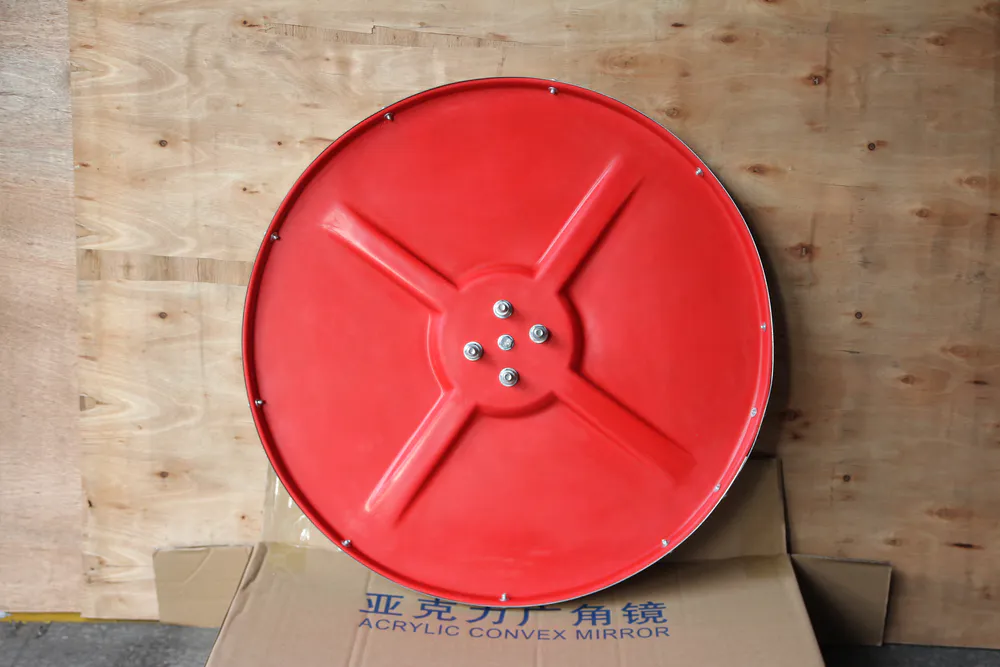
Backings serve several purposes — they provide structural support to maintain the dome’s shape, protect the reflective coating from rear damage, and allow mounting hardware to attach securely.
Common backing options:
- No backing — the mirror is just the formed acrylic dome itself. Lightest weight, lowest cost, least rigid. Suitable for non-critical interior applications only.
- Foam-coated — light foam layer on the rear face provides modest rigidity and protects the coating. Suitable for indoor interior applications.
- Masonite or hardboard — rigid panel backing for interior commercial use. The standard for most indoor commercial installations.
- HDPE plastic — non-porous, weather-resistant, suitable for high-humidity environments like food processing facilities.
- Galvanized steel or stainless steel — heaviest, most durable, suitable for outdoor and high-stress installations. Required for installations exposed to weather or where vandalism is a concern.
For most buyers, the backing decision comes down to matching the rating to the installation environment. Indoor goes with hardboard, outdoor goes with steel or HDPE, and high-humidity environments (food processing, pools, certain industrial settings) go with HDPE or stainless specifically.
Mounting Hardware Standards
Dome mirrors generally come with mounting hardware appropriate to their configuration:
- Full domes typically include chain kits for ceiling suspension. Heavier full domes may include rigid suspension hardware instead of chain.
- Half domes include screw-mounting hardware for wall or ceiling installation, with the mirror flange providing the attachment point.
- Quarter domes include screw-mounting hardware for corner installation, again with flange attachment.
- Three-quarter domes include corner-mount hardware for outside-corner installation.
For installations where the standard hardware isn’t sufficient — heavy industrial environments, high-ceiling installations, secure attachment requirements — custom mounting is generally available with longer lead times. The mirror itself remains the same; only the hardware specification changes.
Specialty Combinations
A few combinations are worth knowing about for less common applications.
Two-way dome mirrors combine the dome geometry with the partial-reflection coating of two-way mirrors. The application is usually security-related — a camera or human observer concealed above a ceiling-mounted dome, monitoring the area below while remaining invisible to the people being observed. The same lighting principles that apply to standard two-way mirrors apply here: the observer side must be darker than the observed side for the mirror effect to work. This is less common than standard dome mirrors but does come up in specialty security installations.
Combined convex and dome installations are used in complex facility layouts. A typical warehouse might use full dome mirrors at major intersections, half domes at T-junctions, quarter domes at L-corners, and flat convex mirrors at aisle ends and dock approaches — each variant matched to the specific geometry of its installation point. For comprehensive facility safety planning, the right specification often involves multiple variants at different positions rather than a single one-size-fits-all choice.
Custom curvature for specific applications is available for production-volume buyers. The standard dome curves work for general surveillance and safety applications, but specific use cases (specific viewing distances, specific reflection ratios, specific field-of-view requirements) sometimes warrant custom production. This is uncommon for individual mirror purchases but comes up regularly for facility-wide installations.
FAQs
Q: Can I use a regular wall mirror at an intersection instead of a dome?
A: A flat mirror only shows what’s directly in front of it; it can’t compress wide-angle views into a single reflection. For multi-directional viewing, a dome is the right product. Flat mirrors are the wrong tool for this application.
Q: How visible is the image from across a large warehouse?
A: Image clarity decreases with distance, and at extreme distances the reflection becomes too small to be useful for detailed observation. The size guidelines above are conservative; in practice, dome mirrors work well within their rated distances and become impractical past them.
Q: Do dome mirrors need professional installation?
A: For full domes with chain mounting, careful attachment to ceiling structure is important — these can be heavy enough to require proper anchoring. For half and quarter domes, standard wall-mounting skills are usually sufficient. Local building codes may require professional installation for commercial or institutional installations.
Q: Will a dome mirror work outside?
A: Yes, but specify outdoor-rated. The combination of UV exposure, moisture, and temperature variation will degrade indoor-rated dome mirrors relatively quickly. Outdoor variants use weather-resistant substrate, sealed perimeters, and corrosion-resistant mounting.
Q: Can I get dome mirrors in non-standard sizes?
A: Standard sizes (12″, 18″, 26″, 30″, 36″, 48″ and the metric equivalents) cover most applications. Non-standard sizes are available for production-volume orders but generally not stocked for retail purchase.