
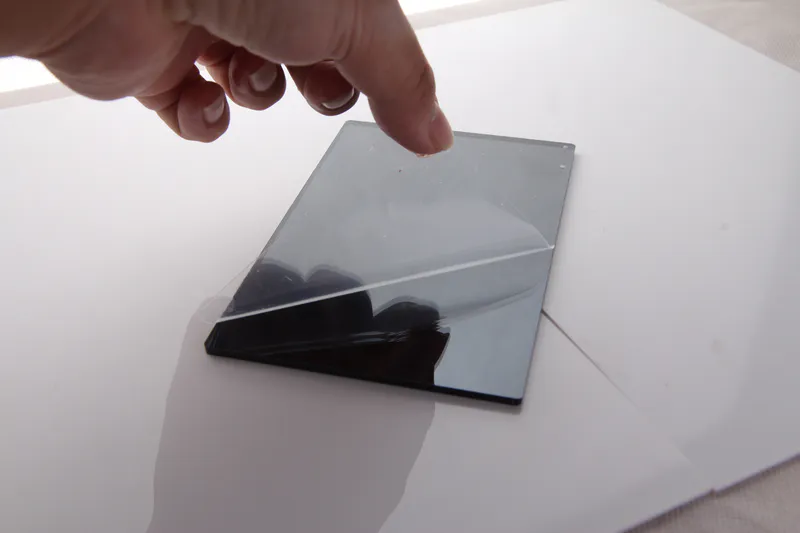
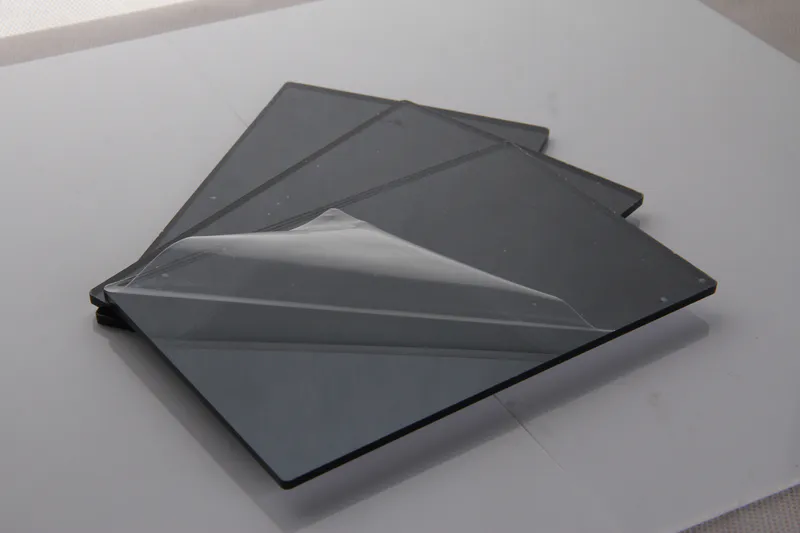
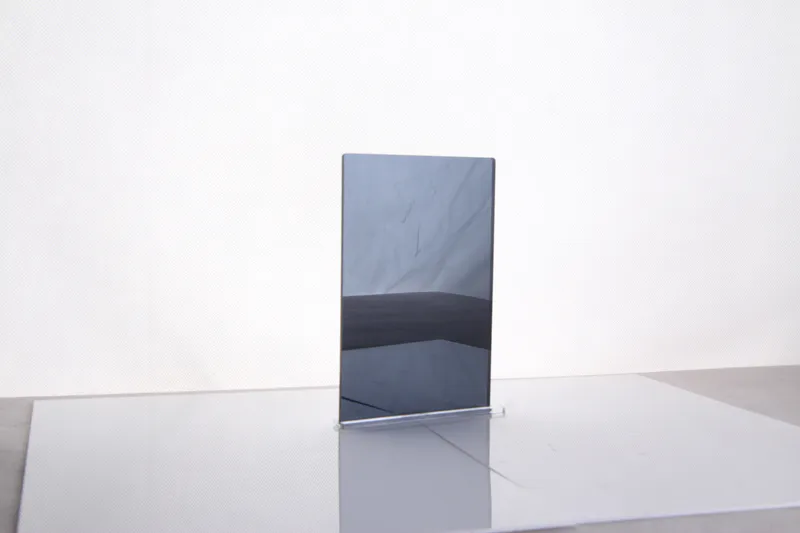
Like other acrylic mirrors in different colors, “black acrylic mirrors” can be considered a unique type of mirror. Rather than simply being black, they are a glossy black that reflects light. The image below shows the black acrylic mirror sheet we produce, and its reflective effect can be clearly seen.
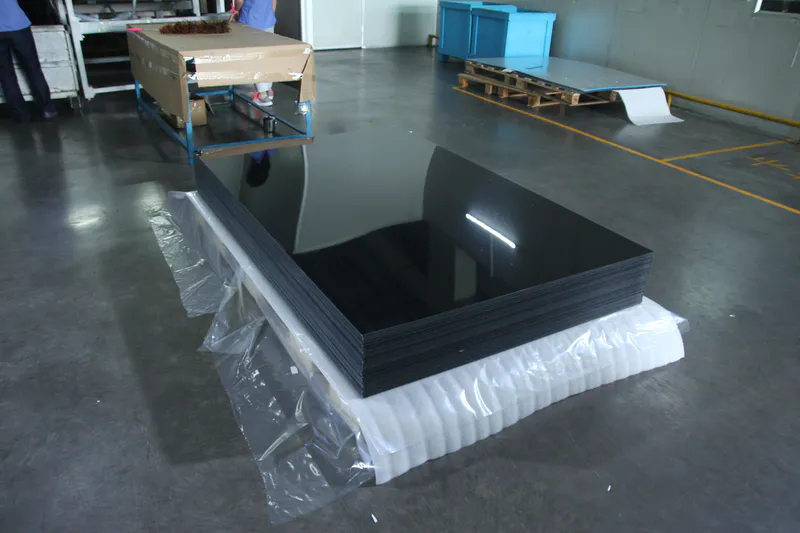
Generally speaking, black is rarely chosen when selecting from the colored acrylic mirror series. Why? Because black mirrors are not as good as black acrylic sheets. After electroplating, black acrylic sheets can achieve the same reflective effect as a mirror.
Please look at the image below. This is a custom black acrylic product manufactured by us. The entire surface has been electroplated, and you can clearly see the reflective effect on it.
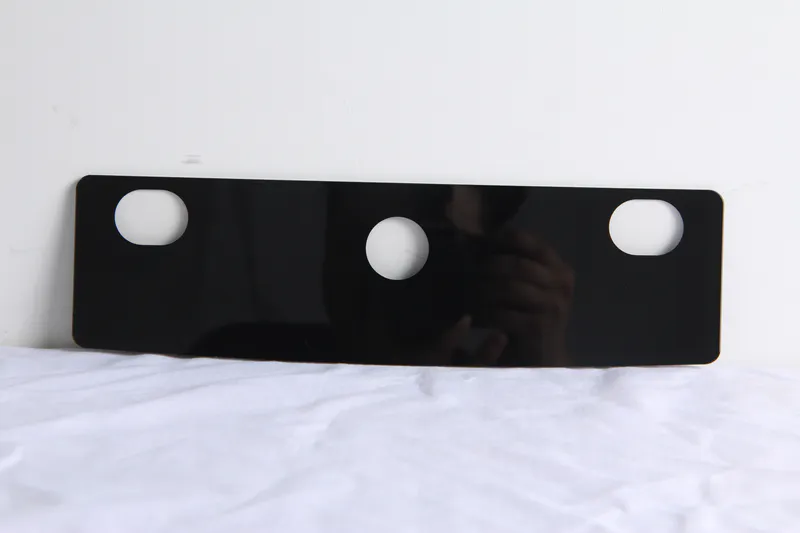
Although the reflective result is certainly not as ideal as that of a mirror, when it comes to the color black, the quality of the reflection is not a major concern. At least, this is the case for most customers.
We can carefully compare the two images below. The one on the left is a black acrylic mirror, while the one on the right is an acrylic sheet. Sometimes you may not need such a high-definition reflective effect. As mentioned above, black acrylic sheets also have some reflective effect after electroplating.
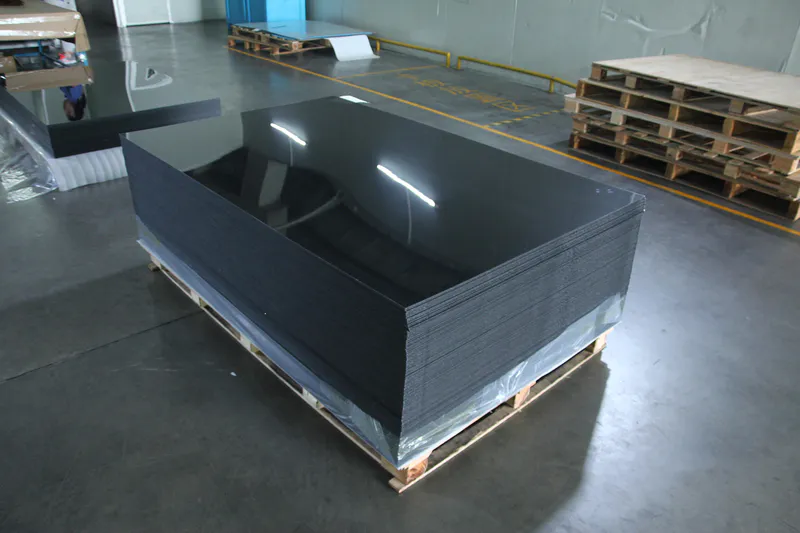
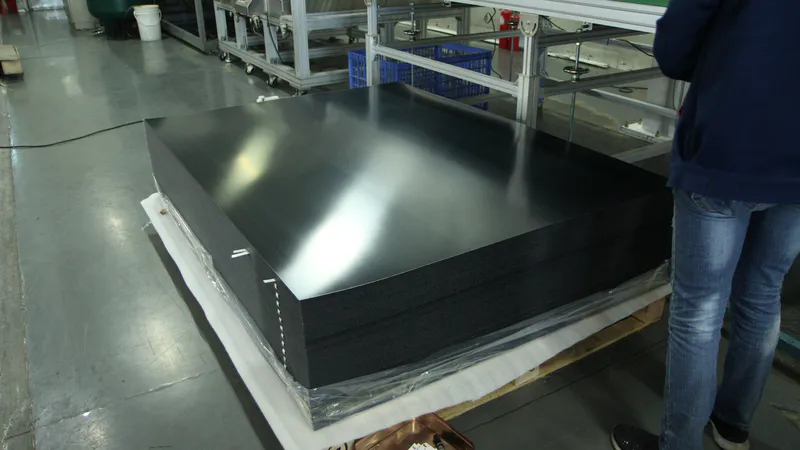
As with other mirrors, the “black” in black acrylic mirrors comes in varying shades—both pure black and grayish black can be described as black. Some products feature very dark, neutral-toned mirror finishes, while others have lighter gray or smoky finishes. It is precisely this versatility in appearance that makes them popular choices for use in restaurants, retail displays, signage, and hotel interiors.
What is black mirror acrylic?
Just like the other colored acrylic mirrors introduced earlier, black acrylic mirrors are simply black acrylic mirrors. Customers who purchase them typically do not place a high priority on their reflectivity, but a clear reflection is fundamental to any mirror.
People tend to view them more as decorative items for special occasions. Among acrylic mirrors, those in black are almost exclusively standard flat mirrors. Items such as two-way mirrors, convex mirrors, and concave mirrors generally do not use black as their base color. Therefore, when you hear the term “black acrylic mirror,” it most often refers to a single-sided flat mirror.
As a colored acrylic mirror, black acrylic mirrors are also available in large sheet sizes. Interestingly, however, very few customers actually need a large sheet of black mirror acrylic. Generally, customers request that it be cut into smaller mirrors for use.
Small-sized mirrors like this are often what customers need when making samples. If they are satisfied with the samples, customers will quickly proceed to further negotiations with us.
How is black mirror acrylic different from similar materials?
| Material | Appearance | Reflection | Typical use |
|---|---|---|---|
| Black mirror acrylic | Very dark neutral mirror | Visible but subdued | Signs, displays and interior accents |
| Grey or smoked mirror acrylic | Lighter grey-tinted mirror | Brighter than most black mirror | Furniture, wall panels and retail fixtures |
| Glossy black acrylic | Solid polished black surface | Surface shine but no clear mirror image | Letters, panels and machine covers |
| Black two-way mirror | Dark reflective surface with partial light transmission | Changes with lighting on both sides | Displays, observation and special effects |
The boundary between black and smoked mirror is not universal. One supplier may call a dark grey sheet black mirror, while another reserves that name for a much deeper shade. Request samples from the colored acrylic mirror sheet range if the project depends on a specific darkness or reflection level.
The black acrylic mirrors we produce have some grayness. In the industry, they are still referred to as ‘black.’ If you have very high requirements for black, it is recommended to first discuss and confirm specific sample results with the supplier. Whether the final result meets your requirements is a standard that reflects the supplier’s production capability.
Where is black mirror acrylic commonly used?
Since this is a highly decorative type of mirror, its applications are the same as those of acrylic mirrors in other colors; the difference lies in how it is used:
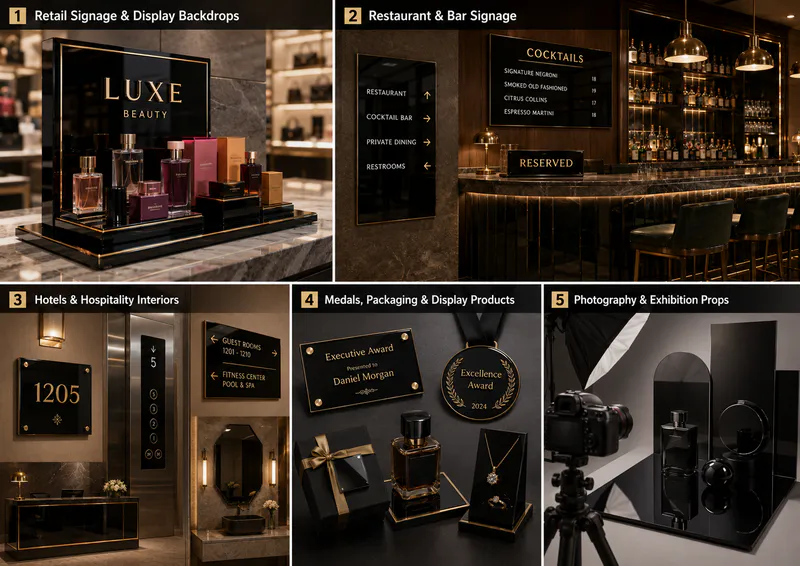
Retail Signage and Display Backdrops
We have used black mirror acrylic to create brand logos, 3D letters, product display stands, display bases, and display backdrops. Compared to standard silver mirrors, black mirrors offer a deeper, more subdued reflection that adds depth to the display space without overshadowing the visual focus of colorful packaging or the products themselves.
In actual projects, we generally do not recommend using black mirror over large, unsegmented areas. A continuous, large mirrored surface is more prone to showing fingerprints, dust, and reflections from overhead lighting. Using it for localized backdrops, decorative borders, brand logos, or key display areas typically yields more consistent results.
Restaurant and Bar Signage
In restaurant, bar, and commercial space projects, black mirror acrylic is commonly used for menu headers, reserved seating signs, wall signage, wayfinding signs, and bar counter facings. We’ve found that when paired with warm lighting, brass-colored metals, dark woods, and stone, it typically creates a more refined and sophisticated visual effect.
For these types of projects, it is essential to test the contrast between the text and the mirrored surface in advance. Based on our practical experience, black text is often not clear enough on a black mirror surface, whereas white, gold, silver, or backlit text is easier to read. If a menu contains a large amount of small text, we generally recommend using black mirror only for headings, borders, or decorative areas, and do not recommend using it directly as a background for blocks of text.
Hotels and hospitality interiors
Room numbers, wayfinding signs, elevator panels, reception details and decorative wall shapes are practical applications. Acrylic reduces weight and can be custom cut into curves and repeated geometric forms.
Black mirror can also be used in small powder-room or vanity accents when a dark reflection is part of the design. It should not replace a main grooming mirror if the user needs a bright, color-neutral reflection.
The use of smoky mirror in high-contrast interiors is not new. An Architectural Digest apartment feature describes a slightly smoky mirror used with silver-leaf surfaces and high-gloss black flooring, showing how a dark mirror can support a dramatic interior without acting as a standard functional mirror.
Medals, Packaging, and Display Products
We have also processed black mirror acrylic for nameplates, medals, gift boxes, display cases, and product bases. The black mirror finish enhances the visual quality of products and is particularly suitable for jewelry, perfume, gifts, electronics, and high-end packaging and displays.
It is important to note that the mirror surface of black mirror acrylic serves primarily a decorative purpose rather than a structural one. When manufacturing awards, display cases, or display stands, we typically bond the material to a sturdier substrate or ensure overall stability through appropriate thickness and support structures.
Photography and Exhibition Props
Black mirror acrylic is also commonly used as reflectors for product photography, exhibition display props, and stage decorative panels. The dark reflection creates a silhouette-like effect while producing a softer, more subdued visual result compared to standard silver mirrors.
For photography and exhibition projects, we typically conduct preliminary tests based on the final lighting, camera angles, and viewing distance. This is because, under certain lighting conditions, minor surface scratches, slight ripples, dust, and fingerprints may be further magnified by the camera lens. Before official use, the protective film should remain in place, and a final cleaning should be performed just before installation or the shoot is completed.
When should you choose other materials?
When users need a brighter, more neutral-colored reflective effect, choose standard silver mirror.
When a project requires a solid black surface but does not require a reflective image, choose glossy black acrylic.
When large panels must remain flat and withstand frequent cleaning or close contact, choose glass mirrors.
When light must pass through from behind, choose a tested one-way mirror. Standard black acrylic mirrors should not be used for hidden display or observation systems unless the supplier confirms they are partially translucent.