
“Acrylic wall mirrors” and “acrylic mirror tiles” are actually the same thing; the difference is simply in the commercial naming. Through our research on these popular products in the market, we found that the problems they encounter are often not technical issues, but rather issues related to practicality.
In a previous article — Guide to Acrylic Wall Mirrors — we discussed the basic knowledge about this type of mirror. In this article, we would like to answer some common questions about it.
About Peel and Stick
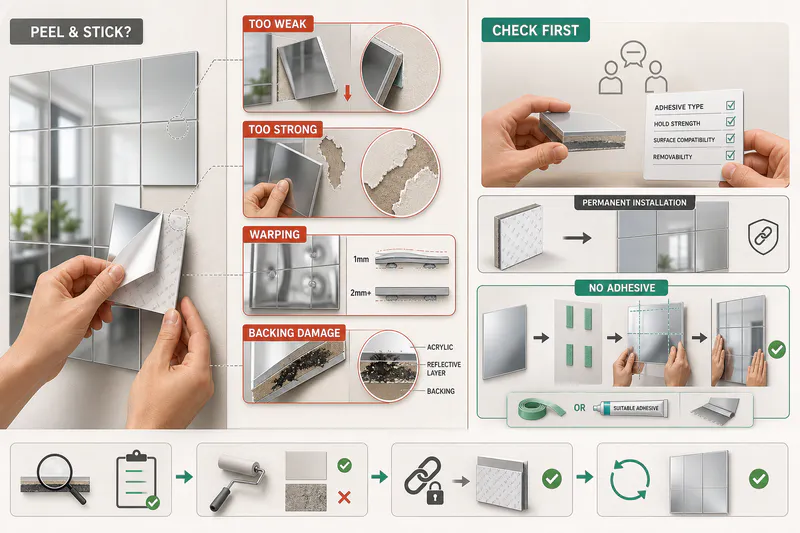
On the internet, the most common user feedback is that acrylic mirror tiles are described as “peel and stick.” But in actual use, this is not really the case.
Some people say the mirror panels fell off the wall. Others say the adhesive was so strong that they could not reposition the tiles or remove them without pulling off the wall paint.
Some people noticed the mirror surface bending around the adhesive points. Others successfully attached the panels firmly, only to later discover that the adhesive had damaged the reflective backing layer. These complaints repeatedly appear in public B&Q customer reviews and Walmart customer reviews.
The main concern for users is overall convenience, and regarding the adhesive performance of mirror tiles, manufacturers usually have different standards. This is because manufacturers that produce acrylic mirrors do not necessarily produce the adhesive backing or backing boards themselves. Manufacturers integrate all the processes and produce this type of product, but it is not easy for them to pay close attention to adhesive issues.
If you are a buyer, I suggest that before purchasing similar acrylic mirror tiles, you first consult the seller or manufacturer to find out what type of adhesive backing is used for these products and whether it can handle the relevant situations. Under normal circumstances, in order to ensure firm adhesion, the adhesive backing is extremely sticky and can hardly meet the requirement for re-adhesion after removal.
The situation where “the mirror surface bends around the adhesive points” is generally related to thickness and product quality. If the thickness is confirmed to be normal, it can be judged as a product quality issue.
Overall, our recommended solution is: before purchasing, first clearly understand the specific adhesive backing situation from the seller or manufacturer. If you need to adjust the installed mirror tiles over a long period of time, consider purchasing mirror tiles without adhesive backing. Manufacturers usually focus more on adhesion itself and do not consider the market’s concerns about adhesive strength. However, you can choose mirror tiles without adhesive backing, allowing you to DIY the installation yourself and reduce the occurrence of problems.
Acrylic Mirror Tiles Should be Used on a Flat Contact Surface
Buyers usually want four things at the same time: no need for drilling, a long-lasting firm bond, enough time to readjust the position of each piece, and the ability to remove it cleanly in the future. Pre-configured adhesive backing from the factory cannot guarantee all four of these points on every wall surface at the same time. As I mentioned above, manufacturers focus more on practicality and will not adjust according to market needs.
However, aside from the issue of the adhesive backing itself, “where” the mirror tiles are installed is also something that needs to be considered. Acrylic mirrors are more suitable for use on flat surfaces; even the slightest protrusion on the contact surface may affect the result.
Some users have reported that after installing mirror tiles, the reflective effect of certain tiles became inconsistent over time. This inconsistency is not due to inconsistent product quality, but because the overall contact surface may have slight unevenness.
If this kind of situation occurs, one good solution is to use acrylic mirror tiles with backing boards instead of adhesive backing. A uniform backing board can ensure that every mirror tile has the same reflective effect.
Repeatedly Applying Adhesive Backing Cannot Make an Uneven Wall Become Flat
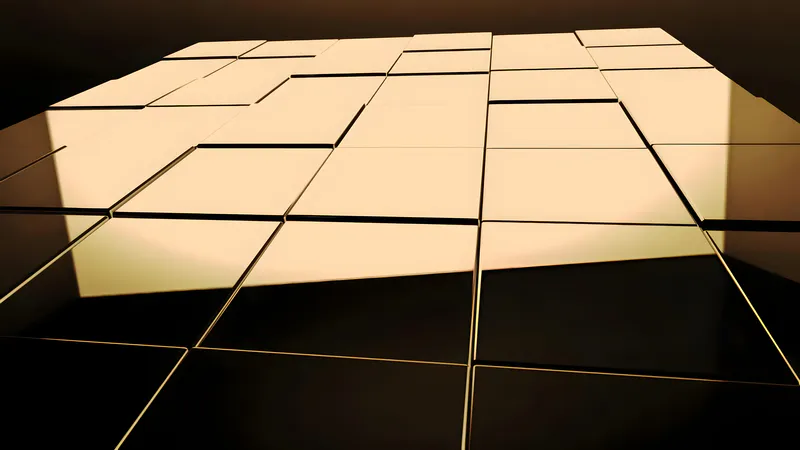
This issue is actually an extension of the previous one. In certain cases, it is indeed possible to make the mirror reflection flatter by manually adjusting the adhesive backing. However, achieving these conditions requires fairly strict circumstances, and adding more adhesive only makes the bond stronger, preventing repeated adjustments. Within the industry, uneven substrates are recognized as one of the causes of localized bending and visual distortion. Adhesives can secure a mirror to a suitable surface, but they cannot create a flat reference plane where one does not already exist.
Users often regard reflection distortion as a product defect. While this is sometimes true, uneven contact surfaces can indeed cause this phenomenon. Thin sheet materials cannot bridge every dip and bump. Small adhesive pads may pull different areas to different heights, thereby altering the reflection within a single mirror piece as well as the angles between adjacent mirror panels.
It is worth noting that many sellers also use uneven walls as an excuse to evade responsibility for product quality issues. Continually focusing on the adhesive alone cannot effectively solve the problem.
For this reason, the solution we provide is: if you are unsure whether the contact surface is flat, you can choose mirror tiles with a backing board but without adhesive backing. If adhesive backing is specifically required, then buy ones that do not use full-surface adhesive backing. Buyers should ideally clarify this before making a purchase.
This is why, before recommending a size or backing board, we first ask about the condition of the wall surface. Compared with adding more adhesive, correcting an unsuitable surface or adding rigid and flat support is more meaningful.
Only Part of a Set of Mirror Tiles Can be Used
Mirror tiles are usually sold by the pack or by the box when purchased, and the products inside are not limited to just one sheet. As a result, some users encounter situations where “only part of a set of mirror sheets can be used.”
This phenomenon is usually related to manufacturers using stock sheets. Why would stock sheets cause this situation? Because when acrylic and similar materials are stored in warehouses and other places, the materials may deteriorate due to environmental factors. At the same time, since the sheets are usually stacked together, the fact that the top few sheets appear to have no issues does not mean that the entire batch is problem-free.
You may ask: “Isn’t it possible to check the product’s quality during processing?” In response, I can tell you seriously that in production and processing environments, processing stock sheets is usually more efficient, and higher efficiency often means that factories will not inspect stock materials. Newly produced sheets usually rarely have this kind of problem.
The situation where “only part of a set of mirror sheets can be used” is usually more likely to occur with trading merchants. If the seller both manufactures and sells the products themselves, such situations occur less often.
When faced with this situation, the solution we recommend is to return everything, because this is fundamentally a product quality issue, and consumers should not have to compromise on problems like this.
About Acrylic Mirror Tiles, We’d Like to Say…
The most common application direction for acrylic mirror tiles is decoration. Compared with glass, they do indeed have advantages in terms of safety and light weight. However, I believe everyone should understand the limits of decoration—not every decorative application is suitable for using them.
Especially for gym projects, if you need acrylic mirror tiles for wall decoration, then the first thing you need to consider is their reflection performance. Usually, when we encounter this type of customer, we are more likely to recommend using glass mirrors for installation on gym walls. For similar large-scale projects, acrylic mirror tiles provide a relatively adaptable solution, but this does not mean they are 100% suitable for such use.
Even for situations where they are only used for simple decoration, do not assume that this product offers much operational flexibility. Just like the feedback issues I discussed above, the vast majority are dissatisfaction with the product’s usage experience, with users feeling that it lacks convenience.
If your primary goal is to create a permanent wall surface, we recommend paying attention to a solid base layer, compatible adhesive, even support, and an installation method that can accommodate possible wall repairs during future removal.
If clean removal and easy repositioning are required, we recommend discussing this requirement from the beginning. Choosing an option with only a backing board would be more appropriate.