
of mirror, abnormal distortion is often the key to demonstrating the mirror’s quality.
Among the orders we have actually completed, there have occasionally been cases in which an entire batch of goods was returned because individual acrylic convex mirrors showed distortion. We also actively work to address the occurrence of such situations.
Here, we would like to explore the causes of distortion in acrylic convex mirrors based on our experience with this type of situation. We will list examples for everyone’s reference, making it easier for you to identify where the problem lies.
Under normal circumstances, the key to determining whether an acrylic convex mirror is distorted is to check whether there are any localized abrupt changes, as well as whether the image remains normal after the installation or usage conditions change.
Common Signs of Acrylic Convex Mirror Distortion
Localized Waviness in the Mirror
Acrylic convex mirrors are usually shipped in one of two ways: one is shipped as a finished product after the mirror and outer frame have been assembled, while the other is to provide only the convex mirror, without the outer frame, according to the customer’s requirements.
For a typical manufacturing facility, a preliminary inspection is usually carried out before the mirror is installed in the outer frame. If obvious localized waviness or distortion is found in the reflected image, or if the image in one area is inconsistent with that of the surrounding areas, the mirror will generally be judged to be defective and will not proceed to the subsequent assembly stage.
This type of problem is sometimes not easy to detect by observing the mirror itself.
For example, when a person slowly moves in front of a convex mirror, most areas of the mirror may reflect normally. However, when the person passes a certain position, the image may suddenly become stretched, compressed, or even slightly bent. This is particularly noticeable when observing straight-line objects such as door frames or wall edges. The reflected image, which should originally change continuously, may show irregular bending in a localized area.
This phenomenon usually indicates that the local curvature of the mirror surface has changed abnormally.

However, there is another situation in which the mirror is completely normal before the outer frame is installed, but localized waviness or image distortion appears only after assembly.
In this case, the first thing that needs to be checked is not the forming process, but the dimensional compatibility between the mirror and the outer frame.
For example, the actual diameter of the mirror may be slightly larger than the installation space of the outer frame, or the height and profile of the mirror’s edge after forming may not match the frame’s fixing structure. These deviations may not directly affect the image when the mirror is not assembled, but when the mirror is forcibly fixed into the outer frame, the edge may be subjected to additional compression, causing the originally continuous curved surface to undergo localized deformation.
At this point, it is necessary to inspect the diameter, edge dimensions, curvature, and forming height of the mirrors in this batch, and compare them with the actual dimensions of the outer frame.
If multiple mirrors in the same batch show similar problems, it is also necessary to further confirm whether there are systematic dimensional deviations in the mold, edge-trimming process, or assembly structure, so as to prevent the same problem from affecting the entire production batch.
For mirrors that already show localized waviness before being installed in the frame, the problem is often related to process control during the forming stage.
Acrylic convex mirrors need to rely on a controlled forming process to create a continuous curved surface. If the sheet is heated unevenly during the heating process, or if there are significant differences in the cooling rate after forming, the shape of the local curved surface may become inconsistent.
The thermoforming information from ACRYLITE also points out that uneven temperature distribution may lead to forming defects, while uneven cooling may cause warping and internal stress.
From the perspective of factory production, localized waviness does not necessarily mean that the factory lacks the ability to produce convex mirrors. More often, it reflects insufficient consistency control in the production process and inadequate quality management capabilities.
For convex mirrors, simply processing the sheet into a raised curved surface is not difficult. What truly needs to be controlled is the continuity and stability of the entire curved surface, as well as forming consistency between different batches.
In particular, for convex mirrors used in traffic observation, security monitoring, and other applications, abnormal local curvature will directly affect the continuity of the reflected image. In severe cases, it may also affect the observer’s judgment of the position and shape of surrounding objects.

Dents or Elongation After Frame Installation
This situation is somewhat similar to the localized waviness mentioned earlier, but the difference is that it often occurs near the points where the mirror piece is secured to the frame.
Before installation, the mirror piece has a relatively smooth overall curvature and image. But after the frame has been installed, localized dents, elongation, or compression suddenly appear in the areas near the fastening points.
Sometimes only one of these effects occurs; at other times, they occur together.
For example, an originally uniform convex surface may develop an inward dent near a fastening point, causing a reflected image of a person to suddenly appear narrower in that area. Beside the dent, the surface may also be compressed, creating another area that bulges outward and makes the image appear elongated again.
These successive localized changes can make the reflected image look very unnatural.
A convex mirror made of acrylic may develop dents or image distortion if it is subjected to excessive fastening pressure during assembly.
mirror piece that have not undergone edge-flanging or other edge-reinforcement processes, as well as thinner convex mirrors, are especially susceptible to assembly pressure.
One of the main purposes of edge reinforcement is to increase the structural rigidity of the mirror piece edge, making it less likely to lose its original curved shape under localized fastening pressure during frame installation.
mirror piece thickness is also an important factor.
With the material and other conditions being the same, the thinner the mirror piece, the lower its bending stiffness is typically, making it more prone to deformation when subjected to external force.
However, a thicker mirror piece is not always better, because different mirror piece sizes, curvatures, and frame structures call for different material thicknesses.
Besides the structural properties of the mirror piece itself, the way the frame is installed is also something that needs to be carefully checked.
For example, if one of the frame’s fastening points is tightened too much, or if there are differences in height within the internal support structure, the mirror piece may be subjected to uneven pressure during assembly.
This is especially true of frames that use clips, retaining strips, or other mechanical fastening structures. If the forces vary too much from one location to another, the surface can easily deform locally.
This is why many factories assign dedicated personnel to assemble convex mirrors, rather than simply placing the mirror piece in the frame and fastening it directly.
It is important to note that dents or elongation after frame installation do not necessarily mean that the mirror piece cannot be repaired.
If the deformation is only temporary elastic deformation caused by assembly pressure, the mirror piece may return to its original curved shape once the frame is removed or the fastening pressure is released.
But if the surface has undergone permanent deformation, or if a localized area has suffered obvious stress damage, readjusting the frame may not restore the original image quality.
For such mirror piece, it is generally necessary to reassess whether they can still be used; in severe cases, they should be replaced outright.
Therefore, when image abnormalities appear only after a mirror piece has been installed in a frame, the correct approach is to first determine whether the problem comes from the mirror piece itself or from the frame structure and assembly pressure, rather than attributing every issue directly to molding quality.

Edge Warping After Heating
This situation is relatively likely to occur with acrylic convex mirrors that have an outer frame, especially products that are placed outdoors for long periods and exposed to direct sunlight.
For example, safety convex mirrors installed at road corners, parking lot entrances and exits, or on outdoor buildings.
These mirrors may have no abnormalities when they leave the factory, and the combination of the mirror and outer frame may also be completely flat. However, after a period of exposure to high temperatures and intense sunlight, the parts of the mirror near the outer frame may gradually begin to warp upward, even causing distortion in localized reflected images.
Some warping is very obvious, and the edge of the mirror can be seen directly from the side to be higher than its original fixed position.
But some cases are not so obvious.
The mirror as a whole still maintains its convex shape, but a slight wave appears near the outer frame. When a person or vehicle passes through this area, the reflected image suddenly becomes elongated or compressed.
If the image is not carefully observed, this problem can easily be overlooked.
So why is the mirror completely normal at room temperature, but develops edge warping after being heated?
One important reason is the difference in thermal expansion between the acrylic mirror and the outer frame.
Acrylic is a thermoplastic material. When the temperature rises, it expands to a certain extent, and when the temperature falls, it contracts again.
However, the mirror and the outer frame are often not made of the same material.
The outer frames of common convex mirrors may be made of plastic or metal, and different materials do not have the same thermal expansion characteristics.
Especially when a metal outer frame is used, the thermal expansion of the acrylic mirror is usually more pronounced than that of the metal.
ACRYLITE’s technical explanation of thermal expansion points out that the dimensional changes of acrylic sheets can be significantly greater than those of many metal materials. Therefore, expansion and contraction caused by temperature changes need to be considered in fixed structures.
If there is insufficient clearance for movement between the mirror and the outer frame, the mirror may be constrained by the outer frame when the temperature rises.
The mirror itself needs to expand, but its edges cannot move normally. The excess deformation may therefore be transferred to other areas, ultimately appearing as edge warping, localized bulging, or curvature distortion.
This is also why some convex mirrors have no problems immediately after assembly, but begin to show image abnormalities only after a period in a high-temperature environment.
However, thermal expansion is not the only cause of edge warping.
Another possibility is that the mirror already has a certain amount of residual stress from the production process, but these stresses do not produce obvious deformation at room temperature.
For example, during the forming of a convex mirror, if there is a large difference in heating temperature between different areas of the sheet, or if uniform cooling is not carried out after forming is completed, uneven internal stress may develop.
When the product has just completed processing, these stresses may not directly cause defects visible to the naked eye.
However, when the mirror is subsequently affected by temperature changes during use, the existing stresses may redistribute, causing new deformation in local areas.
Mirrors whose edges are constrained by the outer frame are especially likely to show abnormalities at these restricted positions.
In addition, the structure of the outer frame itself also affects how the mirror performs after being heated.
For example, some outer frames have relatively tight mounting grooves, with the mirror edges almost completely fixed and insufficient room for movement.
Under room-temperature conditions, this structure may appear very secure, but when the temperature changes, excessive fixation can instead become a problem.
This is because an acrylic mirror is not a rigid object that undergoes no dimensional changes at all.
If the mounting structure does not account for the thermal expansion and contraction of the material, the tighter the outer frame is fixed, the more pronounced the constraint on the mirror may be when the temperature changes.
This issue requires particular attention for larger convex mirrors.
Under the same temperature changes and material conditions, the larger the mirror, the greater its overall thermal expansion usually is.
For large-diameter acrylic convex mirrors, even if the dimensional change per unit length is not obvious, once accumulated along the entire edge of the mirror, it may affect the frame structure.
Of course, this does not mean that all framed convex mirrors will warp in high-temperature environments.
If the mirror dimensions are properly controlled, the outer frame can provide suitable fixation and room for movement, and internal stress has been effectively controlled during forming, the product can generally maintain a relatively stable shape within the normal operating temperature range.
Conversely, if the mirror already has dimensional deviations and is then forcibly squeezed into place during assembly, subsequent temperature changes may further amplify the existing problems.
For a convex mirror that has already developed edge warping, the first thing that needs to be checked is whether this deformation is temporary or has already become permanent.
For example, after the mirror has returned to a normal ambient temperature, the edge shape and reflected image can be checked again.
If the mirror basically returns to its original curved shape after the temperature returns to normal, the problem may be mainly related to thermal expansion and assembly constraints.
In this case, it is necessary to further inspect the installation clearance of the outer frame, the dimensions of the mirror edges, and the fixation method.
However, if the mirror still has obvious warping after returning to room temperature, or if localized reflected images remain unable to return to normal, it is necessary to consider whether the mirror has undergone permanent deformation.
For mirrors with relatively severe permanent deformation, it is generally not recommended to continue using them as qualified products.
In addition, it is also necessary to distinguish the performance after heating of framed and frameless convex mirrors.
Because the edges of frameless mirrors are not subject to the same degree of mechanical constraint, they generally do not experience exactly the same type of compression deformation.
However, this does not mean that frameless mirrors cannot warp.
If the mirror is heated unevenly, contains significant internal residual stress, or remains for a long time in a temperature environment exceeding the applicable range of the material, overall or localized deformation may likewise occur.
As for the yellowing that appears in some plastic mirrors after long-term use, that belongs to another type of problem.
Yellowing needs to be analyzed more in terms of the weatherability of the material itself, ultraviolet protection, and the aging of the mirror coating or rear protective layer. It cannot be directly equated with warping caused by heating.
In particular, high-quality PMMA acrylic itself has good resistance to ultraviolet radiation and outdoor weathering. This does not mean that it will inevitably develop obvious yellowing simply because it is exposed to sunlight for a long time.
From the perspective of factory quality management, the problem of edge warping after heating requires simultaneous consideration of the mirror’s forming quality, the outer frame structure, and the actual use environment, rather than checking only whether the mirror is flat at room temperature.
For convex mirrors that need to be used outdoors for long periods, it is best to conduct appropriate temperature-cycling and image-stability tests on framed samples before mass production.
This is because the fact that a mirror can produce a normal image when it leaves the factory does not mean that it will necessarily be able to maintain the same curvature quality over the long term in an environment where the temperature constantly changes.
What truly needs to be controlled is not only the curvature of the mirror immediately after production, but whether it can continuously maintain a stable curved shape after assembly, during transportation, and throughout actual use.

How to Fix Acrylic Convex Mirror Distortion
After image distortion appears in an acrylic convex mirror, not every case can be corrected through simple adjustments. The appropriate solution depends on when the deformation occurred, where it is located, and how severe it is.
If the mirror has noticeable local waviness or surface distortion before the frame is installed, the problem is usually related to the forming process. Defects of this kind generally cannot be fixed through later assembly.
For a mirror with clearly abnormal imaging, replacement is usually recommended, along with checking whether other products from the same batch have similar problems.
If the mirror was completely normal before it was framed, but develops a depression, stretching, or localized distortion after the frame is installed, first check whether the mirror and frame are properly matched in size, and whether excessive pressure is being applied at the fixing points.
In this situation, you can try removing the frame to relieve the extra pressure on the mirror, then check the reflected image again. If the mirror returns to normal, adjust the installation method or the frame structure to prevent the same problem from recurring.
For a convex mirror whose edges curl up after being heated, first allow the mirror to return to a normal ambient temperature, then check whether its curved surface recovers. If the deformation disappears, further confirm that the frame leaves enough room for the mirror to expand and contract with temperature changes. If the deformation remains, permanent damage may have occurred.
Note that it is not recommended to repair a deformed acrylic convex mirror by applying localized heat, forcibly flattening it, or bending it in the opposite direction. These actions may further alter the mirror’s curvature and may even damage its reflective coating, making the original imaging problem more severe.
For a mirror that cannot return to normal imaging, replacement is generally more reliable than attempting to force a repair. This is especially important for convex mirrors used for traffic safety, road observation, and other situations requiring a stable field of view: ensuring that the reflected image is continuous and stable is more important than keeping a mirror that has already been deformed.
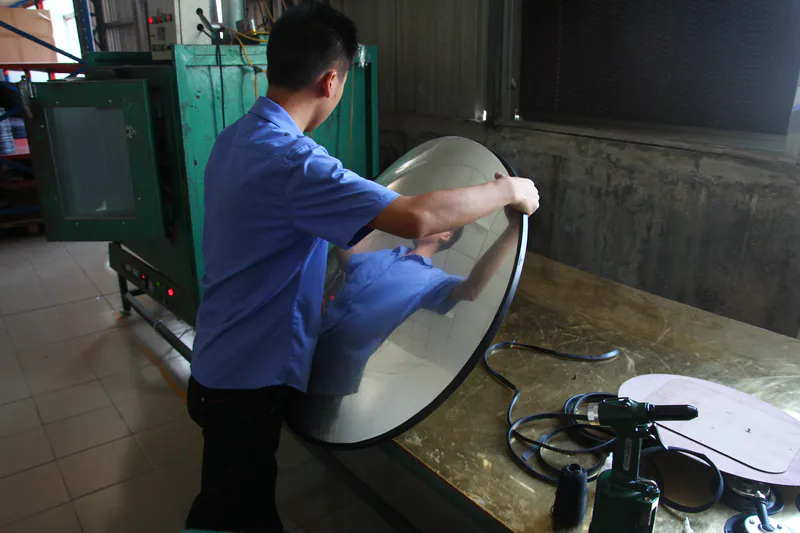
How to Prevent Acrylic Convex Mirror Distortion
Preventing image distortion in acrylic convex mirrors requires consideration of several factors, including mirror piece forming, dimensional control, frame assembly, and the actual operating environment.
The first is process control during production.
Acrylic convex mirrors require a high degree of continuity and uniformity across the curved surface. During thermoforming, the sheet must therefore be heated evenly, and the cooling conditions after forming must be controlled to prevent localized waviness, warping, and other problems caused by uneven temperature distribution or residual stress.
The second is the mirror piece dimensions and curvature.
Even if a mirror piece forms a normal image before being framed, a mismatch between its actual dimensions and the frame can cause it to be squeezed during assembly, deforming the curved surface. Before mass production, therefore, confirm that the mirror piece diameter, formed height, edge profile, and frame mounting dimensions meet the requirements. Refer to the Convex Mirror Sizing and Selection Guide.
For convex mirrors that require a frame, particular attention should also be paid to the mounting method.
The frame’s purpose is to stabilize the mirror piece, not to force it into a different shape by squeezing it. A suitable assembly design should avoid excessive localized pressure and allow appropriate clearance for thermal expansion and contraction based on the mirror piece dimensions, material, and operating temperature.
mirror piece thickness and edge design should also be selected appropriately. For larger convex mirrors or those intended for long-term outdoor use, consider material rigidity, edge reinforcement, and frame support together to prevent deformation caused by insufficient mirror piece stiffness or uneven loading.
The final step is quality inspection of the finished product.
In addition to checking the reflective image of the unframed mirror piece, inspect the assembled convex mirror again, paying particular attention to any localized stretching, indentations, or waviness near the edges and mounting points.
For products intended for long-term outdoor use, appropriate temperature-cycle testing can also be used to assess the stability of the mirror piece and frame as temperatures change.
The key to preventing convex mirror distortion is not simply to produce a mirror piece with the required curvature, but to ensure that it continues to provide stable, continuous reflective imaging after assembly and over the long term.
How Manufacturers Reduce Convex Mirror Distortion
For acrylic convex mirror manufacturers, minimizing imaging distortion requires not only refining production techniques but also establishing robust quality control standards to ensure consistent curvature and optical clarity across different production batches.
Control the Thermoforming Process
Thermoforming is a critical factor influencing the imaging quality of acrylic convex mirrors.
Manufacturers must strictly regulate the heating temperature, ensure even heat distribution, and carefully manage the cooling process to prevent localized temperature variations that can cause surface waviness or residual stress.
For mass production, it is equally essential to maintain consistent forming parameters in order to minimize curvature deviations between batches.
Maintain Consistent Dimensions and Curvature
The dimensions and curvature of the mirror directly impact the final assembly.
Manufacturers typically inspect the mirror’s diameter, forming depth, and edge profile to ensure a precise fit with the outer frame.
For products of the same specification, regular mold inspections are also necessary to prevent batch dimension discrepancies caused by mold wear or shifting forming parameters.
Optimize Frame Assembly
Even with a flawless mirror, improper framing techniques can still introduce imaging distortion.
Therefore, manufacturers must design appropriate mounting methods based on the mirror’s thickness, size, and edge design, avoiding excessive localized pressure.
For outdoor convex mirrors, it is also crucial to account for the differential thermal expansion between the mirror and the frame, thereby preventing edge warping caused by temperature fluctuations.
Implement Quality Inspections
Quality control should not be limited to the post-forming stage; rather, it must be integrated throughout the entire production and assembly workflow.
Inspections should be conducted after forming, trimming, and framing, with a primary focus on detecting localized distortion, stretching, or compression in the reflected image.
For bulk orders, inspection records for critical dimensions and curvature should be meticulously maintained to enable full traceability of production batches and process parameters in the event of any anomalies.
True stability in convex mirror manufacturing relies on more than just controlling the optical quality of individual pieces—it demands consistent curvature, precise dimensions, and reliable assembly performance across every single production batch.
Conclusion
The image distortion of an acrylic convex mirror is not necessarily a quality issue with the mirror itself; it may also occur during framing, transportation, or subsequent use.
Localized waves, dents and elongation after framing, and edge warping caused by heat, although different in appearance, are generally related to changes in curvature, dimensional deviations, or uneven local stress.
For a mirror that has already developed obvious distortion, the source of the problem should first be determined, and then it should be assessed whether the distortion can be corrected by adjusting the assembly method. If the curved surface has undergone permanent deformation, replacing the mirror is usually the more reliable choice.
For manufacturers, however, the key to reducing distortion in convex mirrors lies in a stable thermoforming process, accurate control of dimensions and curvature, a reasonable frame structure, and a comprehensive quality inspection process.
A qualified acrylic convex mirror should not only provide smooth reflective imaging when it leaves the factory, but should also be able to maintain a stable curved shape and imaging quality over the long term under normal assembly and expected use conditions.