
Most articles on acrylic mirror sheets read like a product brochure — bullet points about lightweight, shatter-resistant, easy to cut, suitable for many applications. That’s true and tells you almost nothing useful when you’re trying to place an order.
This is the long-form guide. Sizes that are actually available versus sizes vendors claim. Thickness recommendations that hold up in practice. Edge tolerances. Color options. The applications acrylic sheets handle well, and the ones that look fine in marketing copy but disappoint after installation. By the end you should be able to specify exactly what you need from a supplier, including the questions to ask before you commit.
If you’ve already read our introduction to acrylic mirrors, you’ve got the material basics. This piece focuses specifically on the sheet form — flat panels — which is the most common and most versatile format the material comes in.
What Counts as an Acrylic Mirror Sheet
A sheet, in this context, is a flat panel of acrylic mirror with a vacuum-metallized reflective coating on one side and a protective backing on the other. Sheets are sold by dimension and thickness, with the reflective face typically supplied with a peel-off masking film to protect against scratches during shipping and fabrication.
The sheet format covers most general-purpose mirror applications: walls, fixtures, displays, signage, DIY projects, and anything where the buyer cuts the material to fit. Specialty variants — two-way mirrors, convex mirrors, concave mirrors, dome mirrors, and anti-fog mirrors — are typically sold as finished products in their final form, since the manufacturing for those involves shaping or coating steps beyond what a flat sheet receives. For the rest of this guide, “acrylic mirror sheet” refers specifically to the flat-panel format.
Standard Sheet Sizes
There’s a consistent industry standard for full-sheet sizes, with some regional variation between metric and imperial markets.
The most common full sheet across North American suppliers is 48″ × 96″ (4ft × 8ft). This matches the standard 4×8 sheet format used across most plastic, plywood, and panel products and is the size that ships and stocks most efficiently. A&C Plastics, Farco Plastics, and Canal Plastics all confirm 48″ × 96″ as their default full-sheet specification.
In metric markets, the equivalent standards are 1220 × 2440mm and 1220 × 1830mm, per DHUA Acrylic’s published specifications. The 1220mm width is essentially identical to 48 inches; the difference between markets is mostly in length conventions.
Common pre-cut intermediate sizes most suppliers stock:
- 36″ × 48″ (3ft × 4ft)
- 24″ × 48″ (2ft × 4ft)
- 24″ × 36″ (2ft × 3ft)
- 12″ × 12″, 12″ × 24″ (smaller utility sizes)
Larger-than-standard sheets are available — Interstate Plastics, for example, lists sizes up to 72″ × 120″ as non-stock items. These typically ship slower and at premium freight rates because they exceed standard pallet dimensions.
For projects that need a non-standard size, custom cutting from a full sheet is almost always cheaper and faster than ordering an oversized sheet. We cover this in the “Custom Cuts” section further down.
Thickness — It Matters More Than Realize
This is the single most important specification on an acrylic mirror order, and the one that most often gets chosen wrong.
Standard thicknesses available across most suppliers:
| Thickness | Imperial | Common applications |
|---|---|---|
| 1.5mm | ~0.06″ | Crafts, jewelry, small decor, laser-cut shapes |
| 3mm | 1/8″ | General purpose — wall mirrors, signage, fixtures |
| 5.5–6mm | 1/4″ | Larger panels, commercial installations, extra rigidity |
| 8–20mm | 5/16″ – 3/4″ | Specialty, structural, large-format |
Some suppliers also stock 2mm and 4mm intermediate thicknesses; ranges of 0.5mm to 20mm are available through suppliers like OLFA Plastic, though most projects fall within the four ranges above.
The practical implications:
1.5mm sheets are too flexible for anything but small applications. Use them for craft cuts, mosaic tiles, jewelry blanks, and small decorative pieces under about 12″ in any dimension. Larger pieces will ripple even when mounted.
3mm sheets are the workhorse thickness — most wall mirrors, retail fixtures, and DIY installations use 3mm. It’s rigid enough to hold its shape on a flat backing for sizes up to roughly 24″ × 36″, but starts to show distortion above that range if not mounted to a perfectly flat surface.
6mm sheets are what you specify when size or rigidity matters. Canal Plastics specifically recommends 1/4-inch thickness for mirrors larger than 24 inches to minimize the surface waviness that causes reflection distortion in larger acrylic panels. This is the same caveat we noted in our material introduction: acrylic mirror’s reflection accuracy degrades visibly above roughly 60–80cm (24–32 inches), and thicker stock helps but doesn’t fully solve the problem. For installations where a perfectly flat reflection is non-negotiable, glass remains the reference standard regardless of acrylic thickness.
8mm and thicker sheets are specified for structural applications, very large panels, or installations that double as physical barriers. They’re heavy by acrylic standards but still much lighter than equivalent glass.
Thickness Tolerances
Acrylic mirror sheets carry meaningful thickness tolerance — the actual thickness of a sheet can vary from the nominal value by 5–10% depending on manufacturing method. Acme Plastics publishes their thickness tolerance as ±10%, with typical variance under 5%. Their practical conversion table:
- 0.06″ nominal = 1.5mm actual
- 1/8″ nominal = 3mm actual = 0.118″
- 1/4″ nominal = 5.5mm actual = 0.217″
Note that 1/4″ doesn’t equal 6mm in practice — the sheet sold as “1/4 inch” is typically closer to 5.5mm. This matters when fitting acrylic mirror into a pre-machined frame, slot, or channel. Always order based on actual mm dimensions when precision fitting is required, and confirm tolerance with the supplier.
Cast acrylic typically carries looser thickness tolerance (±10% or more) than extruded (often ±5% or better). For applications where multiple sheets need to match or fit into pre-cut housings, extruded acrylic is usually the safer specification.
Reflective Surface Quality
Not all mirror finishes are created equal. The variables to ask about:
Light transmission and reflectivity. PMMA itself transmits up to 92% of visible light. Once metallized, mirror reflectivity is typically 80–85% for aluminum-coated standard sheets. OLFA Plastic publishes 92–97% light transmission for first-grade material. Differences in this range aren’t visible to the eye, but they matter for photography, lighting reflectors, and any application where small reflectivity differences accumulate.
Haze level. First-grade acrylic mirror sheets carry a haze rating of ≤1.5%, per OLFA’s specifications. Higher haze readings indicate clarity issues — usually from substrate impurities or contamination during the metallization step. You won’t see a haze spec on most retail product pages, but it’s worth asking about for premium applications.
Surface defects. Sheet inspection during manufacturing isn’t perfect. Small specks, pinholes, or coating irregularities can appear in any batch. Reputable suppliers grade sheets and reject defective material; bargain suppliers don’t always. If you’re ordering for a premium application — high-end retail, photography, design-forward installations — pay for grade-A material.
Coating durability. The reflective layer is sealed under a paint or polymer backing, but it can still be damaged by solvents, abrasion, or improper edge sealing. Two-way mirror variants have thinner coatings by design and require more careful handling.
Color Options
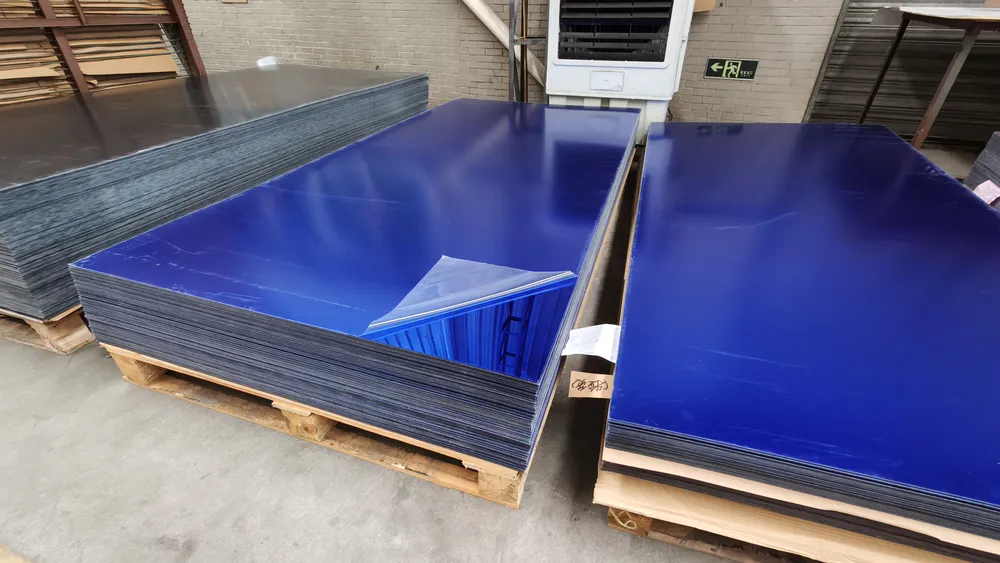
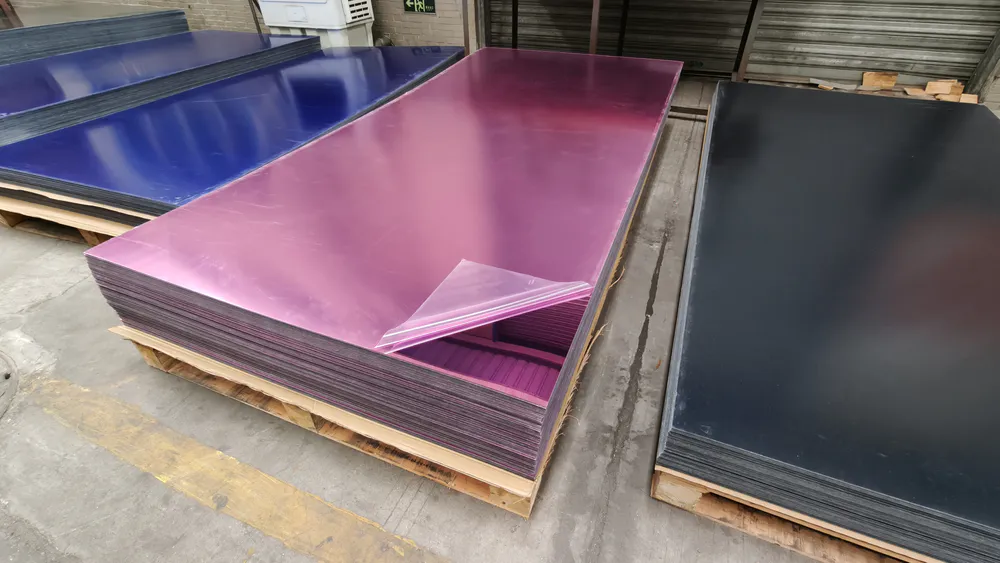
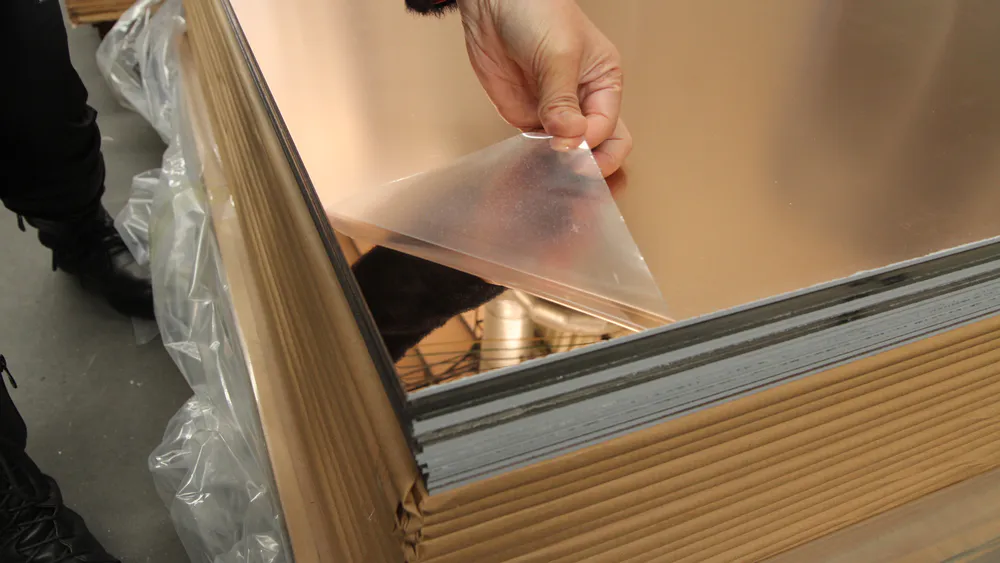
Beyond the standard silver mirror finish, acrylic mirror sheets are available in colors that glass mirrors generally don’t offer. The common range:
- Silver — the default, looks closest to a traditional glass mirror
- Gold — warm-tinted reflection, popular for retail, signage, weddings
- Rose gold — pink-tinted gold, peaked in popularity around 2018–2020 and still strong in event decor
- Bronze — antique/vintage tones for hospitality and residential
- Black (smoked) — modern, used in luxury retail and signage
- Pastels (pink, blue, purple, etc.) — kids’ rooms, retail, event decor
The following images are all colored mirror panels provided by our factory, and there are many other colors available. If you want to learn more about this product, you can check: colored large mirror sheets.
Custom colors can usually be matched against a reference or sample, but with a few caveats: small batch-to-batch color variation is normal in colored acrylic mirror, and the variation can be visible if you order in stages rather than all at once. If a project needs precise color consistency across multiple sheets, order them all in a single batch.
The full color cluster has its own dedicated guide — see our gold mirror acrylic post for the most popular color variant.
Applications That Acrylic Mirror Sheets Actually Suit
The general “acrylic mirror is good for everything” framing isn’t accurate. Here’s where sheets perform well:
Retail and POP displays. Lightweight, customizable, easy to ship. The standard 48″ × 96″ sheet covers most fixture-scale installations. Color variants give visual differentiation.
Signage and display work. Laser-cut acrylic mirror is the dominant material for cut-letter signs, channel-letter faces, and dimensional logo work. Cast acrylic is the preferred substrate for laser cutting because it produces cleaner cut edges.
Smart mirror builds. The maker community uses 3mm acrylic mirror sheets — typically with two-way mirrors for the see-through magic-mirror effect — for smart mirrors.
Safety-critical installations. Schools, daycares, healthcare facilities, mental health facilities. Acrylic sheets are specified primarily for impact resistance, not for reflection quality. Where reflection accuracy is secondary to safety, acrylic is the standard choice.
DIY projects and crafts. Cuttable, drillable, paintable. Standard 1.5mm and 3mm sheets in 12″ × 12″ or similar small formats are popular for jewelry, ornaments, and small decor.
Event decor and signage. Wedding signs, table numbers, photo backdrops. Acrylic mirror’s color range (especially gold and rose gold) and laser-cut customization make it the dominant material in this category.
Backsplashes and accent walls. With the size limitation in mind — meaning you’ll likely have visible joins between sheets rather than a single continuous panel for very large installations.
Greenhouses, plant rooms, and aquarium tops. The lightweight, shatter-resistant nature makes overhead mirror installations safer than glass, where mounting hardware fatigue or impact is a concern.
Where Sheets Don’t Suit (And What to Specify Instead)
The honest list — applications where acrylic mirror sheets disappoint:
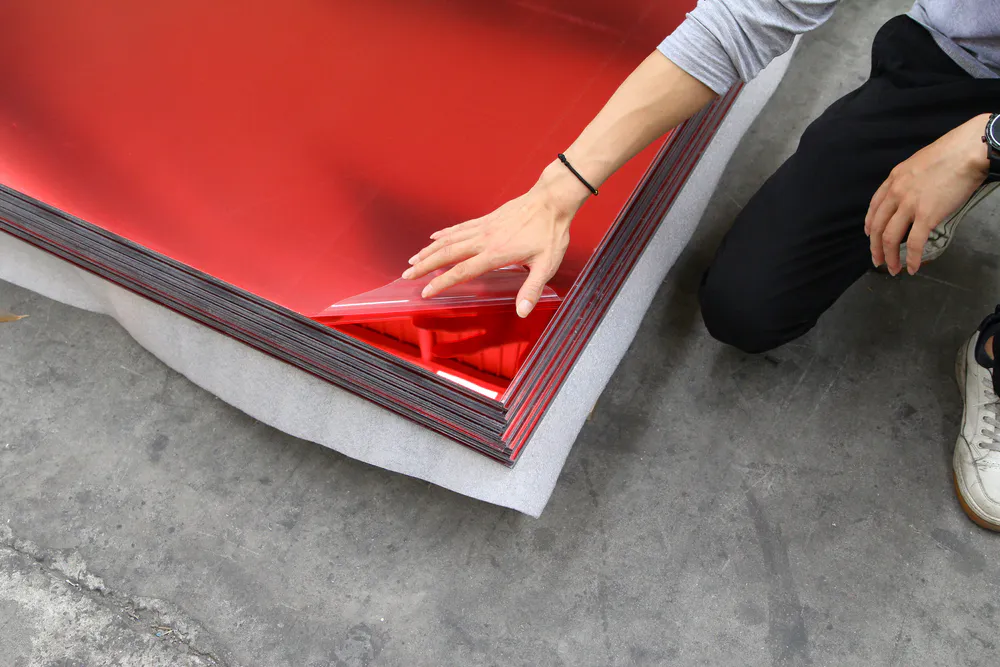
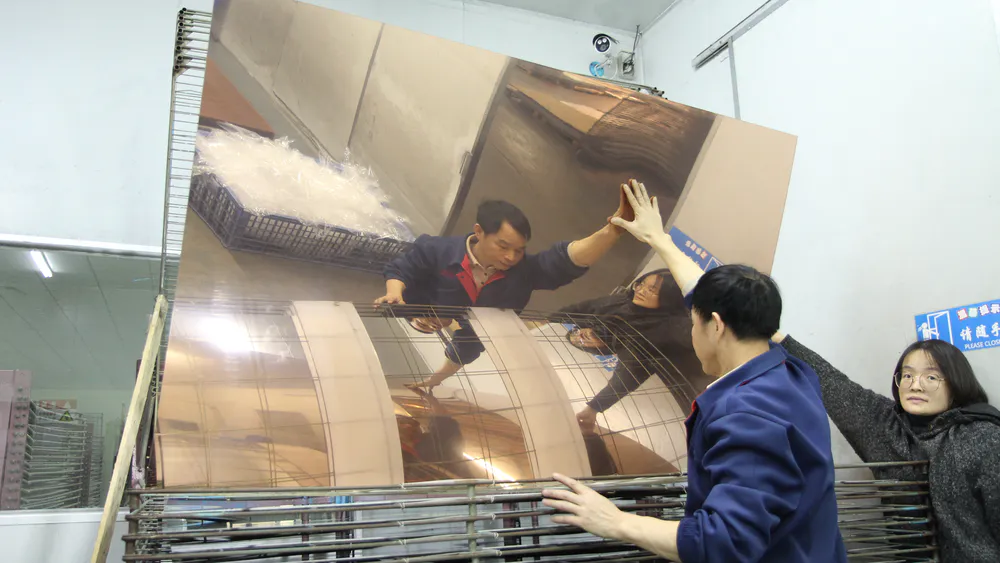
Single-panel large-format wall installations. A continuous flat reflective wall above roughly 24–32 inches in any dimension will show visible surface waviness in acrylic that produces noticeable distortion. For dance studios, gym walls, or large vanity installations where flat reflection accuracy matters, the practical options are: glass mirrors (more expensive, heavier, less safe) or accepting some distortion in exchange for the safety and weight benefits of acrylic. There’s no acrylic-side fix — even thicker stock and rigid backing only mitigate, not eliminate, the issue. This is the most common source of buyer disappointment with acrylic mirror sheets and worth flagging to clients before they commit.
The image below is a product photo we took. Note the position where the worker’s palm is supporting; the distortion effect is clearly visible in the mirror and is much more pronounced than in the other areas that are not supported.
Outdoor installations exposed to weather. Most acrylic mirror sheets are rated for indoor use. UV exposure and humidity gradually degrade the reflective backing, leading to “blackening” or coating failure at the edges. ShapesPlastics specifically marks their mirror acrylic for indoor use only for this reason. Specialty outdoor-rated acrylic mirror exists, but availability is limited.
High-heat environments. Near oven hoods, fireplaces, industrial heat sources. PMMA softens above approximately 80°C.
For applications that don’t fit the flat-sheet format, the alternatives:
- For curved surfaces, see our dedicated guide to curved mirrors (covering convex, concave, and dome variants).
- For one-way visibility, see two-way mirrors.
- For high-humidity environments where standard mirrors fog up, see anti-fog mirrors.
Custom Cuts and Fabrication
Most suppliers offer cut-to-size services, where you specify dimensions and the supplier cuts from full sheets. This is almost always more cost-effective than ordering oversized stock or pre-cut sizes that don’t fit your application exactly.
A few things to know:
Cut tolerance. Standard cut-to-size tolerance is typically ±1/8″ for general work, with tighter tolerances (±1/32″ or so) available at additional cost. Confirm tolerance when ordering — what’s “close enough” for a wall installation may be unacceptable for a precision-fit fixture.
Edge finishing. Saw-cut edges have small chips and a rough surface. For exposed-edge installations, you can specify flame-polished or sanded edges. Edge polishing typically removes 1/32″ to 1/16″ from each cut dimension, which matters for tight-tolerance work.
Hole drilling. Most fabricators will drill mounting holes to spec. Acrylic mirror should be drilled with bits designed for plastics (or carefully with sharp twist bits at slow speed) to avoid cracking from heat buildup. Specify hole positions clearly and dimensionally — “one hole in each corner, 1 inch from each edge” rather than ambiguous descriptions.
Returns. Cut-to-size sheets are non-returnable at almost every supplier, since they can’t be resold. Measure twice.
Mounting and Installation
Brief overview, since this is the subject of a dedicated post:
Adhesive mounting is the most common method. Use acrylic-compatible adhesives — silicone-based mirror mastic or double-sided foam tape rated for acrylic. Avoid solvent-based cements (including some “mirror mastics” sold for glass mirrors) on the painted backing of acrylic mirror; the solvent can attack both the backing and the underlying acrylic, causing delamination or distortion that ruins the mirror.
Mechanical mounting with screws or J-channel works for larger sheets. Drill holes oversize (typically 1.5–2× the screw diameter) to allow for thermal expansion — acrylic expands and contracts more than glass with temperature changes. Constraining a sheet rigidly invites cracking.
Combination mounting — adhesive plus mechanical edge support — is standard for larger installations, where neither method alone is sufficient.
Pricing Reference
Indicative pricing for acrylic mirror sheets in the standard 48″ × 96″ full-sheet size, as of the current market:
- 1.5mm silver mirror, full sheet: roughly $80–150
- 3mm silver mirror, full sheet: roughly $150–250
- 6mm silver mirror, full sheet: roughly $250–400
- Colored variants: typically 30–50% premium over silver
- Custom cuts: based on the parent-sheet price plus a cutting fee, typically $5–15 per cut for standard work
These are reference numbers — actual pricing varies by supplier, region, batch availability, and quantity. Wholesale and trade pricing for ten-sheet-plus orders typically runs 20–35% below retail.
The final prices vary among different countries, and other cost factors need to be taken into account when considering international trade.
Questions to Ask Before You Order
A short checklist for evaluating a supplier:
- Cast or extruded acrylic? Either is acceptable for most uses, but the answer reveals supplier knowledge and specifies what to expect on tolerance and surface quality.
- What’s the thickness tolerance? Particularly important for fitted installations or batch-to-batch consistency.
- What’s the cut tolerance? Standard ±1/8″ is fine for most applications; precision work needs tighter.
- Indoor or outdoor rated? Critical for any exterior installation — ask for the actual rating, not assurances.
- What’s the reflective coating — aluminum or another metal? Aluminum is standard; specialty applications may need alternatives.
- Is the protective film laser-cuttable? Matters for fabricators who plan to laser-cut without removing masking first.
- Do you have grade-A versus standard inspection? Premium applications justify paying for the better grade.
- What’s the lead time for custom cuts and colors? Standard sheets ship quickly; custom work typically adds days.
- What’s the return policy on stock sheets versus cut-to-size? Cut-to-size is almost always non-returnable; stock sheets sometimes are.
- Do you provide samples? Reputable suppliers send sample for color and finish verification.
Final Practical Notes
Three things worth knowing that don’t fit elsewhere:
The protective masking film should stay on until installation. Removing it earlier exposes the mirror surface to fingerprints and scratches that are hard to fully clean off later. Cut, drill, and finish-handle the sheets with masking in place.
When mounting, the side facing out (the reflective side) is the side without the painted backing. It’s easy to install a sheet backwards — the back looks reflective at a glance because of the thin protective film, but the actual mirror finish is on the opposite face. Confirm orientation before applying adhesive.
For ongoing maintenance, the only safe cleaning method is a soft microfiber cloth with either water or a very mild dish-soap solution. Glass cleaners (especially anything ammonia-based) cause permanent surface damage to acrylic. Plastic-specific polishes are available for restoration of fine scratches but won’t repair coating damage.
Acrylic mirror sheets are a workhorse product for most applications they’re specified for. The mistakes that happen — most of them — come from ordering the wrong thickness for the size, ordering for an outdoor application without confirming the rating, or expecting flat-glass reflection accuracy from a large flat-sheet acrylic install. None of these are problems with the material; they’re mismatches between what the material does well and what it was specified to do.