
The term “acrylic mirror” gets used loosely. Sometimes it means a sheet of plastic with a mirror finish on one side. Sometimes it means a tile, a panel, or a sticker. Sometimes it refers to a specialty product — a one-way version, a dome, a curved gym installation. All of these are technically acrylic mirrors, but they’re built differently and they belong in different applications.
This post is the long version of the answer to “what is an acrylic mirror?” — the kind of explanation you’d want before placing your first order. We’ll cover what the material actually is, how it’s made, how the variants differ, and where it does and doesn’t make sense to use one. If you’ve already read our comparison of acrylic mirrors versus glass mirrors, this picks up where that one left off and goes deeper into the material itself.
The Material in Plain Terms
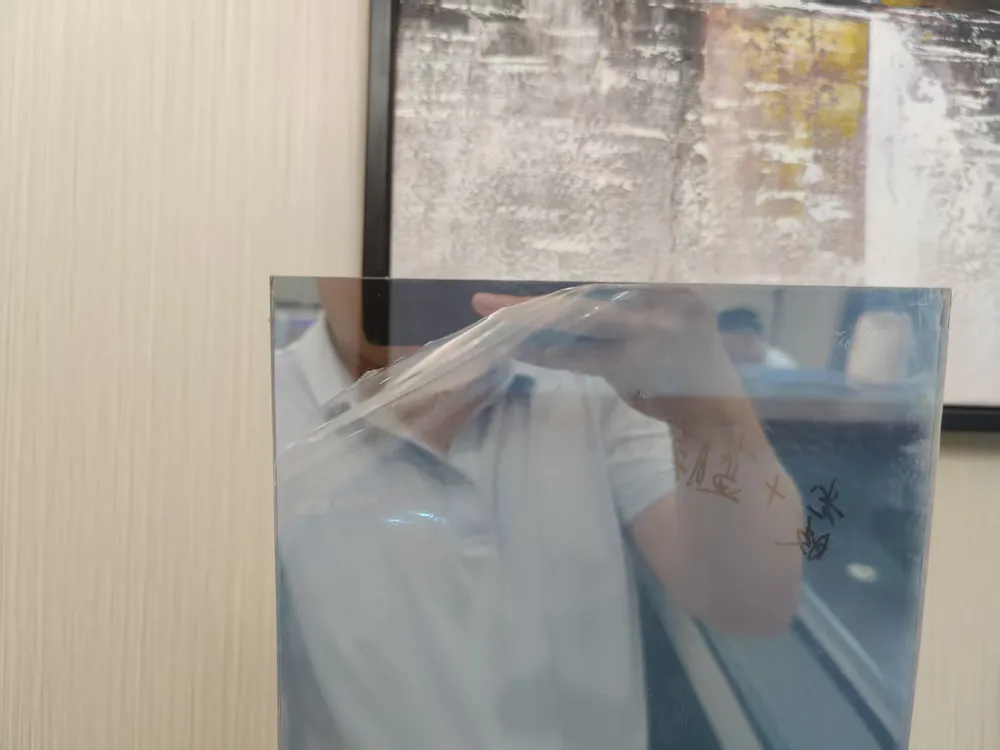
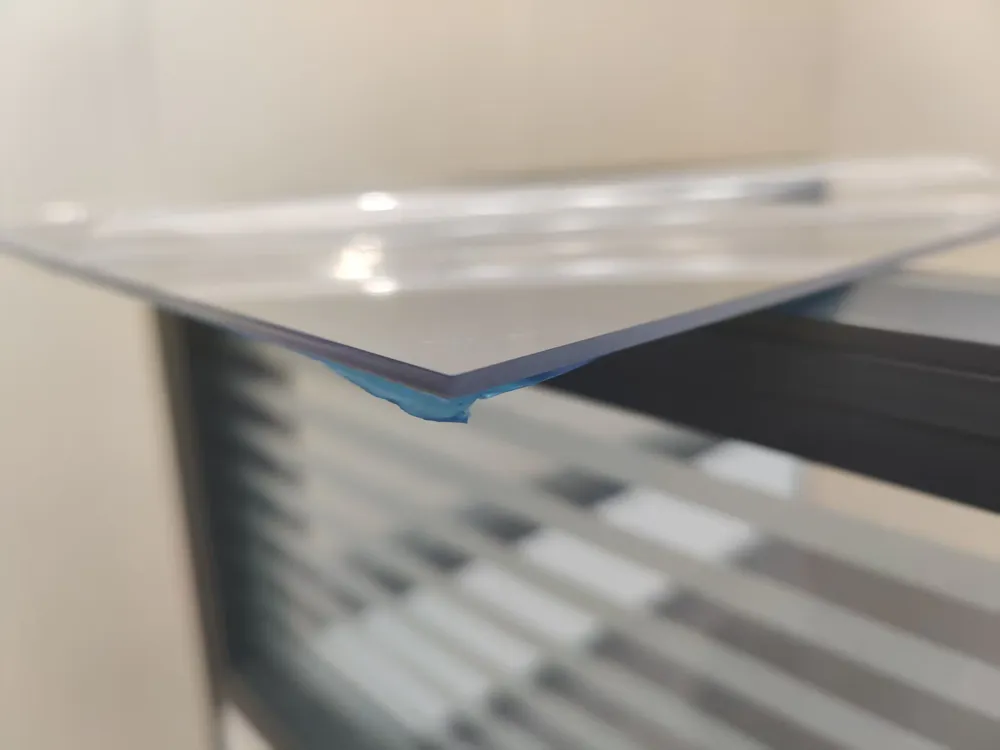
An acrylic mirror is a sheet of acrylic plastic with a thin, highly reflective metal layer applied to one face. The plastic substrate is called PMMA, short for polymethyl methacrylate. It’s a transparent thermoplastic that’s been around since the late 1920s and is widely used as a glass substitute in everything from aircraft windows to medical implants.
According to the Wikipedia entry on PMMA, the material transmits up to 92% of visible light and has a refractive index of 1.4905. In practical terms: it’s nearly as clear as glass, and once you put a reflective coating behind it, the result looks almost identical to a traditional silvered mirror.
The metal layer itself is usually aluminum, deposited at a thickness of around 200 nanometers. Replex, an optical manufacturer, describes the deposition process as physical vapor deposition: the metal is heated under vacuum until it evaporates, then re-condenses on the acrylic surface as a uniform reflective coating. Some specialty mirrors use chrome or even gold instead of aluminum for tinted finishes.
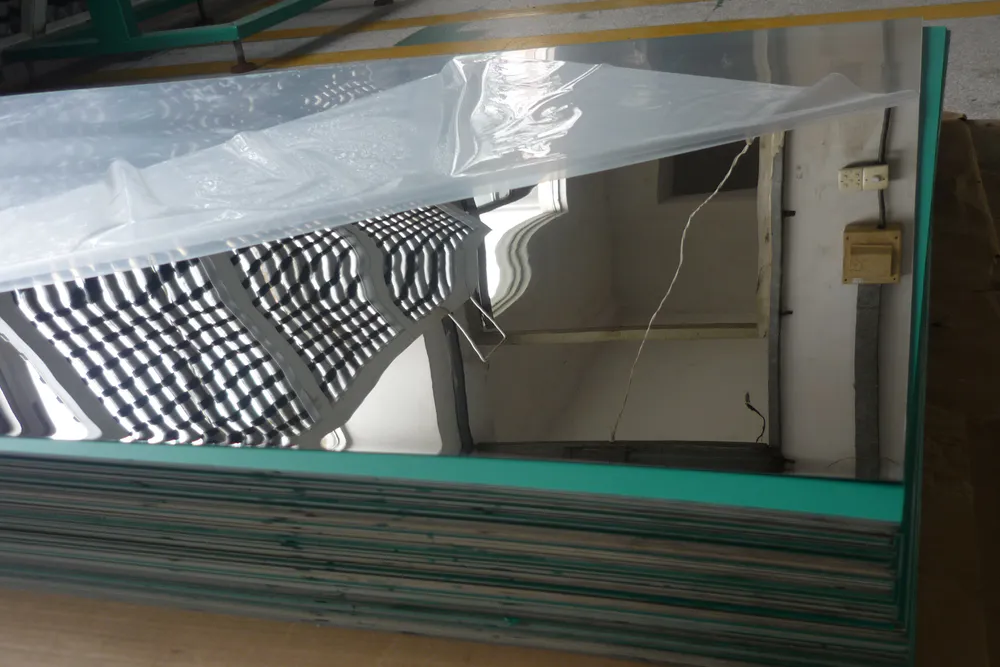
After the metal layer goes on, a protective backing is applied — usually a paint or polymer coating — to keep the reflective surface from being damaged in handling. That’s the back you see when you look at the rear of an acrylic mirror sheet.
How Acrylic Mirrors Are Made
The full production sequence is straightforward, but each step has implications for the finished product:
1. Acrylic sheet production. This is where the substrate is made. Acrylic comes in two forms — cast and extruded — and the difference matters for mirror quality. We’ll get to that in the next section.
2. Surface preparation. The sheet is cleaned and inspected. Any dust, fingerprints, or surface defects at this stage will be visible in the finished mirror, magnified by the reflective coating.
3. Vacuum metallization. The sheet enters a vacuum chamber. Once nearly all air has been pumped out, aluminum (or another metal) is heated to evaporation. The vapor travels in straight lines from source to sheet and condenses as a uniform thin film. The process is described in detail by Canal Plastics and similar manufacturers.
4. Protective backing. A coating is applied to the metallized side. This protects the reflective layer from scratches, oxidation, and moisture during fabrication, shipping, and installation.
5. Trimming and inspection. Sheets are cut to standard sizes (commonly 4ft × 8ft, 4ft × 6ft, and various smaller dimensions) and inspected for defects.
The whole process is significantly faster and cheaper than producing a traditional glass mirror, which is part of why acrylic mirrors are roughly 30–50% less expensive at the sheet level. It is worth noting that the overall affordability of the board does not imply that the material is cheap.
Cast vs. Extruded: Why It Matters for Mirrors
Most buyers don’t ask which type of acrylic was used in their mirror sheet, but it affects the result. There are two manufacturing methods for the underlying acrylic, and they produce noticeably different sheets.
Cast acrylic is made by pouring liquid acrylic monomer between two glass plates and slowly polymerizing it. The process takes longer, produces more uniform optical clarity across the sheet, and yields a slightly harder surface. According to Mitlee Plastics, cast acrylic achieves up to 93% light transmission and is the standard choice for premium signage and laser cutting. Surface hardness is roughly 10–15% higher than extruded, per the LSRPF technical guide.
Extruded acrylic is produced by pushing heated acrylic resin through a die in a continuous process. It’s cheaper to make, has tighter thickness tolerances (typically ±5% versus ±10% for cast), and is generally smoother in surface finish. Acme Plastics notes that extruded acrylic is more dimensionally stable across batches.
For mirror applications, the trade-off is roughly this: cast acrylic gives slightly better optical performance and scratch resistance; extruded gives better thickness consistency and lower cost. Many commercial mirror sheets are made from extruded acrylic for that reason. For decorative, display, or premium applications, cast is typically the better specification.
If a supplier doesn’t tell you which type they use, ask. The answer is usually informative about overall quality.
What Acrylic Mirrors Are Actually Good At
Acrylic mirrors aren’t a universal substitute for glass. They’re a specialized product that excels in specific scenarios. Three properties matter most:
Impact resistance. PMMA has roughly 10 to 17 times the impact strength of soda-lime glass, depending on grade and test method. This is the headline benefit and the reason acrylic mirrors are specified for gyms, schools, healthcare facilities, daycare centers, and any environment where breakage poses a safety risk.
Weight. PMMA is about half the density of glass — roughly 1.18 g/cm³ versus 2.5 g/cm³. For overhead installations, retail fixtures that get rearranged, and any setting where the mirror needs to be moved or shipped frequently, this changes the practical math considerably.
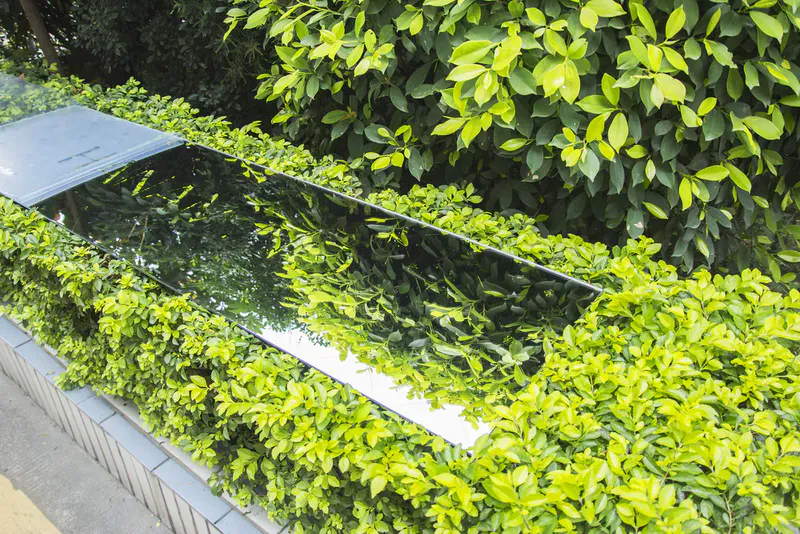
Customization. Acrylic can be cut, drilled, laser-engraved, and thermoformed without specialized glass-cutting equipment. This is why acrylic dominates in custom shapes, signage, jewelry-making, smart mirror builds, and any application where the mirror isn’t a standard rectangle.
A fourth property worth mentioning: acrylic can be produced in colors that glass mirrors can’t easily match — gold, rose gold, bronze, smoked black, and various pastels. For design-driven projects, this is sometimes the deciding factor.
Where Acrylic Mirrors Fall Short
Honest answer, because skipping this part would make the article useless. There are three real limitations:
Surface distortion at larger sizes. This is the most important one for buyers to understand. Because acrylic is more flexible than glass, larger panels can show slight surface waviness that produces visible distortion in reflections. The effect becomes noticeable somewhere around 60–80cm (roughly 24–32 inches) and is more pronounced at thinner gauges. Canal Plastics recommends 1/4-inch (6mm) thickness specifically for mirrors larger than 24 inches to minimize the issue, though it can’t be eliminated entirely. For installations where a perfectly flat reflection matters, glass remains the reference standard. Acrylic is the right choice for those large applications only when impact resistance, weight, or shape requirements override flat-reflection priorities.
Scratch resistance. Acrylic is softer than glass and accumulates fine scratches more readily — particularly during cleaning. Standard glass cleaners (Windex, anything ammonia-based) damage acrylic permanently, causing surface crazing. Acrylic mirrors should be cleaned only with a microfiber cloth and either water or a mild dish-soap solution.
Heat tolerance. PMMA softens at around 80–100°C depending on grade. This is fine for any normal indoor environment but rules out installations near oven hoods, fireplaces, industrial heat sources, or direct prolonged sunlight in hot climates.
Common Variants of Acrylic Mirror
The category isn’t a single product. The main variants you’ll encounter:
Standard mirror sheets. Flat panels in standard sizes, used for walls, fixtures, and DIY projects. Available in clear silver, plus a range of colored finishes. Our large mirror sheets product line covers the standard sizes most projects need; for custom dimensions or shapes, sheets are typically cut to order.
Tinted and colored sheets. Same construction as a standard mirror, but the metal layer (or an added dye) produces a tinted reflection — gold, rose gold, bronze, black, blue, and so on. These are popular in event decor, signage, retail fixtures, and modern interiors.
Two-way (one-way) mirrors. A specialty variant where the metal coating is thinner than usual, allowing partial light transmission. The result is a surface that acts as a mirror when one side is brightly lit and the other is dark — useful for observation rooms, smart mirror projects, security applications, and stage effects. Acrylic versions are available in much larger sizes than glass two-way mirrors. Two-way mirrors are one of the categories where acrylic genuinely outperforms glass on availability and cost. The basics of how the optics work are explained in the Wikipedia entry on one-way mirrors.
Curved mirrors. Because acrylic can be thermoformed, it’s used to produce mirrors in shapes that would be expensive or impossible in glass. The main types in the category we call curved mirrors are:
- Convex mirrors — bulged outward, used for blind-spot safety in driveways, warehouses, retail stores, and traffic situations. Convex acrylic mirrors are the dominant product in their category, simply because the curve and the safety profile both favor plastic.
- Concave mirrors — curved inward, used in optics, solar concentrators, makeup magnification, and lighting reflectors.
- Dome mirrors — full or quarter-spherical sections used for wide-angle observation, particularly in retail loss prevention and warehouse safety. Dome mirrors are essentially convex mirrors with a more aggressive curve and a different mounting profile.
Anti-fog mirrors. Treated with a hydrophilic coating that prevents condensation from forming droplets that scatter light. Common in bathrooms, gyms, locker rooms, and anywhere humidity is a regular issue. Anti-fog mirrors are a smaller category by volume, but a useful specification for environments where standard mirrors would constantly fog up.
How to Choose One
A short decision framework:
If the application is safety-driven (gym, school, daycare, healthcare, public space), specify acrylic. The impact resistance is the entire reason for choosing it.
If the application is shape-driven (curved walls, custom signage, non-rectangular pieces, jewelry, laser-cut shapes), acrylic is usually the only practical option.
If the application is visual-quality-driven (vanity mirror, designer wall mirror, anywhere reflection accuracy matters at close range), glass is usually the better specification.
If the application is size-driven and flat reflection matters (a long studio wall, a full-length entry mirror), the answer depends on which trade-off you can accept. Acrylic gives you safety and weight savings; glass gives you a flatter reflection. There’s no universally correct answer — it depends on the priorities of the specific project.
If the application is specialty (two-way, anti-fog, curved), acrylic is generally the right material for the reasons covered above.
A Few Things Worth Knowing Before You Order
Three practical points that come up regularly in customer conversations:
Thickness affects more than weight. Standard acrylic mirror is sold in 1.5mm, 3mm, and 6mm thicknesses. 1.5mm is light enough for craft work and small applications but flexes too easily for anything large. 3mm is the general-purpose standard. 6mm is what you specify for larger panels where you want to minimize surface distortion. Going thicker doesn’t fix the distortion entirely — but it helps.
Edges and corners matter. Acrylic mirrors come with the protective backing extending to the edges, but the mirror coating itself doesn’t always go all the way to the edge. If you’re trimming or drilling close to the perimeter, plan for that. For exposed-edge installations, edges can be flame-polished or bevel-finished; ask your supplier what’s included.
Lead time on customization. Standard sheets ship quickly. Custom sizes, custom shapes, two-way variants, and color matches typically add days to the order. If a project deadline is tight, mention it when you order.
For most buyers the right starting point is a standard 3mm sheet in a standard size, ordered with a clear understanding of where acrylic excels and where it’s a compromise. The material is excellent at what it’s designed for. The mistakes happen when it gets specified for applications it wasn’t built for.