
Customers’ demand for a “double-sided mirror” may refer to two different products. Some buyers need a mirror that provides reflective surfaces on both sides. Other buyers are looking for a one-way semi-transparent mirror, which reflects light while allowing part of the light to pass through.
These are two completely different products, and they do not work in the same way.
A double-sided acrylic mirror provides normal reflection from both sides. It does not require a bright side and a dark side, and people usually cannot see through the middle to the other side. A one-way mirror, on the other hand, is partially transparent, and its effect depends on the lighting conditions on both sides as well as the mirror’s own light transmission and reflectivity.
Before quoting materials, suppliers should confirm this distinction. Some customers do refer to “double-sided” as “two-way,” so it is important to clarify which product is actually needed.
Since we have already discussed a lot about “two-way mirrors” earlier, here we will focus mainly on “double-sided mirrors.”
What is a double-sided acrylic mirror?
Standard acrylic mirror panels typically have only one reflective surface—that is, they are ordinary one-way mirrors. A metallic reflective layer is coated onto one side of the acrylic substrate and covered by a protective backing. Edmund Optics explains the general role of metal coatings in mirror construction.
The reverse side is not a second complete mirror surface. Therefore, many double-sided mirrors are constructed by assembling two single-sided acrylic mirror panels back-to-back. These two panels can be bonded directly together or mounted on either side of a rigid core or frame.
The appropriate construction depends on the panel’s size and intended use. For small hanging displays, two thin mirror panels may be sufficient. Freestanding display panels or portable practice panels typically require internal bracing to keep both reflective surfaces flat.
Therefore, product specifications should include:
- The thickness of each mirror surface;
- The total thickness of the finished product;
- Whether the intermediate structure consists of direct bonding, a rigid core, or a frame;
- Edge finishing;
- The color of the mirror surfaces on both sides;
- Installation method.
If these details are missing, mirrors from different suppliers may vary in weight, rigidity, and final appearance.
Not all double-sided mirrors are made by combining two single-sided mirrors; some are manufactured directly with a metallic reflective coating on both sides. This is typically found in thinner mirror products.
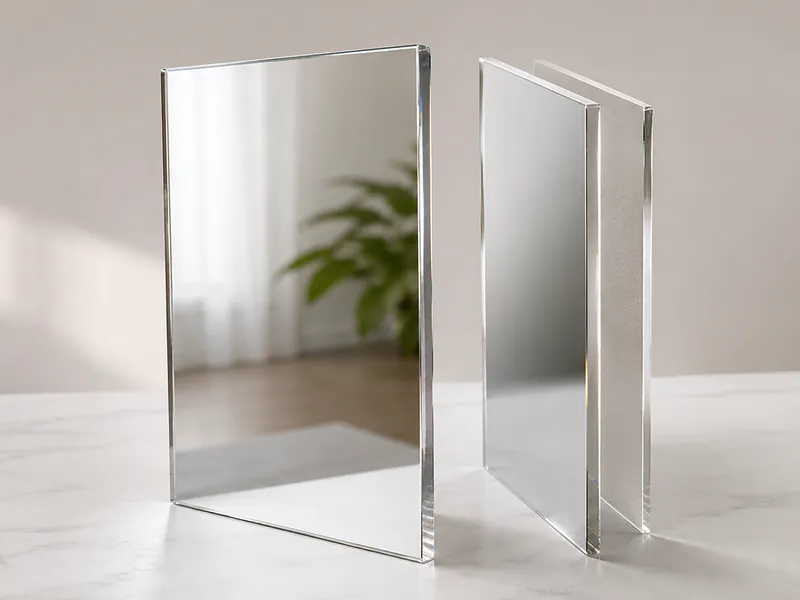
Double-sided acrylic mirrors and two-way mirrors are different
Both outer surfaces of a two-way mirror are reflective. A one-way mirror reflects some of the incident light and transmits the rest.
| Characteristics | Double-sided acrylic mirror | One-way acrylic mirror |
|---|---|---|
| Main Function | Provides a mirror effect on both sides | Combines reflection with partial light transmission |
| Can people see through it to the other side? | Usually not | Yes, under appropriate lighting conditions |
| Do both sides require different lighting conditions? | No | Yes |
| Typical Structure | Two mirror surfaces joined together or mounted on a support structure | 50% light transmittance + 50% reflectance |
| Common Uses | Freestanding displays, rotating panels, and double-sided decorations | Smart mirrors, infinity mirrors, and hidden displays |
If the screen, light source, product, or room needs to remain visible from behind the mirror, use One-Way Acrylic Mirrors.
If your project only requires standard reflection from both directions, use a double-sided mirror. The reflective effect does not depend on which side of the room is brighter.
When should you use a double-sided acrylic mirror?
Two-way mirrors are used for “decorative” purposes. Based on our many years of experience, the following four scenarios are the most common:
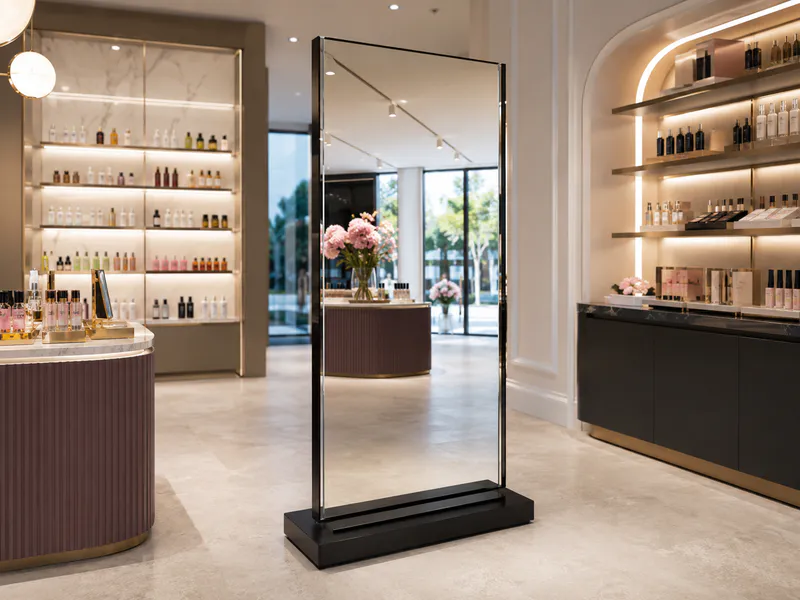
Freestanding retail and showroom displays
A freestanding display can be approached from more than one direction. A double-sided mirror allows both customer-facing sides to remain reflective instead of leaving one unfinished back exposed.
This construction can be used for rotating displays, central showroom fixtures, cosmetic counters and product presentation panels. Acrylic is useful because it is lighter and more impact resistant than glass. Acme Plastics also lists retail, signage and display work among common acrylic mirror applications.
The display still needs a stable frame or base. Joining two thin mirror sheets does not automatically produce a rigid panel. If the stand moves or the panel bends, both reflections will be affected.
Hanging signs and decorative panels
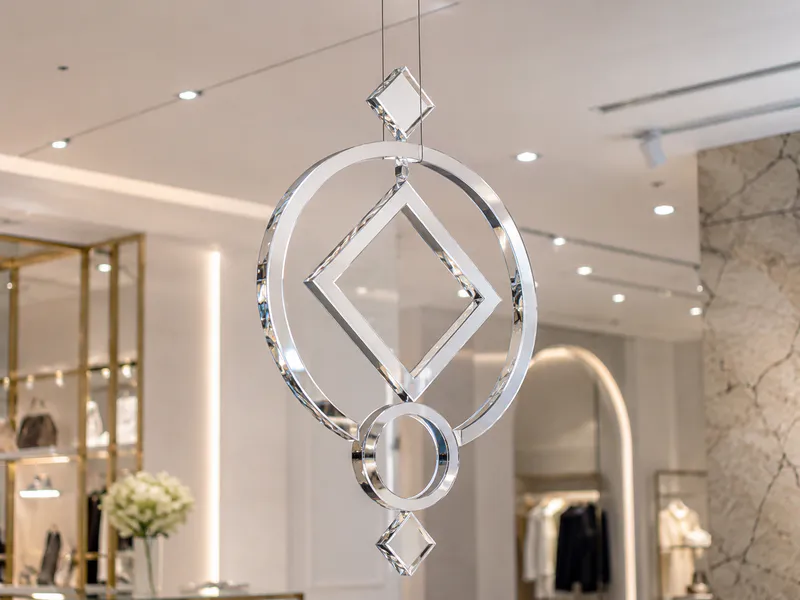
Double-sided acrylic mirror can be used for hanging shapes, ceiling decorations, event pieces and reflective signs that are visible from both directions. The mirror faces can be laser cut or CNC cut into letters, logos and geometric forms.
The edge is visible in this type of application. The buyer should decide whether the joined layers can remain exposed or whether the panel needs a trim, channel or decorative edge cover. A direct back-to-back bond may be acceptable for a small ornament, while a premium retail installation usually needs a cleaner edge solution.
Acrylic is practical for suspended pieces because PMMA is widely used as a lightweight and shatter-resistant alternative to glass.
Mirrored Partition Walls in the Room
Portable partitions can provide reflection on both sides, allowing two practice areas to share the same panel. Acrylic reduces the structural weight and lowers the risk of glass breakage when moving the panels.
However, large acrylic mirrors may warp. Double-sided mirrors cannot rely on the entire wall for support, so they require a rigid frame or core material. They are suitable for settings where the need for a mirrored surface is not particularly high, but they cannot provide the flat, reflective finish expected from permanent glass dance studio walls.
For large mirror installations, please review the size and support limitations in our Guide to Large Acrylic Mirrors before selecting materials.
Photography, events and stage props
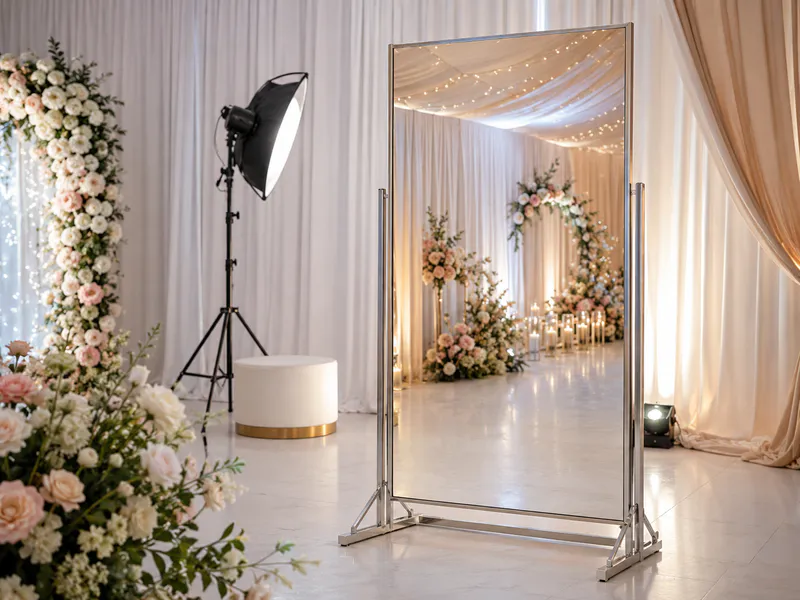
Photographers and event designers may need a lightweight mirror that remains reflective when viewed from either side of a set. Double-sided acrylic can be moved, suspended or installed in a temporary frame more easily than a comparable glass assembly.
It works well for decorative reflections, product photography, wedding installations and stage props. It is less suitable when a camera is positioned close to a large panel and requires a perfectly flat image. Cameras can make small waves, scratches and surface marks more visible than they appear to the eye.
When is a double-sided acrylic mirror unnecessary?
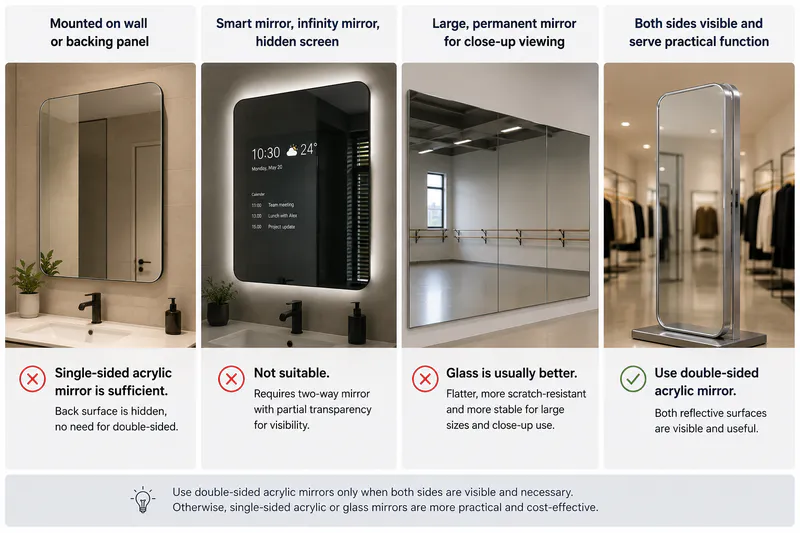
A double-sided design increases material and labor costs, as well as requirements for thickness and edge finishing. A double-sided design should only be used when both reflective surfaces are visible and serve a practical function.
When a mirror needs to be mounted on a wall, cabinet, or backing panel, a standard single-sided acrylic mirror panel is more suitable. If the mirror surface on the back is always hidden, there is no benefit to using a double-sided panel.
Double-sided mirrors are also unsuitable for projects requiring visibility through the panel. Smart mirrors, infinity mirrors, and hidden screen displays require the use of partially reflective two-way mirror panels.
For large, permanent mirrors intended for close-up viewing, glass may provide a flatter and more scratch-resistant surface. Using double-sided acrylic mirrors does not eliminate the limitations of acrylic in terms of size and warping, especially for panels larger than 60 cm.
What should you confirm before ordering?
When you need to purchase a two-way mirror, what questions should you ask the supplier? Generally, you can discuss these issues with the supplier before receiving the final quote:
Describe how the panel will be used. State whether it will hang, rotate, stand on the floor, sit on a counter or move between locations.
Provide the visible size. The overall panel and the mirror area visible inside a frame may be different.
Confirm the construction. Ask whether the product will use two sheets bonded directly together or two mirror faces with a rigid support between them.
Specify the total thickness and weight limit. The finished panel will be thicker and heavier than a single mirror sheet. This affects stands, hanging hardware and packaging.
Specify the mirror colour on each side. Both faces can use the same finish, or a decorative project may combine silver, gold, rose gold or another colour.
Include holes and cut-outs in the drawing. The two mirror faces must align. Hole diameter, position and distance from the edge should be confirmed before assembly. Our custom-cut acrylic mirror guide explains the information needed for made-to-measure parts.
Confirm the edge finish. A visible laminated edge, frame channel and decorative cover produce different results.
State the required reflection quality. Tell the supplier the viewing distance and whether the mirror is decorative, functional or camera-facing. This helps determine whether acrylic is suitable and how much support the panel needs.
A sample is useful when the order includes different colours on each side, a visible bonded edge or an unusual internal construction. The buyer can approve the appearance before full production begins.
How should it be handled and installed?
Both faces remain exposed during installation, so the panel should not be placed face-down on an unprotected floor or workbench. Keep the protective film on both sides until cutting, framing and hardware installation are complete.
The frame should support the panel evenly. Tight screws, uneven clamps and isolated pressure points can bend the acrylic and affect both reflections. Fasteners should not be overtightened.
Clean both sides with a soft microfiber cloth and an acrylic-safe cleaner. Avoid abrasive pads and ammonia-based glass cleaners. Acrylic is lighter and more impact resistant than glass, but it also scratches more easily.
Should you choose a double-sided acrylic mirror?
When viewers will be approaching from two directions and both sides need to provide a normal reflection, choose double-sided acrylic mirrors. They are best suited for freestanding retail displays, rotating installations, hanging decorations, portable practice panels, and temporary photography or event setups.
Do not choose this option when one side will remain hidden, the project requires visual observation through the mirror surface, or large panels must provide a flat reflection identical to that of architectural glass.
Before placing an order, please confirm whether the supplier is quoting two bonded mirror panels, a mirror surface mounted on a core material, or a two-way mirror panel.