
When customers pick up a thinner acrylic mirror sticker, they can often see it bend slightly with the movement of their hands. But once they try to fold it, or roll it onto a paper tube like a film, they immediately feel the hardness of the material. So the question arises: is it an acrylic mirror sheet, or a flexible sticker?
Our answer is: it is still an acrylic (PMMA) mirror sheet; it is just that the thinner specification allows it to undergo limited elastic bending, and the degree of bending is also affected by its size and shape. The “bendable” characteristic here is not the same material behavior as the “softness” of PET mirror.
We have seen products on e-commerce platforms labeled as acrylic mirror stickers using images that show them being “rolled up.”
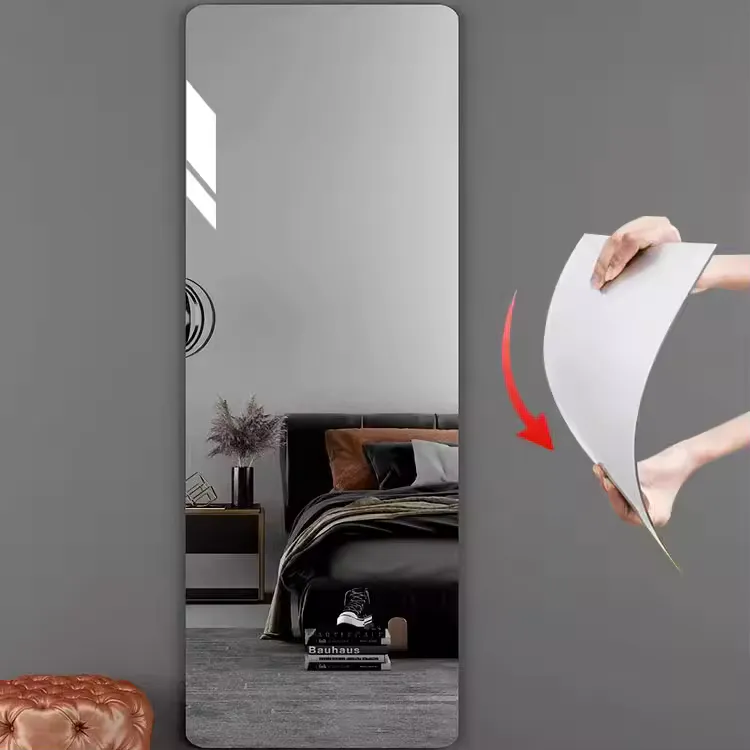
This is where the contrast lies: acrylic mirrors have rigidity, and when bent beyond a certain degree, they will crack directly. However, the name “mirror sticker” also makes people think of a soft film that can be folded, rolled, and applied to arbitrary surfaces.
In reality, these two descriptions often correspond to different substrate materials. To determine what a product actually is, you cannot rely only on whether the title contains “acrylic” or “sticker”; you also need to confirm the substrate material, thickness, supply form, and the permitted bending method.
“Sticker” Refers to the Adhesive-Backed Structure, Not That the Mirror Sheet Is a Soft Film
In the context of common mirror products, “acrylic mirror sticker” usually refers to a PMMA acrylic mirror sheet with a self-adhesive backing on the rear side. The main body is still an acrylic sheet; “sticker” describes the installation method, meaning that the back of the product is pre-coated with pressure-sensitive adhesive, double-sided tape, or another adhesive layer, allowing it to be fixed in place after peeling off the release liner. It does not mean that the PMMA itself has become a flexible film like a label.
Acrylic itself is a rigid material with a certain degree of toughness. When combined with the concept of a “sticker,” it can only mean an acrylic mirror with built-in adhesive mounting functionality, and it must be in flat sheet form; it cannot be rolled up.
A standard PMMA mirror sheet is generally composed of an acrylic substrate, a reflective layer, a protective backing coating, and a surface protective film. The self-adhesive version simply adds an adhesive layer behind the protective backing structure. In other words, it can simultaneously have the properties of being both a “mirror sheet” and “self-adhesive,” but it does not lose the inherent rigidity of the sheet material because of this.
If you see mirror stickers on e-commerce platforms that can be rolled up while also claiming to be made of “acrylic,” they are most likely not actually made of acrylic. Although acrylic is tougher than glass, it is still a rigid plastic sheet material.
True self-adhesive mirror sheets based on PMMA are usually supplied as flat panels and can be processed into circles, letters, strips, geometric segments, or other custom contours, then applied to wall panels, cabinet doors, display backboards, signage panels, or decorative components. Even when relatively thin, they should still be treated as semi-rigid mirror sheets rather than as a roll of mirror film.
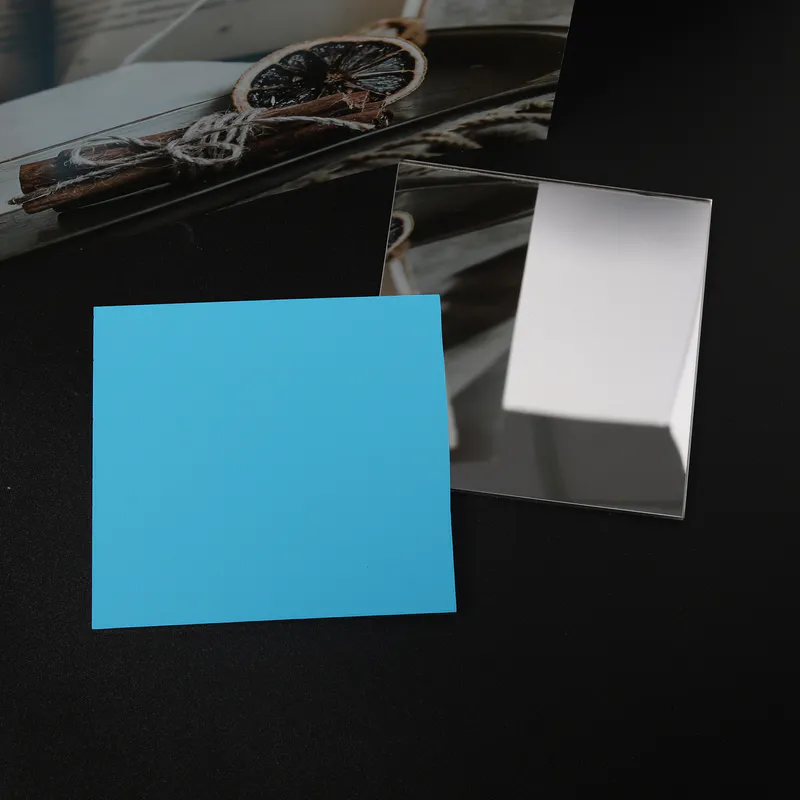
PMMA Acrylic Mirror Sticker Can Bend, but Cannot Be Folded or Rolled Arbitrarily
Thinner PMMA mirror sheets can indeed undergo limited bending. The key points here are “limited” and “elastic”: under relatively small force, the mirror sheet can temporarily deviate from a flat surface; once the external force is removed, it will attempt to return to its original shape. It is not suitable for being folded to create creases, nor for being tightly rolled onto a small-diameter paper tube like PET film.
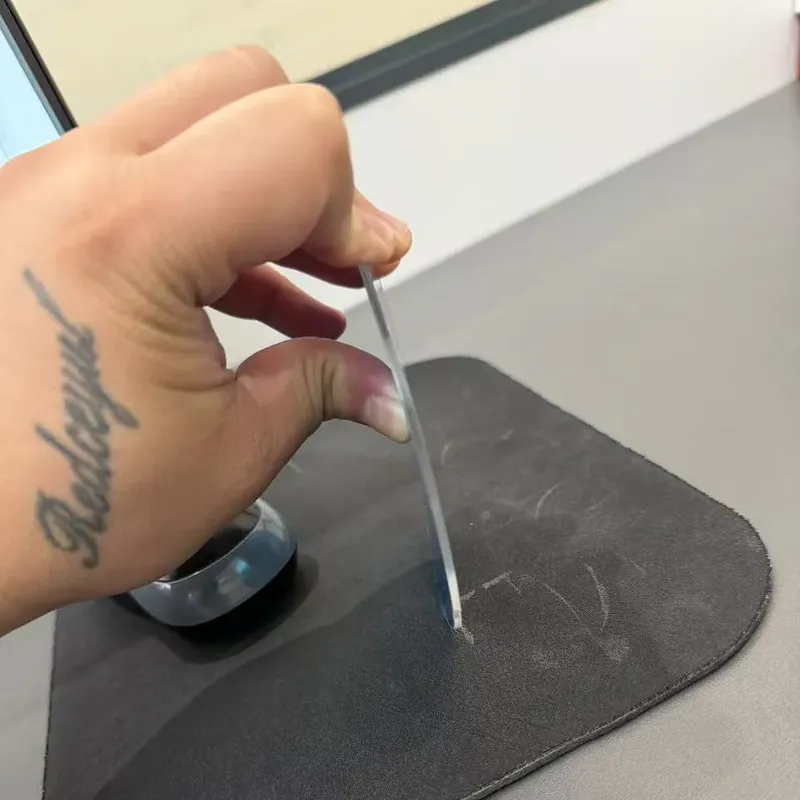
Here I used an acrylic mirror that isn’t particularly thin for testing. You can see that my fingers are pressing so hard they’ve turned pale, yet the mirror still hasn’t bent much.
Thickness Significantly Changes the Bending Feel of the Mirror Sheet
For the same material under the same loading conditions, the bending stiffness of a sheet is approximately proportional to the cube of its thickness. Therefore, the difference between a 1 mm mirror sheet and a 3 mm mirror sheet is not simply “three times thicker.” Under otherwise approximately identical conditions, the theoretical bending stiffness of a 3 mm sheet can reach about 27 times that of a 1 mm sheet.
This also explains why thin sheets visibly sag when held in the hand, while thicker mirror sheets remain nearly flat. However, this ratio is used to illustrate the thickness trend and cannot be directly converted into the product’s safe bending radius. Mirror size, aspect ratio, processing direction, edge condition, temperature, loading position, and loading duration will all affect the actual result.
Size and Shape Also Affect “How Soft It Appears”
A narrow and long 1 mm mirror sheet is usually easier to bend than a small circular sheet of the same thickness; a large-area thin mirror sheet will also show obvious sagging due to its own weight and longer unsupported span. Conversely, mirror sheets with small dimensions, short spans, or full-surface support will appear stiffer.
Therefore, products cannot be judged solely by conclusions such as “1 mm can bend, 2 mm cannot bend.” For projects that need to conform to slightly curved surfaces, samples should be made according to the actual dimensions and tested on the target substrate for rebound behavior, edge stress, adhesive stability, and reflection distortion.
Forceful Bending Will Not Turn PMMA into a Flexible Material
When bending exceeds the range the material can withstand, PMMA may first develop localized stress concentration, followed by fine cracks, whitening, permanent deformation, or direct fracture. Cut notches, sharp corners, drilled holes, and rough edges further increase this risk.
Therefore, thinner acrylic mirror stickers may be described as “slightly bendable,” but should not be marketed as “freely foldable” or “rollable into a coil.” These two concepts correspond to different material states.
What Material Is an “Acrylic Mirror Sticker” That Can Be Rolled Up Usually Made Of?
If a mirror material can be rolled up like a poster or label material, forms a very small diameter when rolled, and does not show obvious sheet rebound when unfolded, then it is usually not a conventional PMMA acrylic mirror sheet, but more likely a mirror film based on materials such as PET film.
PET mirror film itself is supplied in rolls. It can be adhesive-coated, die-cut, and applied to large one-way curved surfaces or slightly irregular surfaces, so it is very common in wall stickers, decorative decals, packaging, labels, and handmade products. Its advantages are that it is thin, lightweight, and rollable, but it is also more likely to reflect the texture, seams, and unevenness of the substrate onto the mirror surface.
PETG Mirror Sheets Are Not the Same as PET Mirror Film
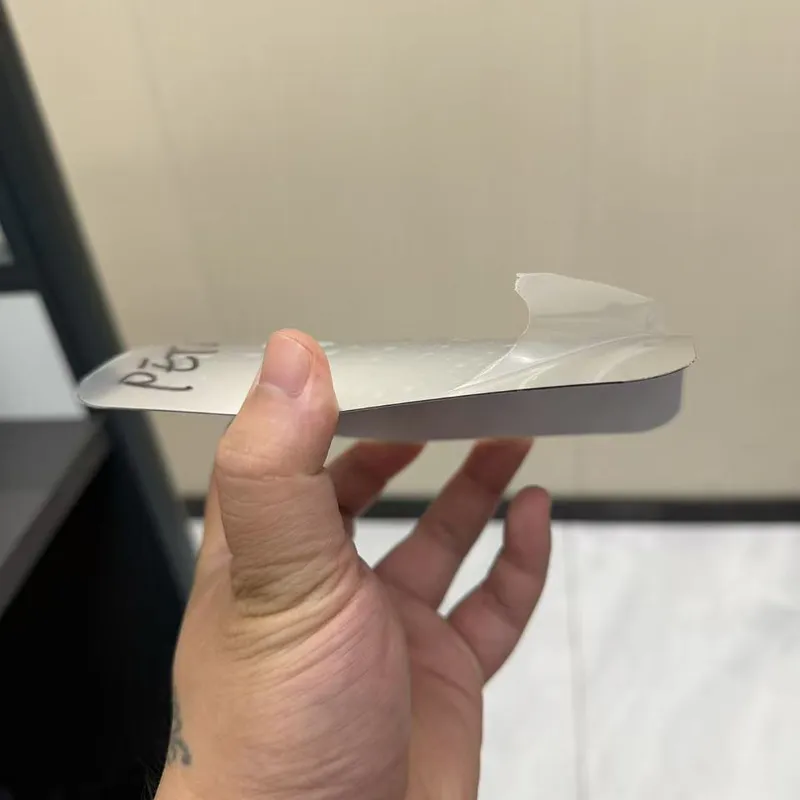
PETG also often appears in discussions of flexible mirror products, but it is not supplied in the same form as PET film. PETG mirror sheets are still usually supplied as sheets, but they have better impact performance and forming capability, can be cold-bent or thermoformed, and are used for more complex processing structures.
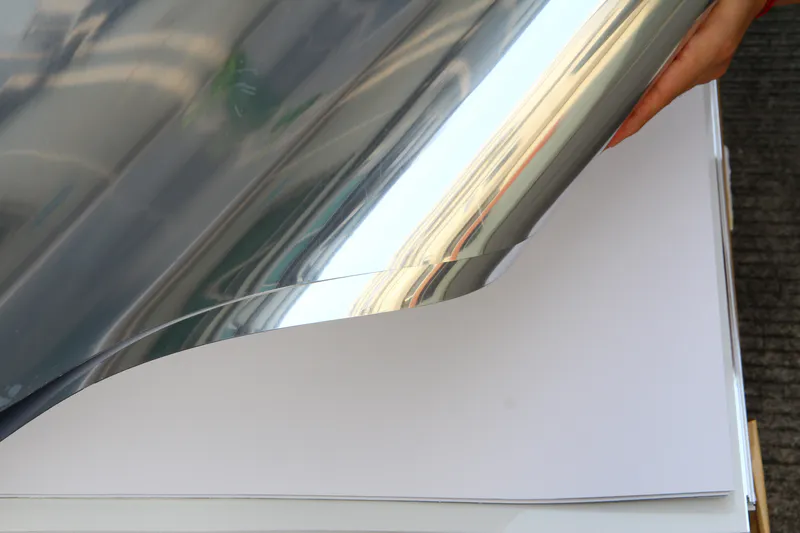
Thin-gauge PETG sheets can bend more easily than ordinary PMMA, but this does not mean that all PETG mirror sheets can be rolled up like film. As thickness increases, they will also exhibit obvious sheet rigidity. However, PETG material is usually not commonly made into very thick sheets; if rigidity is desired, other materials such as acrylic may be considered instead. The following product image shows a mirror sheet made of PETG material.
What are the differences between PMMA, PET mirror film, and PETG mirror sheets?
| Comparison Item | PMMA Acrylic Mirror Sticker | PET Mirror Film | PETG Mirror Sheet |
|---|---|---|---|
| Common supply form | Semi-rigid flat sheets, optionally with adhesive backing | Flexible roll material, usually can be adhesive-coated | Sheet material, generally with higher flexibility and formability than standard PMMA |
| Can it be rolled? | Not suitable for tight rolling | Can be rolled | Depends on thickness; generally should not be directly regarded as PET roll film |
| Bending method | Thin specifications can achieve limited elastic bending | Can bend and curl with the substrate | Can be cold bent or thermoformed, depending on grade and thickness |
| Flat reflection effect | When installed flat, usually easier to achieve a stable mirror appearance | Easily affected by substrate texture, tension, and wrinkling | Between PMMA sheets and PET film; still requires stable support |
| Dimensional stability | Relatively good, but large thin sheets may still warp or develop waves | More sensitive to installation tension and temperature changes | Generally good; post-forming results depend on process control |
| Common processing | CNC, laser or saw cutting, engraving, drilling, contour processing, adhesive backing | Die-cutting, laminating, printing, bonding | Cutting, die-cutting, cold bending, thermoforming |
| Suitable surfaces | Flat, rigid substrates with continuous support | Flat or slightly curved surfaces; substrate texture directly affects appearance | Flat surfaces, single-direction curved surfaces, or designed formed parts |
| Typical applications | Displays, signage, decorative inserts, cabinet doors, wall panels | Packaging, labels, decorative stickers, handicrafts, lightweight surface lamination | Formed display parts, shatter-resistant mirrors, curved decorative components |
| Main limitations | Cannot be folded; excessive bending may cause cracking; large thin sheets are prone to deformation | Mirror image is more prone to distortion, wrinkling, or showing substrate defects | Material and forming parameters must match; reflective layer may limit processing methods |
There is no absolute answer as to which of these three materials is “better.” PMMA focuses more on maintaining flatness and contour stability; PET focuses more on rollability and surface lamination; PETG balances sheet strength and forming capability. When selecting materials, the function should be determined first, rather than simply pursuing “the softer the better.”
A Material Being Flexible Does Not Mean Mirror Surfaces Are Suitable for Any Curved Surface
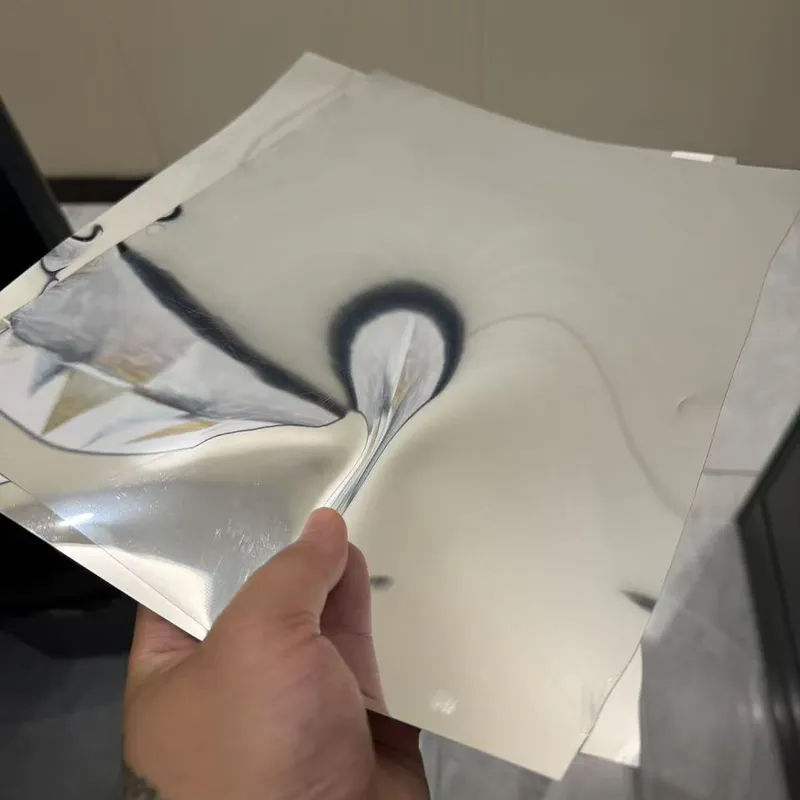
The special characteristic of flexible mirror materials is that even very small surface irregularities will be magnified through reflection. A regular decorative panel may have slight waviness that is barely noticeable to the naked eye; however, if the same waviness appears on a mirror surface, it can cause straight lines to appear bent, distort human proportions, or create a funhouse-mirror-like effect. For mild single-direction curves, thin PMMA or PETG mirror sheets can sometimes be used with sufficient support, but four points must be verified at the same time:
- Whether the material remains within the allowable stress range after bending;
- Whether the adhesive backing can resist the mirror sheet’s spring-back force;
- Whether the edges will lift or gradually lose adhesion;
- Whether the reflection distortion falls within the acceptable range for the project.
If the surface is a double-curved surface, spherical surface, or continuously complex curved surface, forcibly fitting it using adhesive backing alone is usually not a reliable method. For such projects, preformed mirror sheets, specially designed curved mirrors, or accepting PET mirror as primarily decorative reflective material rather than for accurate imaging should be considered. Formed curved mirrors provide a better optical reflection effect; directly using mirror stickers to achieve curved reflections generally does not produce ideal results.
When Choosing Acrylic Mirror Stickers, First Determine Which Type You Need
After the previous introduction, you should now have an understanding of what so-called Acrylic Mirror Stickers are. Therefore, I will give a brief summary below: the three are different materials, and the mirror sticker you need may not actually be made of acrylic material.
Need a Flat Appearance and Relatively Stable Reflection
Give priority to PMMA self-adhesive mirrors. They are suitable for flat displays, signage, furniture inserts, geometric wall decorations, and other components that require clear contours. The larger the size, the higher the requirements for thickness, backing board flatness, and complete support. In the category of mirror stickers, it does not offer flexibility.
Need Roll Supply or Application on Slightly Curved Surfaces
Give priority to PET mirror. It is suitable for die-cut labels, packaging, craft decoration, or projects requiring roll-to-roll processing, but its imaging effect should not be directly equated with that of flat mirror sheets. Keep in mind that the more flexible the material, the harder it is to achieve perfect image clarity, and in many cases reflection quality is not the primary consideration.
Need Sheet Strength While Also Requiring Bending or Forming
Overall, only PETG mirror material meets these requirements. When purchasing, you should provide the target curvature, finished product dimensions, forming method, and usage environment, and confirm through samples whether the reflective layer remains intact after processing and whether the formed mirror image meets the requirements. The characteristics of this material are more consistent with the “Acrylic Mirror Sticker” products sold on platforms.
Choosing Thin Sheets Only Because “Thinner Means Cheaper”
This approach often creates new problems. Thinner mirror sheets are easier to bend, but they are also more likely to sag, reveal substrate defects, and produce wavy reflections. For large wall installations or components requiring relatively stable imaging, thickness, support structure, and installation method should all be considered together, rather than only comparing the price of individual sheets.
FAQ
Can acrylic mirror stickers be folded?
Conventional PMMA self-adhesive mirror sheets should not be folded. Thin sheets can bend slightly, but forming sharp angles or creases will sharply increase localized stress and may cause cracks or breakage.
If a product can be rolled up, does that mean it is fake?
Product quality cannot be judged based on this alone, but it can indicate that it is most likely not a conventional PMMA mirror sheet. It may be PET mirror, very thin PETG sheet, or another flexible reflective material. Before purchasing, you should ask the supplier to clearly specify the substrate material, thickness, delivery form, and reflective layer structure.
Are thinner mirror sheets always better for wall mounting?
Not necessarily. Thin sheets are easier to bend and install, but they are also more likely to replicate unevenness in the wall surface. For large-area applications requiring a more stable mirror image, a flat rigid backing board and appropriate thickness are usually more important than simply reducing thickness.
Can PMMA mirror sheets be directly applied to curved walls?
Thin PMMA specifications may work on slight, continuous, and single-direction curves, but no guarantee can be made based solely on the material name. Actual-size samples should be tested for bending stress, rebound, edge adhesion, and reflection distortion. Smaller radii or complex curved surfaces should use more suitable materials or pre-formed structures instead.
What information should be provided when requesting a quotation?
At minimum, you should specify the substrate requirements, thickness, length and width dimensions, custom shapes, application surface, flat or curved surface, indoor or outdoor use, required adhesive method, and the priority between mirror clarity and bending capability. This allows the supplier to determine whether PMMA, PET mirror film, or PETG mirror sheets should be used.
One Response