
In hotel shower rooms, gym locker rooms, apartment bathroom mirror cabinets, and commercial sanitaryware projects, the selection of an anti-fog mirror directly affects the end-user experience and long-term maintenance costs.
Compared with traditional glass mirrors, plastic mirror panels offer clear advantages in terms of lightweight construction, impact resistance, and the ability to be processed into irregular shapes. However, many purchasers and designers often have questions during evaluation: the plastic substrate itself does not possess anti-fog properties, so how exactly does a plastic anti-fog mirror work?
How does it maintain a clear image in high-humidity, steam-filled environments, and what objective limitations does its effectiveness have? This article will discuss this process point by point.
We will begin with the physical mechanism of condensation, systematically break down the fundamental differences between hydrophilic anti-fog coatings and hydrophobic films, examine the synergistic relationship between the substrate and the coating, identify the key variables that affect clarity in actual shower environments, and, drawing on project experience, summarize common misconceptions and acceptance criteria.
The Core Mechanism Behind How Plastic Anti-Fog Mirrors Work
To understand how plastic anti-fog mirrors work, we first need to clarify the physical nature of “fogging” on a mirror.
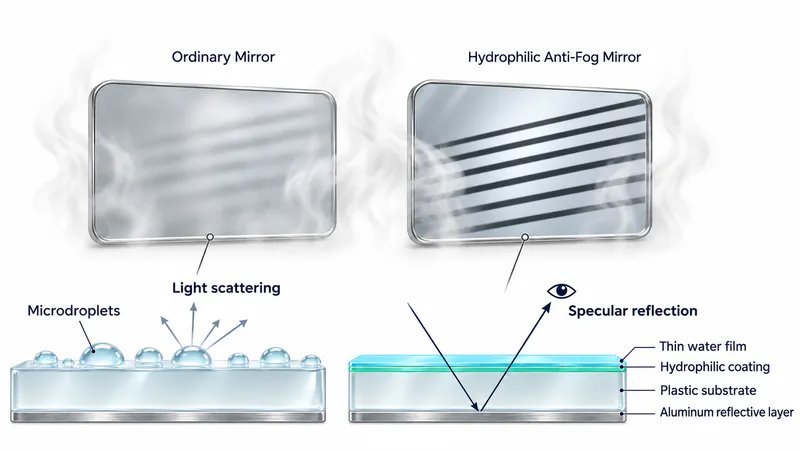
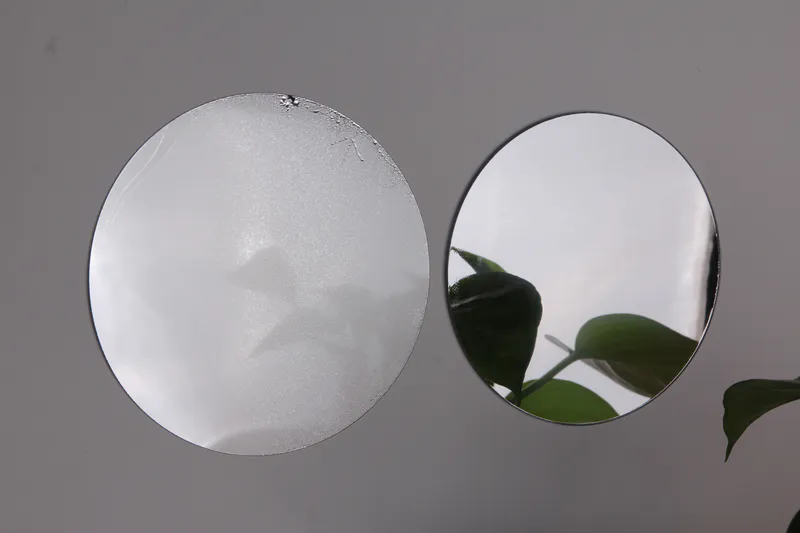
Fogging is not caused by water vapor directly blocking the light, but by light scattering. When high-temperature, saturated water vapor inside a shower room comes into contact with a mirror surface at a lower temperature, the water vapor condenses on the surface.
On untreated ordinary acrylic (PMMA) or polycarbonate (PC) mirror surfaces, because the plastic surface energy is relatively low, the condensed water gathers due to its own surface tension into countless hemispherical microdroplets with extremely small diameters.
These densely distributed microdroplets act like thousands of tiny convex lenses, scattering incoming and reflected light irregularly in all directions. What the human eye sees is a vast expanse of white fog.
How Hydrophilic Coatings Rewrite Surface Wetting Behavior
The core technology behind the mainstream commercial plastic anti-fog mirror panels is not to “block water vapor from making contact,” but to change the form in which water exists through a surface hydrophilic anti-fog coating.
Hydrophilic coatings are rich in polar chemical groups, such as hydroxyl groups, which can form strong hydrogen bonds with polar water molecules and greatly increase the surface energy of the mirror.
When hot steam comes into contact with a mirror surface treated with a hydrophilic coating, the adhesion between the water molecules and the mirror surface is much greater than the cohesion between the water molecules themselves. As a result, the condensed water cannot gather into droplets, but instead rapidly spreads into an extremely thin, uniform, continuous transparent water film.
Because the continuous water film has a flat and smooth surface, light can pass through the water film along an almost perpendicular regular path and be reflected back to the human eye by the underlying aluminum reflective layer. No obvious diffuse reflection occurs, thereby achieving “clear, fog-free imaging.”
This rigorous explanation may leave you somewhat confused, so let me give you a simpler explanation below.
A mirror fogs up because water vapor condenses into countless tiny water droplets, which scatter the light and make the surface appear white and hazy. An anti-fog coating does not keep the water outside. Instead, it quickly flattens these tiny water droplets, joining them into an extremely thin, smooth, transparent water film.
Once the surface becomes flat, light can reflect normally, so the mirror naturally remains clear and does not fog up.
Contact Angle: The Quantitative Core for Measuring Anti-Fog Performance
Our factory’s technical team typically uses the Water Contact Angle to quantify the anti-fogging ability of hydrophilic coatings.
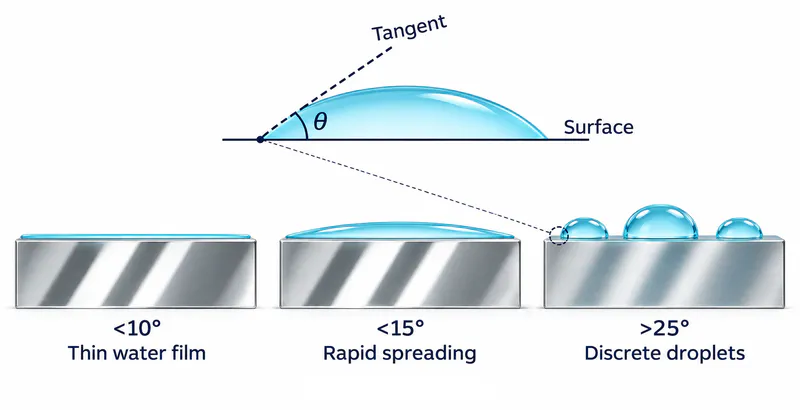
The contact angle refers to the angle between the tangent line at the edge of a water droplet and the solid surface: the smaller the angle, the more hydrophilic the surface and the more fully the water film spreads.
According to Biolin Scientific’s interpretation of research on the role of contact angle in superhydrophilic anti-fog surfaces, there is a direct correlation between surface contact angle and anti-fog performance:
- Below 10° (superhydrophilic range): Water droplets almost instantly spread out completely, forming a highly transparent and uniform water film, resulting in the best anti-fog performance.
- Below 15° (high-efficiency anti-fog range): The surface demonstrates excellent anti-fog performance. A low contact angle helps the water film spread rapidly and subsequently evaporate, effectively suppressing the formation of fog.
- Above 25° (critical point for declining anti-fog performance): The surface gradually loses its stable anti-fog capability, and water vapor once again tends to form discrete droplets, causing optical blurring.
Perhaps this explanation still does not give you a clear understanding, so I will put it into an even simpler explanation.
It is like an invisible “water-droplet iron.” It does not keep the water outside; instead, it specifically “irons flat” the round, bulky water droplets that can easily obstruct your vision, allowing them to spread into a layer of invisible transparent water film.
The flatter the water droplets are “ironed” (the smaller the contact angle), the clearer the mirror will be, and the better the anti-fog performance will be.
Once you understand the underlying logic of how hydrophilic coatings “turn droplets into a film,” you can also understand where hydrophilic coatings are useful.
It is worth noting that there is more than one solution for mirror anti-fog coatings. There is also a solution that is completely opposite to hydrophilic coatings, known as hydrophobic coatings.
So, if hydrophobic films can also achieve an anti-fog effect on mirrors, why are they rarely the preferred solution for plastic anti-fog mirrors?
Hydrophilic Coatings vs. Hydrophobic Films in Plastic Anti-Fog Mirrors Work
In the field of surface treatment, hydrophilic and hydrophobic properties represent two distinctly opposite anti-fogging strategies. As explained in the optical coating supplier PhotonExport’s technical analysis of the anti-fogging mechanisms of hydrophilic and hydrophobic surfaces:
Surfaces with a static water contact angle of less than 90° exhibit hydrophilicity (attracting and spreading water), while surfaces with an angle greater than 90° exhibit hydrophobicity (repelling water and causing droplets to form spherical shapes, thereby reducing the contact area).
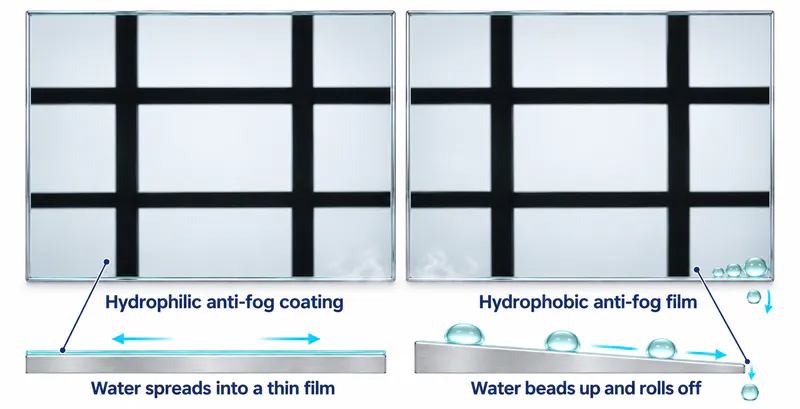
Based on this explanation, we can clearly understand the general operating principle of hydrophobic coatings. Their primary function is to prevent fog droplets from appearing on the mirror surface, much like applying a layer of material to the mirror that does not allow water to adhere to it.
This phenomenon is commonly seen on automotive windshields or outdoor surveillance lenses. Outdoor high-speed airflow or the product’s own inclination can cause rainwater to slide off quickly, preventing it from leaving any water marks on the mirror. This is the key function of a hydrophobic coating: to drive water away.
However, this is ineffective in an enclosed space such as a shower, where there is no strong airflow, high humidity, and primarily micron-scale condensation vapor. In practical applications of plastic anti-fog mirrors, hydrophilic coatings and hydrophobic coatings (films) exhibit significant differences in performance.
Hydrophilic Coatings Compared with Hydrophobic Coatings
| Comparison Dimension | Hydrophilic Anti-Fog Coating | Hydrophobic Film/Hydrophobic Coating |
|---|---|---|
| Water Contact Angle Characteristics | Extremely low (less than 15° for highly effective anti-fogging; often less than 10° for superhydrophilic surfaces) | High (typically > 90°; > 115° for superhydrophobic surfaces) |
| Form of Condensed Water | Spreads into a continuous, transparent, uniform ultra-thin water film | Condenses into separate spherical or hemispherical microdroplets |
| Clarity in a Steamy Shower Environment | High; the water film does not scatter light, so clarity is maintained immediately upon contact with steam | Easily limited; microdroplets are too light to slide off under gravity and still cause scattering and blurring |
| Optical Appearance | Reflections remain sharp and coherent, without a grainy appearance | Beads of water are clearly visible on the surface and can easily cause visual distortion during close-up shaving or skincare |
| Typical Applications | Shower anti-fog mirrors, bathroom mirrored cabinets, refrigerated display doors, protective goggles | Automotive windshield glass, outdoor rain shields, easy-clean anti-stain panels |
| Main Drawback | The surface easily adsorbs grease and soap residue, requiring maintenance with gentle cleaning methods | Cannot truly prevent fogging in a stationary steam environment; suitable only for large-particle splashes |

Why Plastic Anti-Fog Mirrors Generally Use the Hydrophilic Approach
As can be readily seen from the table above, hydrophobic films face an unavoidable physical bottleneck when used for bathroom anti-fogging: condensed microdroplets are simply too light. When water vapor first condenses on a vertically installed hydrophobic mirror surface, the volume of each droplet is extremely small, and gravity is far from sufficient to overcome the surface hysteresis force and make the droplets roll off. Before the droplets can coalesce to the point where they are large enough to slide off, the entire mirror surface will already be covered with dense microdroplets, making it visually almost indistinguishable from an ordinary fogged mirror.
Therefore, hydrophobic films are not without useful applications. Their true domain is outdoor environments where large water droplets impact the surface or strong airflow is present, such as automotive windshields and rearview mirrors, outdoor surveillance lenses, building glass curtain walls, and photovoltaic panels.
In these environments, what lands on the surface is rainwater or splashed water with large volume and substantial mass, rather than the lightweight condensed microdroplets found in bathrooms. The gravity of the large droplets, combined with natural wind or airflow, is sufficient to easily overcome the surface hysteresis force, allowing the round water beads to slide off instantly or be blown away directly. This not only helps maintain a clear field of view quickly but also carries away surface dust, providing a self-cleaning advantage similar to the “lotus leaf water-repellent effect.”
By comparison, a hydrophilic coating begins to work within the first second that steam contacts the mirror surface. It requires no preheating, no electricity, and no waiting for water droplets to accumulate and slide off.
However, a coating is only a very thin film and does not exist in isolation. It must be firmly attached to the surface of the plastic sheet. How different plastic substrates bond with the hydrophilic coating directly determines the flatness and service life of the anti-fog mirror.
Substrate Selection and How Plastic Anti-Fog Mirrors Perform Over Time
Plastic anti-fog mirrors are a typical “multilayer composite structure”: from the mirror surface to the back of the mirror, the layers are usually arranged as follows: hydrophilic anti-fog functional layer (some products also provide hardening and scratch resistance) → transparent plastic substrate → vacuum-deposited aluminum reflective layer → protective paint or sealed backing panel.
The substrate does more than provide structural support. Its surface polarity, heat resistance, and rigidity also directly affect the bonding strength and long-term stability of the anti-fog coating.
In commercial bathroom projects, the substrates most commonly used for anti-fog mirror processing are PMMA (acrylic) and PC (polycarbonate). For a more comprehensive comparison of different plastic mirror materials, please refer to the Plastic Mirror Substrate Selection Guide.
Comparison of PMMA and PC Substrates in Anti-Fog Mirrors
| Comparison Criterion | PMMA (Acrylic) Anti-Fog Mirror | PC (Polycarbonate) Anti-Fog Mirror |
|---|---|---|
| Optical Transmittance and Clarity | Extremely high (transparent substrate transmittance of approximately 92%), with imaging close to glass | Relatively high (transparent substrate transmittance of approximately 86%), slightly inferior to PMMA |
| Heat Resistance and High-Temperature Steam Tolerance | Continuous-use temperature of approximately 70–80°C, sufficient for standard shower environments | Better heat resistance (continuous-use temperature can reach ~100°C), more conducive to slowing thermal aging of the coating |
| Impact Strength | Approximately 5 times that of glass of the same thickness, providing everyday shatter resistance | Approximately 20 times that of glass of the same thickness, and nearly impossible to break |
| Processing and Customization Flexibility | Excellent performance in laser cutting, beveling, and drilling; more cost-effective | Processing requires strict control of internal stress to prevent deformation or stress cracking; processing costs are higher |
| Basic Surface Hardness | Moderate, lower than glass; additional scratch-resistant hardening or functional coatings are recommended | The base surface is relatively soft and easily scratched, relying heavily on anti-fog/hardening surface protection |
| Typical Commercial Applications | Hotel shower mirrors, residential anti-fog mirrors, and customized bathroom mirror cabinets | Public locker rooms, security/high-impact-risk bathroom spaces, and high-temperature steam cabins |

Interfacial Adhesion Determines Whether the Coating Can Withstand Thermal Cycling
Many low-cost plastic anti-fog mirrors perform acceptably in factory testing, but after several months of use, they begin to show coating wrinkling, localized peeling, or mottled anti-fog areas. The core technical challenge behind this is the interfacial adhesion between the coating and the plastic substrate.
A peer-reviewed study published by the U.S. National Center for Biotechnology Information (PMC), Study of Hydrophilic/Hydrophobic Polymer Heterogeneous Network Anti-Fog Coatings, points out that, on transparent optical substrates such as PMMA and glass, strong interfacial adhesion and a reasonable polymer network structure are key to preventing interfacial failure and swelling-induced wrinkles in anti-fog coatings under repeated fogging conditions.
Because hydrophilic coatings undergo microscopic swelling after absorbing moisture, if the primer process or crosslinking and curing is insufficient, the coating may gradually peel away from and deteriorate on the substrate surface after prolonged exposure to cycles of “moisture absorption and expansion during hot-water showers followed by drying and shrinkage.”
In terms of heat resistance, polycarbonate (PC) mirror panels, due to their higher heat-deflection temperature, offer certain advantages in slowing anti-fog coating aging in high-frequency, high-temperature steam environments; PMMA mirrors, meanwhile, offer advantages in terms of overall processing convenience and cost.
Even when the hydrophilic coating and substrate are properly selected, the clarity of plastic anti-fog mirrors in real shower rooms is still constrained by numerous external environmental conditions and usage habits.
Next, we will focus on the five key factors that most commonly cause clarity to decline during on-site use.
Key Factors Affecting Clarity When Plastic Anti-Fog Mirrors Are Used in Showers
Laboratory steam tests often use standardized variables, such as pure water vapor and clean test samples. Real bathroom environments, however, are far more complex. In actual installation projects, customer feedback that an “anti-fog mirror has become blurry” or that the “image has become distorted” is often not caused by the coating itself completely failing. It may instead result from the combined effects of the following five factors:
1. Surface contamination from soap scum, conditioner, and skin oils
The anti-fog mechanism of a hydrophilic coating depends heavily on the surface’s high surface energy and low contact angle. During a shower, droplets of shower gel, shampoo residue, calcium and magnesium scale from hard water, and skin oils left by finger contact can all form a hydrophobic organic contamination film on the coating surface. This contamination film directly blocks contact between water molecules and the hydrophilic groups, causing the surface contact angle to rapidly rise above 25°. As a result, the originally uniform water film breaks up again into tiny fog-like droplets.
2. Irreversible damage caused by incorrect chemical cleaners
This is the primary reason plastic anti-fog mirrors are prematurely discarded in commercial hotel and apartment projects. Many cleaning staff are accustomed to wiping mirror surfaces with conventional glass cleaners containing ammonia, strong acids, strong alkalis, or high concentrations of alcohol. As noted in the Acrylic Mirror vs. Glass Mirror Comparison Guide, ammonia-based cleaners can cause permanent crazing on acrylic surfaces, meaning dense fine microcracks. At the same time, strong solvents can directly dissolve or damage the chemical structure of the hydrophilic coating. Once the coating has been chemically attacked, the anti-fog function will be permanently lost.
3. Micro-scratches caused by mechanical wear and rough wiping
Plastic substrates naturally have a lower Mohs hardness than inorganic glass. Even functional anti-fog coatings with a certain degree of hardness have difficulty withstanding repeated, forceful wiping with scouring pads, rough paper towels, or dry cloths carrying hard-water crystal particles. Micro-scratches not only directly reduce the smoothness and reflective sharpness of the mirror surface, but also damage the continuity of the hydrophilic layer, causing the areas around the scratches to become “starting points” for fogging and condensation.
4. Drainage saturation in environments with extreme temperature differences and continuously high humidity
Although hydrophilic anti-fog coatings can spread water vapor into a transparent water film, when the shower water temperature is extremely high, ventilation is poor, and the shower lasts for an extended period, the amount of condensation accumulating on the mirror surface will continue to increase. When the water-film thickness exceeds a critical value, gravity causes downward-flowing water streaks to form. Although the mirror surface remains “fog-free,” the rapidly descending sheet of water can create localized fluctuations in refraction within a short period, affecting visual stability during precise shaving or makeup application.
5. Optical distortion caused by insufficient substrate thickness and an uneven installation backing surface
Clarity means not only being “fog-free,” but also producing an “undistorted image.” Plastic sheets are less rigid than glass. If a sheet that is too thin is selected for a large bathroom mirror, or if the installation wall is uneven and the adhesive is applied inconsistently, such as spot-applied adhesive creating localized stress and pulling, the mirror surface can easily develop slight warping as temperature and humidity change, creating wavy distortion similar to a “funhouse mirror.” For more information on sheet thickness and backing-support principles for different bathroom scenarios, refer to the Selection Guide for Plastic Anti-Fog Mirror Sheets for Bathrooms.
By understanding these limiting factors, we can evaluate exaggerated claims in market promotions more objectively and clarify which views represent the correct understanding of plastic anti-fog mirrors and which are misconceptions likely to lead to poor product-selection decisions.
Common Misconceptions About How Plastic Anti-Fog Mirrors Work
During procurement discussions, buyers often encounter two extreme viewpoints: one side promotes plastic anti-fog mirrors as an all-purpose solution that is “permanently maintenance-free and a complete replacement for glass”; the other believes that “plastic mirrors will inevitably deform and fog up, making them entirely impractical.” Both views deviate from the facts. We need to clearly distinguish correct views from incorrect views.
- Incorrect View 1: Acrylic or PC plastic mirrors are inherently anti-fog, so buying a plastic mirror is equivalent to buying an anti-fog mirror.
- Correct View: The plastic substrate itself does not have anti-fog properties. Uncoated plastic mirrors will also fog up quickly in a shower room. The anti-fog performance of plastic anti-fog mirrors comes entirely from the hydrophilic anti-fog coating or functional film applied to the surface. When purchasing, buyers must explicitly require specifications with certification for the anti-fog process.
- Incorrect View 2: A hydrophilic anti-fog coating is a one-time, permanent solution that remains effective forever.
- Correct View: The effective service life of a coating depends on the formulation system, curing process, frequency of temperature and humidity cycles, and daily cleaning practices. With proper maintenance, a high-quality cured hydrophilic coating can maintain stable anti-fog performance for a relatively long period. However, it is a functional surface layer, not something that is absolutely “permanently non-degrading.” Strong chemical agents or scratching with hard objects can greatly shorten its service life.
- Incorrect View 3: Plastic anti-fog mirrors can perfectly replace large glass primary mirrors in all bathroom settings.
- Correct View: The most prominent advantages of plastic anti-fog mirrors are in small- and medium-sized shower mirrors, shaving mirrors, children’s/accessibility-safe bathroom mirrors, mirror cabinet inserts, and custom-shaped mirrors. For large wall-to-wall mirrors in a private master bathroom that are more than 1.2 meters wide and require extremely high absolute flatness over long distances, plastic mirrors are more likely to reveal uneven surface reflections unless they are combined with a high-rigidity backing panel and installed under strict controls.
- Incorrect View 4: If an anti-fog mirror becomes foggy, it means the coating has failed and the mirror can only be discarded and replaced.
- Correct View: In many cases, “fogging” is only a temporary “failure” caused by soap residue, body wash, or limescale covering the hydrophilic layer. Gently rinsing the surface with warm water and a very small amount of neutral dishwashing detergent, then absorbing the water with a microfiber cloth, can restore the surface’s ability to form a continuous water film. If this happens, it indicates that the coating itself is still intact.