
Concave mirrors come up in conversations with customers more often than the actual sales numbers would suggest. They’re a fascinating product — capable of magnification, capable of focusing light, capable of producing optical effects that flat mirrors simply can’t replicate — and they show up in pop-science explanations of how telescopes work, how solar cookers focus heat, how science museums create “ghost” effects. A reasonable percentage of the inquiries we get about acrylic concave mirrors come from buyers who’ve seen these applications and want to build their own version.
The conversation usually has to start with a correction. Acrylic concave mirrors and the precision concave mirrors used in real telescopes, real solar concentrators, and real laboratory optics are different products serving different purposes. The acrylic version handles a narrower set of applications, and the most important thing we can do for some buyers is tell them honestly that what they’re trying to do isn’t going to work with this material.
For this reason. We’ll cover what concave mirrors do at the level of physics, where acrylic concave mirrors genuinely work well, and the categories where the material falls short. By the end, you should know whether the acrylic version fits your project or whether you’re better served by a different product entirely.
What a Concave Mirror Actually Does
The Physics, in Plain Terms
A concave mirror is the optical opposite of a convex mirror. The reflecting surface curves inward — toward the viewer — rather than bulging outward. When parallel light rays strike the surface, they converge toward a single point in front of the mirror called the focal point. The focal length (f) and the radius of curvature (R) are related by the same formula that applies to convex mirrors, but with a different sign convention: f = R/2, with the focal point being a real point in space rather than a virtual one behind the mirror.
This convergent behavior is what makes concave mirrors useful. They can:
- Magnify an image when the object is closer than the focal length
- Focus parallel light (like sunlight) to a point
- Produce real, projected images when the object is beyond the focal length
- Create distinctive optical effects that flat mirrors can’t replicate
Standard physics references cover the math comprehensively — LibreTexts’ optics chapter is a thorough reference if you need the full treatment. For our purposes here, what matters is that the precision of the curve directly determines how cleanly the mirror can perform its optical job. A perfect curve gives a sharp focal point and a clear image; an imperfect curve gives a smeared focal point and a distorted image.
This precision question is where the acrylic-versus-glass conversation becomes important.
Why the Curve Quality Matters So Much
For a concave mirror in a real optical application — focusing light, projecting an image, magnifying an object — the surface accuracy required is far beyond what’s needed for ordinary mirror applications. Precision optical manufacturers like Avantier specify surface figure accuracy of λ/4 PV at 633 nm for baseline imaging quality, with λ/10 required for diffraction-limited systems.
In plain terms: the surface needs to be accurate to within a quarter wavelength of visible light. That’s roughly 158 nanometers — about 1/300th the thickness of a sheet of paper. Achieving this level of accuracy requires precision-ground glass, vacuum-deposited reflective coatings, and careful quality control throughout manufacturing.
Acrylic concave mirrors aren’t manufactured to anything close to this specification, and they can’t be without abandoning the cost and weight advantages that make acrylic worth choosing in the first place. The thermoforming process used to produce most acrylic concave mirrors creates a curve that’s optically smooth enough for many applications but is nowhere near the precision required for serious imaging or focused-light work. Tower Optical’s overview of optical components puts it directly: plastics like acrylic and polycarbonate “usually have lower optical quality and temperature stability than glass or crystals.”
This isn’t a manufacturing flaw. It’s an inherent limitation of the material and the production method. Acrylic concave mirrors are sold for the applications where the limitation doesn’t matter — which is a meaningful range of uses, but a different one than the precision-optics market.
Where Acrylic Concave Mirrors Don’t Work Well
Honest section first, because steering the wrong customer to the wrong product wastes everyone’s time.
Telescopes and Precision Imaging
A serious telescope needs a primary mirror with surface figure accuracy in the λ/4 to λ/10 range, applied to a polished glass substrate, with vacuum-deposited reflective coating optimized for the wavelength range of interest. Even an inexpensive consumer telescope uses precision-figured glass. Acrylic concave mirrors don’t approach this specification and can’t be used for astronomical or technical imaging applications.
If you’re researching this for a school astronomy project, the right product is a glass parabolic mirror from a telescope-mirror supplier — not an acrylic concave mirror at any size. The price difference is meaningful, but the optical difference is the actual point.
Solar Concentration and Concentrated Solar Power
This is where the most ambitious customer projects come from, and unfortunately also where acrylic is most likely to disappoint.
Real solar concentration works by focusing direct sunlight to a small area where the energy is converted to heat. According to ScienceDirect’s overview of concentrator mirrors, well-designed solar concentrators can produce temperatures of 1000°C or higher at the focal point. This works with precision-figured glass mirrors or with specialized aluminized acrylic films bonded to engineered rigid substrates.
A standard thermoformed acrylic concave mirror has two problems for this application:
The curve isn’t precise enough to produce a tight focal point. The energy spreads across an area larger than ideal, dramatically reducing the achievable temperature. You might get a noticeable warm spot; you won’t get the temperatures needed for serious applications like solar cooking, water heating, or any kind of melting or smelting work.
The acrylic itself can’t tolerate the temperatures it would need to handle if it did work. PMMA acrylic softens at approximately 80–100°C and degrades at higher temperatures. Even the partial heat that does concentrate at the focal point can damage the mirror itself if reflected energy returns to the surface, and the substrate begins to deform or yellow with sustained UV exposure at high reflective intensity.
Aluminized acrylic film does have legitimate roles in some solar concentrator designs — products like 3M’s silvered acrylic Solar Mirror Film have been studied for industrial concentrator applications. But these films are flat or precision-formed materials bonded to engineered concentrator structures. They’re not the same product as a thermoformed acrylic concave mirror, and they’re not what most buyers researching “acrylic concave mirror” are looking for.
For a project that genuinely needs solar concentration, the practical options are precision-figured glass parabolic mirrors (expensive, heavy), Fresnel lenses repurposed from large rear-projection televisions (a common DIY hack), or industrial-grade solar reflector film systems. Acrylic concave mirrors aren’t a workable substitute for any of these.
Laser Optics and Industrial Light Focusing
Industrial laser systems use concave mirrors to focus high-power beams for cutting, welding, or medical procedures. As Alibaba’s concave mirror reference notes, these mirrors typically use dielectric coatings designed to withstand specific laser wavelengths and intensities, with surface accuracy of λ/4 or better.
This is precision-optics territory. Acrylic concave mirrors are not used for laser focusing applications, and using one in this role would damage the mirror, the laser system, and probably the operator.
Where Acrylic Concave Mirrors Genuinely Work
Now the productive side of the conversation. There are several application categories where acrylic concave mirrors are a legitimate and sometimes preferable choice.
Display and Retail Effects
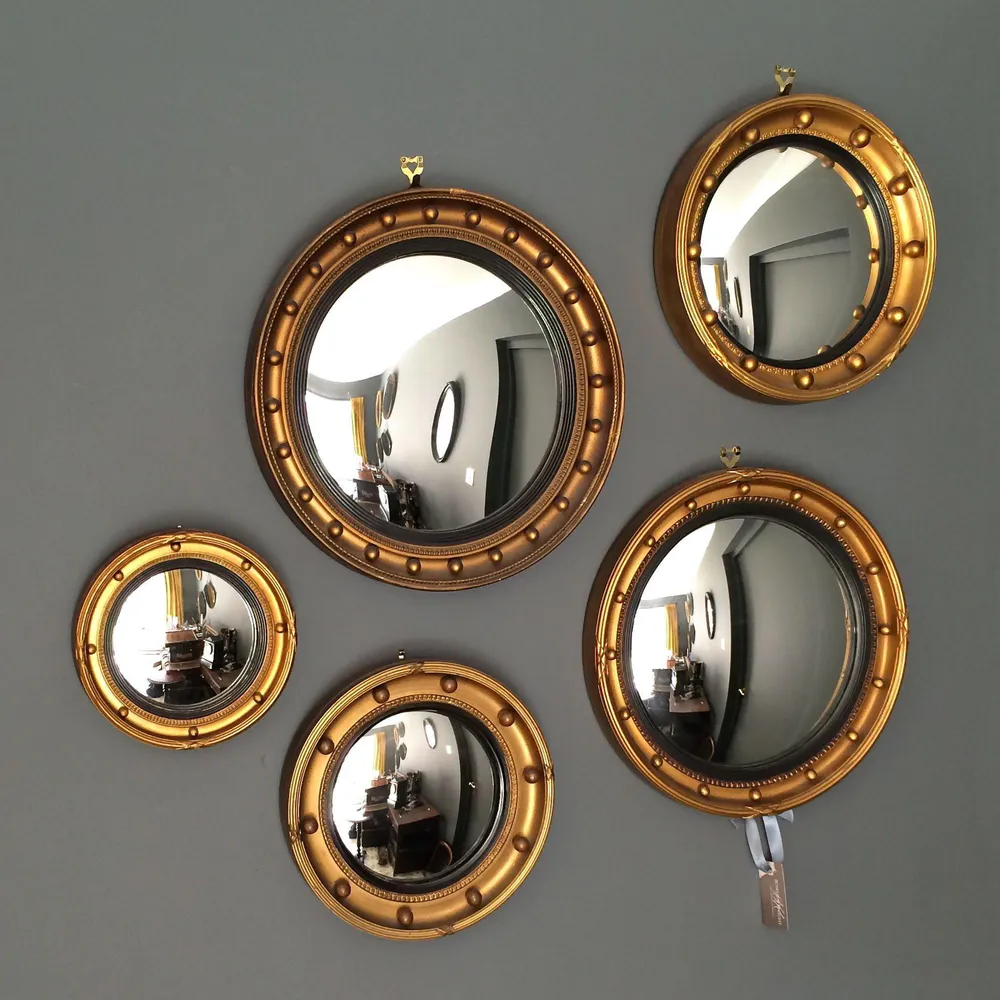
Concave mirrors are used in retail and display environments for visual interest and to create specific optical effects. Variations include the magnified reflections at perfume counters and cosmetic displays, the distinctive depth in entryway installations, and the subtle visual interest in luxury retail environments. The same kind of decorative application as residential use, but specified for commercial environments.
These installations sometimes use multiple concave mirrors at varying sizes to create progressive optical effects across a wall or display. The lightweight, customizable nature of acrylic makes it well-suited for these applications, particularly when the installation may be reconfigured periodically.
Novelty, Carnival, and Entertainment Applications
The classic “funhouse mirror” effect — the distorted, magnified, exaggerated reflection — is produced by mirrors with deliberately imperfect curves. For these applications, the imperfections of acrylic concave mirrors aren’t a flaw; they’re the point. Carnival mirrors, magic and illusion props, photography studios specializing in stylized portraits, and various entertainment installations all use concave mirrors as part of the intended effect.
These applications often want larger sizes than the standard specification, which is where acrylic’s weight and shatter-resistance advantages become significant. A glass concave mirror at large sizes is heavy, expensive, and unsafe for public installation; acrylic at the same size is lighter, more affordable, and considerably safer if the installation receives heavy public traffic.

Low-Magnification Cosmetic and Personal Use
For non-critical magnification applications — a small concave mirror in a personal grooming kit, a budget magnifying mirror for occasional use — acrylic at low magnification ratios (typically 2x to 3x) can be acceptable. The optical performance won’t match a precision glass mirror, but for casual use the difference may not matter to the buyer.
Quality glass cosmetic mirrors are widely available at reasonable prices, however, and most buyers seriously concerned about magnification quality should choose glass. Acrylic shows up in this space mostly for safety-driven applications — children’s mirrors, RV and boat applications where breakage concerns dominate, and similar settings.

How These Mirrors Are Produced
Briefly, because the production method affects what the product can do.
Most acrylic concave mirrors are produced by thermoforming — heating a flat acrylic sheet until it becomes pliable, then forming it against a mold of the desired curve and allowing it to cool. The reflective coating is applied either before forming (with the substrate handled carefully to avoid coating damage during the forming process) or after forming using vacuum metallization on the formed surface. Both approaches are in use; the choice depends on the manufacturer’s process and the intended application.
The advantages of thermoforming are speed, cost, and the ability to produce a wide range of sizes from common substrate materials. The disadvantage is surface accuracy — the curve produced is consistent enough for decorative and educational use but doesn’t approach the precision of optical-grade ground and polished glass.
For higher-precision applications, some plastic concave mirrors are produced by injection molding against precision-machined molds. According to a U.S. patent describing the process, this approach can produce contoured plastic mirrors with better optical properties than thermoforming, though still below glass standards. Even with these methods, acrylic concave mirrors don’t compete with precision glass for serious optical applications.
Selection Suggestions
Since we sell acrylic concave mirrors as the mirror itself rather than as finished products, the specification process is straightforward but worth covering.
The Two Variables That Matter
Diameter. This determines both the mirror’s physical size and, indirectly, the curvature — manufacturers typically pair specific curvature radii with specific diameters as standard combinations. Larger diameter generally means a larger radius of curvature (less aggressive curve) for a given focal length specification.
Curvature or focal length. For applications where the focal behavior matters (educational demonstrations, light fixture reflectors, some display work), specify the desired focal length or radius of curvature when ordering. For purely decorative applications where the visual effect is what matters, the standard combinations work fine and you don’t need to specify a precise curve.
Standard Sizes
Our acrylic concave mirrors are available across a range of diameters from compact sizes for craft and educational use through large diameters for decorative and commercial applications. Sizes are specified by diameter rather than viewing distance because concave mirrors aren’t typically used in the long-distance viewing applications that drive convex mirror sizing.
For specialty applications — non-standard diameters, specific curvature requirements, or matched-set ordering — custom production is generally available with longer lead times.
Mounting and Installation
Acrylic concave mirrors don’t come with mounting hardware as standard. Common mounting approaches include:
- Mirror adhesive (the type compatible with acrylic — silicone-based mastic, never solvent-based) for direct wall mounting
- Frame mounting for decorative installations where the frame is part of the aesthetic
- Hidden bracket mounting for floating-mirror effects
- Custom housings for light fixture and educational use
Edge protection becomes more important with concave mirrors than with flat mirrors because the curve creates more visible edge geometry. For decorative installations with exposed edges, edge polishing or framing produces a noticeably better finish.
Common Questions We Get
Can I use an acrylic concave mirror to focus sunlight to start a fire? Generally not effectively. The surface accuracy isn’t tight enough to produce a small enough focal point, and the acrylic substrate would heat unevenly at any meaningful concentration. If this is the project, a Fresnel lens (large clear acrylic lens with concentric ridges) is the actual product you want, not a concave mirror.
Can I build a telescope with this? No. Telescope mirrors require precision-ground glass with surface accuracy that thermoformed acrylic doesn’t achieve. Telescope-grade primary mirrors are available from astronomical optics suppliers; that’s where the right product is.
Will it work as a magnifying mirror for makeup or shaving? At low magnification (2x or so) and for occasional use, possibly. For regular daily use or higher magnification, glass is the better specification. The cost difference between an acrylic concave mirror and a glass cosmetic mirror is usually small, and the optical difference is consistent enough to favor glass for this application.
Why are acrylic concave mirrors cheaper than glass? Manufacturing costs are lower (thermoforming is faster and uses less expensive substrates than precision grinding), shipping costs are lower (acrylic is roughly half the weight of glass), and the precision requirements are deliberately lower for the application categories acrylic serves. The price difference accurately reflects the difference in capability — buyers getting glass at a higher price are getting precision they often don’t need; buyers getting acrylic at a lower price are getting decorative and educational suitability without the precision premium.
Do you sell finished concave mirror products? No. We sell acrylic concave mirrors as the mirror itself. Customers handle frame, mounting, and installation according to their specific application. For finished cosmetic mirrors, finished educational kits, or finished display fixtures, you’ll want a supplier that specializes in those finished-product categories.