
Installing acrylic mirrors on ceilings is one of the more common projects, and many renovation contractors or interior design teams have needs in this area.
Among the projects we have worked on, acrylic mirrors used in hotel lobbies, various reception halls, and other commercial spaces account for the highest proportion, while other special personal requirements can be considered negligible.
Therefore, in this article, I will discuss acrylic mirrors used on ceilings based on the experience we have had with such projects.
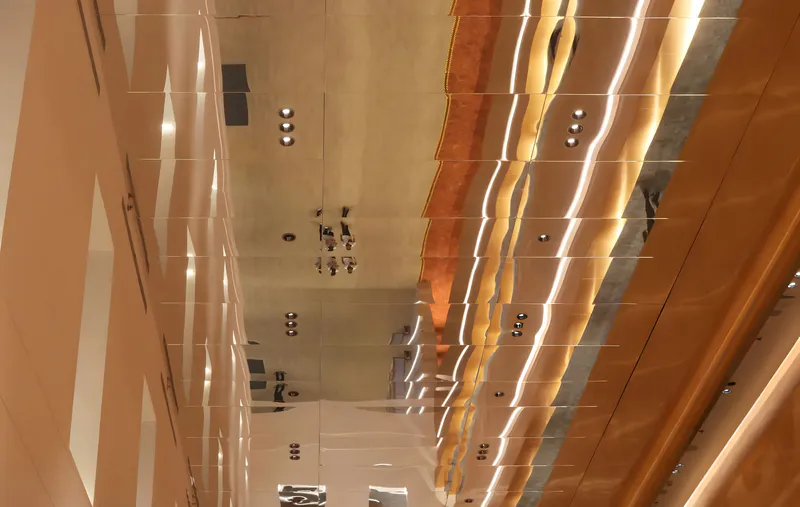
The Ceiling Can Accept Reflection Flatness Requirements That The Wall Surface Cannot Accept
When we provide quotes for acrylic mirrors used on ceilings, the flatness of the reflection is rarely something discussed in the project. Why?
For acrylic mirrors installed on walls, people can see themselves from the front in the mirror reflection. This situation tends to attract more attention, so in terms of requirements, even for decorative mirrors, when people have the need to look at them, whether the reflection is flat should be included as part of the product quality. Any distortion or deformation may change the focus of attention, unless that effect is intentionally desired when installing it. As we mentioned in many previous blog articles, large acrylic mirrors may produce wavy distortion in the reflection due to the flexibility of the material itself. You can read:
However, acrylic mirrors installed on ceilings rarely have this need for “attractiveness” to be a concern. People do not constantly look up at the ceiling, and the occasional glance upward is usually only seen as interesting and does not attract too much attention.
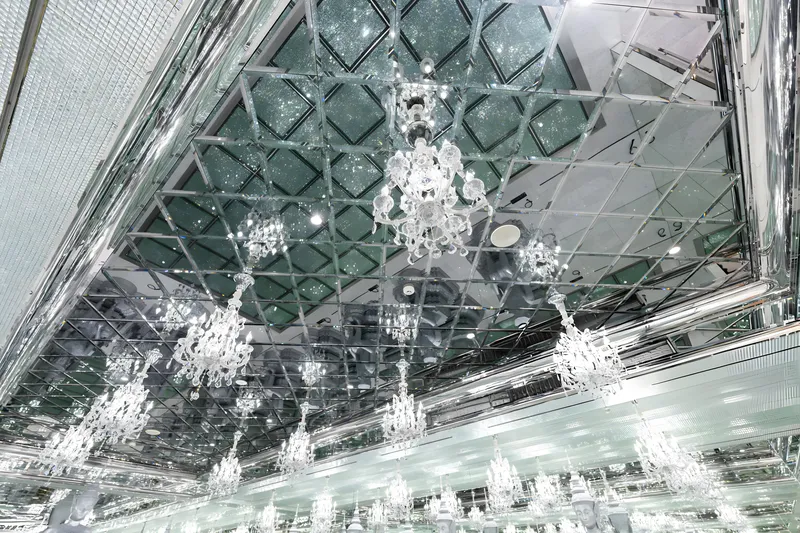
At the same time, in places such as hotel lobbies and various reception halls, a ceiling with a certain visual effect is also regarded as a sophisticated design. Its function is usually to create a reflective upper surface rather than to provide the precise imaging required of dressing mirrors or gym mirrors. Therefore, some deformation that would be unacceptable in wall applications may have almost no impact on the success of a ceiling project.
As shown in the picture, the ceiling uses an acrylic mirror. Looking at its reflective effect, distortion still occurs, but people do not constantly pay attention to this phenomenon.
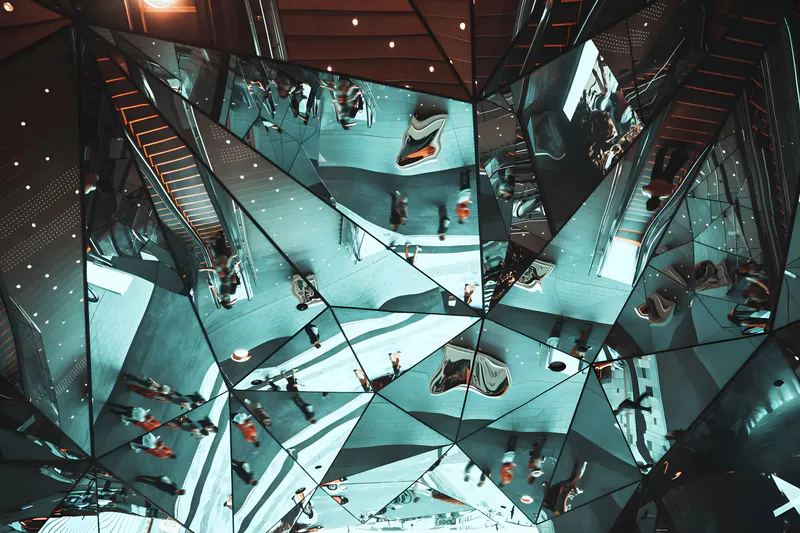
Why Not Choose Glass Mirrors
Glass has higher rigidity and a flatter reflective effect, but its greater weight and the consequences caused by breakage make overhead installation more complicated. Acrylic is lighter, more impact- and shatter-resistant, and easier to fabricate into designs that meet ceiling layout requirements.
This gives us more options when considering larger sheet sizes, but size, thickness, and support methods are still interconnected. Acrylic is less rigid than glass, so wider spans are more likely to experience distortion or deflection. Increasing thickness can improve rigidity, but it also increases cost and weight.
The PLASKOLITE FABBACK Fabrication Guide explains that viewing distance, thickness, and installation method all affect visual distortion and may reduce distortion, but cannot eliminate it completely. This also supports the way we handle ceiling panels: first control their length, width, thickness, and installation method, and then set reasonable expectations for the reflective effect.
Therefore, for us, “whether the reflection is flat” is not the primary concern.
Weight is The Key Factor
We also mentioned in a previous blog that acrylic sheets of the same size and thickness weigh only about half as much as glass. This makes them the primary choice for mirrored ceiling designs.
A reduction in weight does not mean the material itself costs less. Counterintuitively, acrylic actually costs more than glass. However, if you are purchasing acrylic mirrors from another country, when weight and volume are taken into account, the overall cost situation is slightly better.
Labor costs during installation also need to be considered. The lower weight reduces the amount of work required for unloading, handling, positioning, and replacement. It also reduces the dead load borne by the ceiling, eliminating the need to consider additional costs for reinforcement.
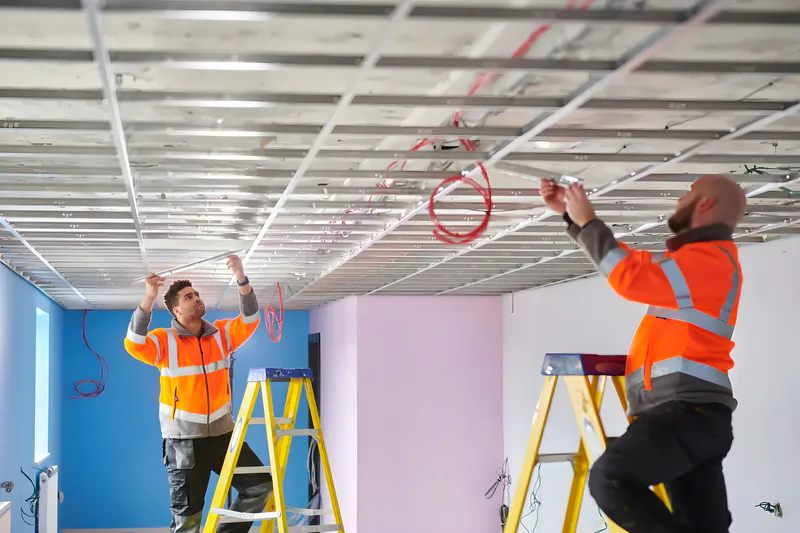
Because of the reduced weight, the number of mirrors that can be added within the same target area can increase accordingly, provided the project actually requires that many mirrors. Most ceilings must take suspended ceiling load-bearing capacity into account, so choosing lightweight materials by default is more project-friendly. Where the existing suspended ceiling framing is applicable, switching from glass to acrylic is also more favorable for maintaining the framing due to the change in weight.
This does not mean acrylic can be directly adhered overhead without additional restraints. Unless the panels are installed within an edge-retaining frame (such as a T-bar suspended ceiling grid system) or mechanically fastened, they are not recommended for ceiling and overhead installations. Compatible adhesives may be specified as auxiliary components, but they should not replace the edge-retaining frame or mechanical fastening required for overhead applications.
The Same Applies to Hanging Decorative Items
The use of acrylic mirrors on ceilings is not limited to flat, full-surface applications; there are also cases where they are paired with hanging decorative items.
For example, the disco mirror balls we commonly see, or other mirror-based decorative pieces with various shapes. These are also considered one type of acrylic mirror application in ceilings.
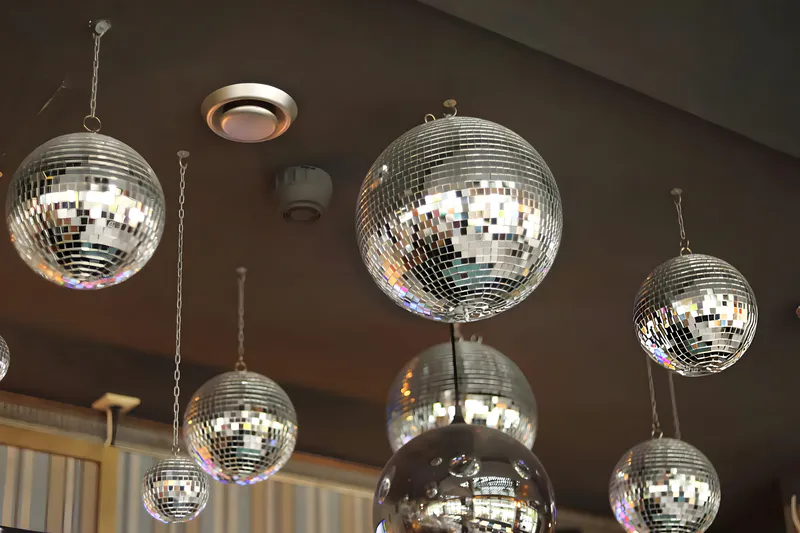
However, here we are mainly discussing situations where acrylic mirrors are used across the entire ceiling, and for now we do not intend to explore these hanging products in depth.
Even so, acrylic’s weight advantage remains convincing. Moreover, products suspended from ceilings often require greater attention to weight issues than decoration covering the entire ceiling area.
Acrylic Mirror Panels Are Easier to Process
Ceilings rarely provide us with a complete blank rectangle. Structural framing members, access panels, lighting, ventilation, sensors, sprinklers, and changes in height can all affect installation. The project team must confirm the required clearance requirements, and acrylic mirror panels give us more possibilities when adapting to existing structures.
Acrylic mirror panels can be cut, milled, drilled, and edge-finished using laser cutting equipment, ensuring a high degree of precision in processing. During production, repeatable hole positions, slots, edge contours, access openings, chamfers, and rounded inner corners can all be prefabricated before removing the protective film. The overall design and the distribution of panel sizes can both be completed during the manufacturing stage.
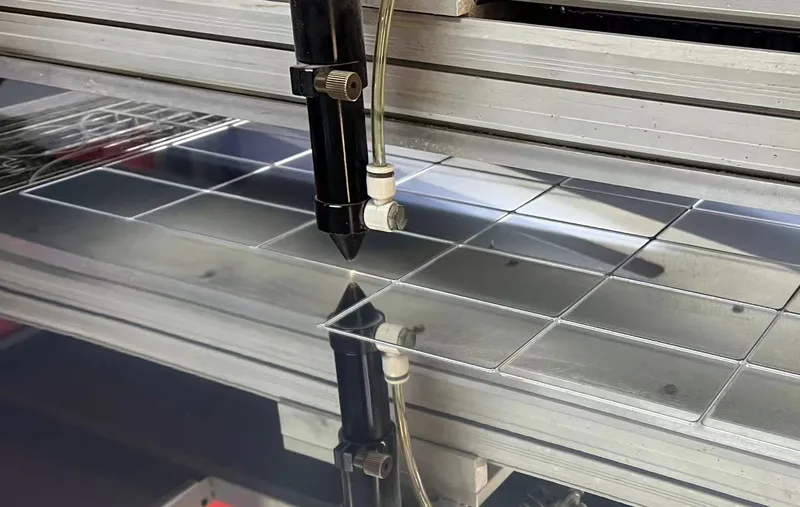
These things can also be achieved with glass, but certain processing operations for glass are relatively time-consuming, and the costs may be higher in comparison. Acrylic’s greatest advantage in this respect is that even after factory processing, you can still make temporary adjustments upon receiving the material, making its secondary adjustability far superior to glass.
Ease of processing does not mean that hole positions can be placed arbitrarily. ACRYLITE’s On-Site Drilling Guide recommends that the edge distance for point-fixation holes should be at least twice the bolt diameter, and the distance from the hole center to the edge should be at least 1.5 times the hole diameter. Enlarging the hole diameter can allow for displacement, while soft washers or sleeves can reduce stress concentration. These spacing requirements are intended to guide fabrication; they do not determine the number, spacing, or load-bearing capacity of the fasteners required for overhead installation.
Sharp inner corners also deserve attention. They concentrate stress and may become the starting point for cracks. Whenever the ceiling layout permits, we tend to add appropriate radii, support the panels during processing, and keep openings away from vulnerable edges. Machine screws should not be over-tightened either: oversized holes are recommended, along with soft washers between metal fasteners and the acrylic surface to reduce deformation.
The real processing advantage is not that acrylic can ignore engineering specifications, but that it offers much greater ease of adjustment.
Large or Small Acrylic Mirror Panels Can All Serve a Purpose
For ceiling installation projects, mirror panels are not often standardized to a single size. Sometimes there is a distribution in usage between large-sized and small-sized panels. Many customers working on these projects usually only need large-sized mirror panels and then take them back for their own processing and fabrication. Small-sized panels are mainly requested during the sample evaluation stage.
Based on our many years of sales experience, small-sized mirror panels are actually very useful as well. Especially when a ceiling project requires a certain level of aesthetic design, the flexibility brought by smaller sizes makes it easier to solve problems.
Many projects first ask us during quotation inquiries how large of a mirror panel we can provide. Although large panels can reduce seams, they also require larger packaging and more careful installation. If a panel is supported from only one corner during lifting, or is heavily twisted in order to align hole positions, the mirror surface, backing coating, and pre-processed openings may all be damaged. If a small-size design is adopted instead, the installation process becomes much easier.
When installing large panels, we hope the protective film can remain in place as long as possible until positioning is completed, that the panel receives continuous support during storage and lifting, and that fastening is carried out gradually after all fixing points are aligned. A small amount of reflective waviness may not affect the overall ceiling effect, but if the panel is forcibly twisted during installation to align hole positions, continuous stress may cause dents, cracking, or permanent deformation.
If the suspended ceiling itself has already been divided into a regular grid by the framework, we usually recommend considering the use of smaller mirror panels assembled grid by grid. Smaller panels have shorter unsupported spans, are easier to lift and replace, and allow for more compact packaging. For projects that need to pass through elevators, corridors, or narrow maintenance access routes, they may also significantly reduce transportation and site-entry difficulty. If a single panel becomes scratched or damaged, only the corresponding module needs to be replaced.
Panel size must also strike a balance between the number of seams and installation locations. When we finalize dimensions, we simultaneously consider the ceiling grid, viewing distance, site-entry route, packaging method, and future maintenance access. It may be one large panel, or it may be a group of numbered small panels for installation; the key is whether the size matches the entire ceiling system.
However, trade-offs still exist. More panels mean more seams and more installation positions. Therefore, module size should be determined by the ceiling grid, viewing distance, transportation path, packaging plan, and required reflection effect, rather than based on general assumptions such as “smaller sizes are always better” or “larger sizes are always better.”
Fire and Yellowing Requirements Belong in the Ceiling Specification
When acrylic mirror panels enter shopping malls, hotels, restaurants, or other large public spaces, a project cannot stop at confirming color, dimensions, and adhesive. Once the panels are positioned overhead, fire safety documentation, usage environment, and responsibility for fixation all need to be clearly defined before production begins.
Standard PMMA is a combustible thermoplastic material, so “acrylic mirror panels” cannot be broadly marketed as fireproof materials. The technical documentation for ACRYLITE Reflections also explicitly requires the material to be kept away from flames and high heat sources, and to comply with applicable building codes. In practice, what projects truly need to review is often not just the bare sheet, but also the mirror coating, backing layer, adhesive, and the final ceiling assembly. We can provide the existing technical data and certificates for the supplied grade, but whether a material can be used in a specific venue should be confirmed by the project team according to local regulations and the complete installation method.
For example, in projects using the IBC system, it is necessary to verify the actual adopted local version of the IBC Chapter 8 interior finish requirements; plastic materials and the complete ceiling assembly may also involve other applicable clauses, product certifications, and approval requirements. Other countries and regions also have their own classification systems. A result obtained by one grade in a particular test does not automatically mean that all thicknesses, colors, backing coatings, or installation combinations have been approved for use.
Resistance to yellowing also needs to be confirmed according to the specific finished product. Acrylic mirror panels also include reflective layers and protective backing coatings, and the applicable warranties are not necessarily the same for colored products, different brands, or projects exposed long-term to skylight sunlight or heat from lighting fixtures. For such projects, we verify the specific mirror grade, installation environment, and supplier documentation, rather than directly applying the warranty for transparent acrylic sheets to every type of mirror finished product.
This is also why we hope to obtain the ceiling type, panel layout, fixing method, project location, lighting and heat-source conditions, and the fire safety documents required for submission before providing a quotation. Once mirrors are moved onto the ceiling, the advantages of acrylic do indeed become more apparent: it is lighter than glass, easier to fabricate according to structural requirements, and also suitable for being divided into modules that are easier to transport and replace. But these advantages only truly translate into cost and construction convenience when incorporated into a complete ceiling solution.
We do not begin by deciding for clients “how large it can be” when it comes to a mirrored ceiling. We prefer to first understand how it will be seen, how it will be supported, how it will enter the site, and what approvals the project ultimately needs to pass. Once these questions have answers, choosing between acrylic and other materials usually becomes much easier.