
Thickness is the specification that buyers most often get wrong on an acrylic mirror order. Color, size, and quantity are usually obvious. Thickness is where mistakes happen — typically by ordering thinner stock than the application actually needs, because the price difference is meaningful and the consequences aren’t visible until the mirror is mounted and disappointing.
This is a focused practical guide to choosing thickness. Each common option, what it actually handles in practice, where it fails, and how to match the spec to the project. We’ll also address the “I want to see it in person before buying” question that comes up regularly in this category, because thickness is genuinely difficult to judge from photos.
If you’ve already read our complete guide to acrylic mirror sheets, the basic thickness ranges will be familiar. This piece goes deeper on the practical implications of each thickness — the kind of detail that matters once you’re actually placing an order.
Why Thickness Matters More Than People Expect
Rigidity and Reflection Quality
Acrylic is a flexible material. Even at full sheet sizes, you can flex a 3mm sheet noticeably with two hands. This flexibility is one reason acrylic is so easy to handle and ship — it doesn’t crack from minor stress the way glass does — but it has a direct consequence for mirror applications: thinner sheets show their mounting surface.
Mount a thin acrylic mirror to a wall that isn’t perfectly flat, and the mirror will conform to the wall’s irregularities. A slight bow in drywall, an uneven adhesive layer, or a frame that pulls one corner becomes visible in the reflection. Thicker stock resists this conformity. The sheet’s own rigidity overrides small surface variations, producing a flatter reflection.
The practical scaling: 1.5mm sheets need a near-perfectly-flat backing or frame to look acceptable. 3mm tolerates moderate surface irregularity. 6mm sheets behave more like a glass mirror in this respect — they hold their own shape against typical wall imperfections.
Weight and Handling
Glass mirror weighs roughly 2.5 kg per square meter per millimeter of thickness. Acrylic mirror is about half that — closer to 1.18 kg per square meter per millimeter, per density figures from SyBridge Technologies. For a 1m × 1m sheet:
- 1.5mm acrylic: roughly 1.8 kg
- 3mm acrylic: roughly 3.6 kg
- 6mm acrylic: roughly 7.1 kg
These numbers matter at full sheet sizes. A 4ft × 8ft (roughly 1.2m × 2.4m) sheet at 6mm weighs about 21 kg — manageable for one person, but a job for two if you want to handle it carefully without flexing it. The same sheet at 1.5mm weighs about 5 kg and is essentially a one-person material, even at full size.
Cost
Material cost scales close to linearly with thickness, sometimes slightly faster. A typical retail price progression in standard 4ft × 8ft sheets:
- 1.5mm: roughly $80–150 per full sheet
- 3mm: roughly $150–250 per full sheet
- 6mm: roughly $250–400 per full sheet
Custom-cut pieces follow similar ratios. The cost difference matters for large projects where sheet count is high, but for most single-installation buyers, the price gap between 3mm and 6mm is small enough that the right specification almost always justifies itself. If you purchase mirror panels from us, the cost of a single full panel is not that expensive, but when you factor in the total transportation costs, the price will be similar depending on the country, but overall it can be a bit cheaper.
Cutting and Fabrication
Different thicknesses require different tools and different techniques.
1.5mm can be cut with heavy-duty scissors or a sharp utility knife, scoring repeatedly until the score becomes deep enough to snap cleanly along. Drilling is straightforward with normal twist bits. Laser cutting is quick and clean.
3mm can be score-and-snapped with a plastic-cutting blade for straight lines, but power tools — a jigsaw with a fine-tooth blade, a table saw with a plastic-rated blade, or a CNC router — produce cleaner results for any non-trivial cut. Laser cutting works well at appropriate power settings.
6mm typically requires power tools. Score-and-snap is impractical at this thickness. Drilling needs to be done at slow speeds with bits designed for plastic, or with carefully sharpened twist bits, to avoid heat buildup that melts the cut edge. Laser cutting requires significantly more power and slower speeds.
It is important to note that not all plastic mirrors can be cut using laser cutting. For example, mirrors made of PS material may experience melting at the edges due to the heat emitted by the laser during cutting. Therefore, most of the time, we use stamping methods to produce small items made of PS material.
What’s Actually Available
The standard thicknesses you’ll encounter from most acrylic mirror suppliers:
| Thickness | Imperial equivalent | Availability |
|---|---|---|
| 1.5mm | ~0.06″ / 1/16″ | Common, mostly in smaller pre-cut sizes |
| 2mm | ~0.08″ | Less common, intermediate |
| 3mm | 1/8″ | Universal — the standard |
| 4mm | ~5/32″ | Less common, intermediate |
| 5.5–6mm | 1/4″ | Common for premium and large-format |
| 8mm and thicker | 5/16″+ | Specialty / structural |
In practice, 1.5mm, 3mm, and 6mm cover the vast majority of buying decisions. The intermediate thicknesses (2mm, 4mm) exist but rarely offer enough advantage over the adjacent standard sizes to justify their availability premium.
A small note on the nominal-versus-actual issue: when a sheet is sold as “1/4 inch,” the actual thickness is typically closer to 5.5mm, not 6mm. Acme Plastics publishes their conversion table showing 1/4″ nominal = 0.217″ actual = 5.5mm. For fitted installations or batch-matched ordering, ask suppliers for actual mm dimensions rather than nominal imperial sizes.
The thickness is usually also in millimeters. For large plastic mirror sheets, we can achieve a minimum of 0.25 mm and a maximum of over 10 mm, but typically it is more often 6 mm or less.
1.5mm Acrylic Mirror Sheets
Where 1.5mm Works Well
The 1.5mm thickness is the right choice for small-scale and craft applications where rigidity isn’t critical and ease of cutting matters more than visual perfection.
The natural fits:
- Craft and DIY projects, particularly anything cut to non-standard shapes
- Small decorative pieces under roughly 12 inches in any dimension
- Mosaic tile installations where the underlying surface provides the structural backing
- Jewelry, ornament, and small-format laser-cut pieces
- Picture frame inserts and small mirror accents
- Backings for small displays and signage
For laser-cut applications specifically, 1.5mm is often the preferred thickness — it cuts quickly, produces clean edges, and the relative flexibility doesn’t matter when the finished pieces are small.
Where 1.5mm Fails
Anything larger than about 12 inches starts to ripple. Even with adhesive mounting, a 1.5mm sheet at 18″ × 24″ will show visible waviness in the reflection. The material isn’t rigid enough at that size to hold its own shape against the imperfections of typical mounting surfaces.
Wall mounting without a rigid backing produces immediate disappointment. Buyers sometimes order 1.5mm for a full-length door mirror or a wall accent and find that the reflection looks like a funhouse mirror. The material is doing exactly what it should at that thickness; it’s just not the right specification for the application.
Edge handling becomes finicky. 1.5mm sheets are easy to crack at the corners during cutting, drilling, or installation. Score lines that don’t run cleanly produce ragged edges. For projects with exposed edges, the thinner material is harder to finish well.
Pricing and Sourcing 1.5mm
The standard retail format for 1.5mm acrylic mirror is small pre-cut sizes — 12″ × 12″, 12″ × 24″, and similar. Full 4ft × 8ft sheets at 1.5mm are available but less commonly stocked, since the size combined with thinness creates handling and shipping issues. Big-box hardware stores typically don’t stock acrylic mirror at any thickness — clear acrylic, yes; mirrored acrylic, usually no. As a factory, we also do not keep 1.5mm sheets in stock; generally, we arrange production only after receiving an order.
3mm Acrylic Mirror Sheets
The Workhorse Standard
If you’re not sure what thickness to order, 3mm is almost always the right answer. It’s the format that most general-purpose acrylic mirror applications are designed around, and it’s what suppliers stock most heavily across all sizes and color variants.
The natural fits at this thickness are wide:
- Wall mirrors up to about 24 inches in any dimension
- Retail and POP fixtures
- Signage and laser-cut display work
- DIY home installations with conventional mounting
- Smart mirror builds (the thickness almost universally specified for two-way mirrors in DIY magic-mirror projects)
- Standard decorative and craft pieces above the 1.5mm threshold
- Custom-cut shapes for general applications
3mm is also the standard substrate for most factory-applied surface treatments. Anti-fog mirrors are typically built on 3mm stock unless a specific application calls for a different gauge, since the coating and substrate are paired during manufacturing.
Where 3mm Falls Short
Two limitations are worth noting.
Surface distortion becomes noticeable at any size over approximately 24 inches. This is the size-related distortion we discussed in earlier posts—acrylic’s flexibility can produce visible waves on larger panel sizes, and the plastic’s rigidity is insufficient to completely suppress this phenomenon. For applications where viewers are a few feet away from the mirror, this effect is noticeable but generally acceptable;
Mounting irregularity shows. 3mm tolerates moderate mounting surface variation but doesn’t completely override it. For wall installations, the underlying drywall flatness affects the result. Adhesive mounting needs to be done with consistent layer thickness — a heavy spot of mastic on one corner will produce a visible bow.
Practical Notes on 3mm
Most suppliers stock 3mm in the widest range of sizes and colors. Custom cutting at 3mm is straightforward and well-priced. For projects with multiple matching pieces, batch consistency tends to be best at this thickness because manufacturers run more 3mm volume than any other.
For installations involving thermoforming or curved applications — and this includes most of the curved mirrors category, plus some custom architectural work — 3mm is also the typical substrate. Thinner stock doesn’t hold a thermoformed shape well; thicker stock requires significantly more heat and is harder to form precisely.
6mm Acrylic Mirror Sheets
When to Specify 6mm
Step up to 6mm when one of the following is true:
The mirror is larger than about 24 inches in any dimension. Canal Plastics specifically recommends 1/4-inch thickness for mirrors larger than 24 inches to minimize the surface distortion inherent to acrylic at scale. The recommendation is real and worth following when the application warrants it.
Rigidity matters for the installation. Free-standing mirror panels, double-sided installations, and any configuration where the mirror isn’t backed by a continuous flat surface benefit substantially from the additional thickness.
Long-term flatness is a priority. Acrylic exhibits “cold flow” — slow permanent deformation under continuous load — and Plexiglas’s own technical literature notes that this can be minimized by using thicker sheet, reducing unsupported areas, or thermoforming. For installations expected to last decades, 6mm holds its shape better over time than 3mm.
The application is premium or visible. Designer installations, retail hero displays, architectural features, and any application where the mirror is the focal point rather than a functional element generally justify the additional cost of 6mm.
Trade-offs
The 6mm specification is heavier, more expensive, and harder to fabricate. The shipping math changes meaningfully at this thickness — full 4ft × 8ft sheets are no longer one-person carry items, and freight costs reflect the additional weight.
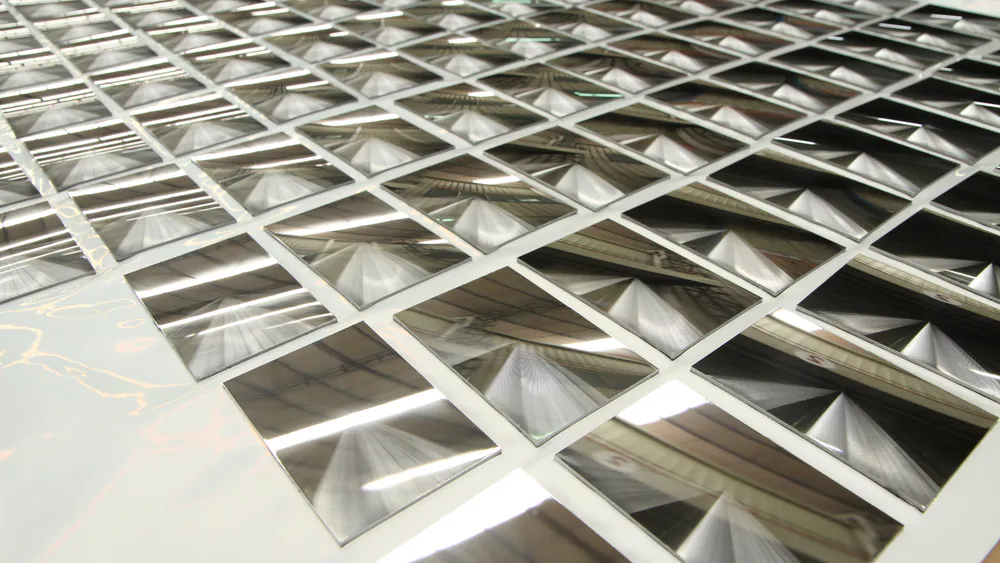
For projects where 6mm is the right specification but cost is a concern, ordering pre-cut sizes rather than full sheets often makes sense. The per-square-foot cost is similar, but you don’t pay for material you won’t use, and shipping is simpler.
We will arrange the pre-cut small mirrors for transportation, which makes it easier for better transport and convenient for you to use directly. Just like the picture below.
A Note on Edge Quality
At 6mm, edge quality becomes more visible. The material is thick enough that any cut edge is a meaningful surface in itself, not just a thin perimeter. For exposed-edge installations, specify edge treatment — flame polishing, sanding, or beveling — when ordering. The cost premium for finished edges is small relative to the appearance difference.
Other Thicknesses
2mm and 4mm Intermediate Options
These exist primarily for specific applications. 2mm is sometimes used for mid-format craft work where 1.5mm is too flexible but 3mm is heavier than needed. 4mm shows up occasionally in installations where 3mm isn’t quite rigid enough but 6mm is overkill and more expensive than the budget allows.
For most buyers, the intermediate thicknesses don’t offer enough advantage over the adjacent standard options to justify the limited availability. Stick with 1.5mm, 3mm, or 6mm unless there’s a specific reason for the in-between gauge.
8mm and Thicker
Specialty range. Used for:
- Structural or architectural mirror installations
- Very large flat panels where rigidity is the priority
- Some large mirror sheets specifications where size and flatness both matter
- Public installations where thickness contributes to vandal resistance
- Specialty fabrication where the mirror functions as both reflector and structural element
Pricing scales quickly at these thicknesses, and lead times often extend because thicker stock isn’t held in inventory as broadly. For applications that need 8mm or thicker, expect to spec the project and order through a fabricator rather than buying off the shelf.
Order Placement Process Recommendations
A meaningful chunk of the search traffic for thickness-specific queries comes from buyers who want to see and handle the material before committing to an order. The “near me” and “in-person stores” variants on this search pattern reflect real buyer behavior — thickness is hard to judge from a photo, and the difference between 1.5mm, 3mm, and 6mm is something most buyers genuinely understand only when they pick up a sample of each.
This is a reasonable instinct, and there are a few practical ways to address it:
Order sample chips before committing to a full order. Most reputable acrylic mirror suppliers will send small sample pieces — typically 4″ × 4″ or 6″ × 6″ — at the various thicknesses for evaluation, sometimes free, sometimes for a nominal fee that’s credited against a subsequent order. For a project where thickness selection isn’t obvious, this is the cleanest solution.
Compare physical samples directly. When you have samples of three thicknesses in hand, the differences become immediately obvious. 1.5mm flexes substantially under hand pressure. 3mm flexes noticeably but resists significant deformation. 6mm feels nearly rigid. The weight difference is similarly clear. Five minutes with samples will resolve thickness uncertainty better than any amount of online research.
For visual quality comparison, use larger samples or borrowed pieces. If you’re trying to assess how a specific thickness will look at a specific size, the small-chip comparison won’t fully answer the question. Some suppliers will produce a representative larger sample (e.g., a 12″ × 12″ piece) on request. For commercial projects with significant order value, this is a reasonable ask.
Specialty plastics distributors are the most useful local option. Big-box hardware stores typically don’t carry acrylic mirror — they stock clear acrylic, polycarbonate sheet, and sometimes very small pre-formed mirrors, but not standard mirrored acrylic in usable sizes. Specialty plastics suppliers (the type of business that serves sign shops, fabricators, and trade buyers) are more likely to have acrylic mirror in stock and to allow inspection before purchase. These suppliers are usually findable by searching for plastic supply or sign supply businesses in your area rather than searching directly for “acrylic mirror near me.”
Final Practical Notes
Three things worth keeping in mind that don’t fit neatly elsewhere:
Thermal expansion matters at the higher thicknesses. Acrylic expands and contracts approximately 8 to 10 times more than glass with temperature changes, per ACRYLITE’s published technical data. For installations exposed to significant temperature variation — sunrooms, areas near heating vents, outdoor-adjacent positions — mounting hardware needs to allow for thermal movement. Drilled holes should be slightly oversize, and adhesive mounts shouldn’t constrain the entire perimeter rigidly. This applies more to 6mm and thicker stock than to thin sheets, simply because the absolute movement is larger at greater thicknesses.
Don’t over-specify for applications that don’t justify it. 6mm is genuinely better for large or premium installations, but for a 12″ × 18″ decorative wall mirror in a hallway, 3mm is the right specification and 6mm is unnecessary cost and weight. Match the thickness to what the application actually requires.
For matched-batch projects, order all material in a single purchase. Manufacturer batches vary slightly in color (for tinted variants), reflectivity (for premium grades), and exact thickness within tolerance. A project that needs visually consistent material across multiple sheets should specify a single batch when ordering.
For most buyers, the thickness decision comes down to size and application. Small projects, 1.5mm. General-purpose installations under 24 inches, 3mm. Larger or premium installations, 6mm. The mistakes happen when buyers under-specify to save cost — and then have to live with a mirror that doesn’t look right because the material wasn’t suited to the application.