
“Why is a new mold needed just to reduce the diameter slightly?” This is a common question when purchasing custom convex mirrors. It may seem like only a dimensional change on the drawing, yet the quotation may include additional mold costs and a longer lead time.
Manufacturers generally do not keep thermoforming molds ready for every custom convex mirror; they usually focus on standard formats. On the other hand, for some products with obvious shape variations, suppliers can still complete them using existing molds.
A convex mirror does not only involve length, width, and diameter, but also curvature, arch height, and mounting edges. Whether the modification affects these structures, and what forming method the supplier uses, are the key factors in determining whether a new mold is required.
“If existing tooling can reliably produce a curved surface that meets the requirements, and customization can then be completed through trimming or other processing, there is a chance the tooling can be reused; if the target curved surface or structure exceeds the capability of the existing tooling, then it becomes necessary to evaluate modifying the mold, replacing part of the tooling, or creating a completely new mold.”
Most projects fail to move forward because of the additional costs involved, so here we want to discuss mold-related issues in custom convex mirrors. Specifically, to clarify what the “mold” mentioned in a quotation actually refers to.
What Does a Custom Convex Mirror Mold Include?
Here we primarily discuss thermoformed convex mirrors made from plastic sheets such as acrylic and polycarbonate. When suppliers mention “tooling creation” or “mold opening” for these products, they could be referring to several distinct types of equipment serving different purposes:
- Surface Forming Molds: Used in contact molding processes to help the sheet achieve the desired three-dimensional contour.
- Clamping or Forming Frames: Secure the heated sheet and define the boundaries of the forming area.
- Trimming and Positioning Fixtures: Support the mirror during cutting, drilling, or assembly to ensure consistent processing locations.
Since these tools perform different tasks, their manufacturing costs and modification complexities vary significantly. Replacing a trimming fixture is entirely different from remaking an entire set of surface-forming molds, and the two should not be conflated.

Why Convex Mirrors Require Molds for Production
Standard plastic sheets used for mirrors are manufactured flat, whereas convex mirrors are curved. Achieving the convex effect requires bending an originally flat sheet.
Molds are an indispensable component in achieving this curvature. They dictate the mirror’s contour, and different sizes will perform differently under varying curvatures. In practical applications, these factors lead to significant variations.
Therefore, when discussing custom convex mirrors—especially if the project demands strict reflection standards—customized tooling is essential to ensure that every produced mirror meets the exact same specification, preventing inconsistencies such as one mirror having a great wide-angle view while another fails to meet standards.
Some Curves Are Not Formed by Pressing Against a Full Mold Surface
In free-blowing or free vacuum forming, sheets can form domed surfaces through clamping frames and air pressure differentials, eliminating the need for the effective optical surface to press directly against a complete mold face. The ACRYLITE Thermoforming Guide outlines these methods, as well as how to adjust the forming height using pressure or vacuum.
This means that certain adjustments to curvature or dome height can be achieved using existing equipment and molds. However, the ability to adjust the height does not mean any arbitrary curve can be instantly achieved; validating the contour, thickness distribution, and optical imaging quality remains necessary.
When procuring, you can ask the supplier to itemize the new tooling costs: whether the charges are for the forming mold, the clamping frame, or post-processing fixtures. Understanding these distinctions, alongside the manufacturing process of acrylic convex mirrors, makes it much easier to see exactly which production step your tooling fees correspond to.
When Can an Existing Convex Mirror Mold Be Reused?
Whether an existing mold can be reused cannot be judged solely by whether the supplier has previously made mirrors of a “similar size.” We believe a more meaningful comparison is: what exactly is different between the existing molded part and the target product?
This usually requires precise measurements. Factories generally have their own inspection tools, such as spherometers, contour measuring instruments, vernier calipers, thickness gauges, and so on.
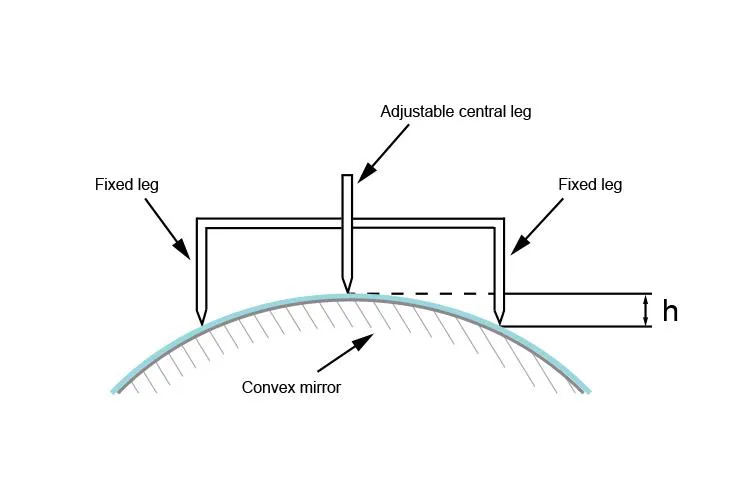
If the differences are mainly concentrated in surface treatment and other secondary processing, while the required curved surface already meets the specifications, then using the same solution can be considered.
| Customization Change | Reuse Solution | What Needs Attention |
|---|---|---|
| Add logos, adjust packaging or protection methods | Continue using the existing molding mold and adjust subsequent processes | Whether the pattern position, surface treatment, and packaging affect mirror usage |
| Add holes or local notches | Adjust machining programs and positioning fixtures | Support near the holes, edge strength, and mirror coating protection |
| Reduce the outer dimensions while retaining the original curved surface | Trim from a suitable molded blank | Whether the effective curved surface is sufficient, and whether the trimmed sag height and assembly dimensions meet requirements |
| Slightly adjust the sag height within existing process capabilities | Fine-tune molding conditions and adjust auxiliary molds if necessary | Whether contour, thickness, and imaging performance can be stably repeated |
| Change material or sheet thickness while keeping the target shape unchanged | Conduct process adaptation trials first | Whether heating, cooling, springback, and dimensional changes can still be controlled |
If the adjustments throughout the overall process flow are not too significant, factories generally will not charge a mold-opening fee either. For projects that can reuse existing mature processes, quickly solving the customer’s needs is the top priority.
However, sometimes the situation is different…
The same reduction in diameter may actually represent two different kinds of customization
Suppose a spherical convex mirror originally has a diameter of 300 mm, and now it is desired to reduce it to 280 mm, while the original curvature remains unchanged.
If the customer accepts the original curvature, and the existing blank has enough qualified curved surface area, it may be possible to obtain the smaller mirror by trimming. Even in this case, the sag height, edge position, and assembly relationship after trimming must still be rechecked.
But if the customer requires that after reducing the diameter, the mirror still maintains the original sag height, then the situation changes. For a spherical design, the diameter and sag height together determine the curvature. You cannot simply cut off the outer ring and simultaneously satisfy both requirements.
Therefore, even if “the size only changed a little,” manufacturers still need to invest effort into process and workflow adjustments, and this does not mean the workload is small.
The key is whether the customer wants to retain the original curved surface, or instead wants a new mirror that has a smaller outer shape and a correspondingly changed curvature.
This kind of customization clearly no longer falls within the scope of simple reuse. Even if part of the similar process can still be reused, the overall scale of adjustments required for the final forming process is not small.
When Does a Custom Convex Mirror Require New Tooling?
When existing molds cannot be used for target production, investing in new ones must be considered. In the overall manufacturing process, molds play a decisive role in thermoforming. Even if the production workflow remains unchanged, a new mold is indispensable to achieve the desired result.
Standard convex mirror tooling is relatively inexpensive because it relies on basic spherical molds. However, if your required surface curvature is unconventional, the corresponding spherical mold will be equally specialized.
If such specifications are uncommon in the market, tooling fees are likely to increase. Manufacturers should provide a detailed explanation of these variations rather than simply dismissing it with the blanket statement that “all custom products require tooling fees.”
Substantial Changes in Curvature or Surface Profile
For instance, consider a scenario where the diameter of a convex mirror remains constant, but its height (or sag) changes. This constitutes a substantial change in curvature or surface profile, thereby necessitating mold readjustment.
If this specific modification has no precedent in the factory’s production history, they will inevitably request a tooling fee to cover the additional costs incurred in manufacturing the convex mirror.
This actually serves as a useful red flag for buyers, allowing them to assess the factory’s production experience and capabilities. Since manufacturers encounter a wide array of demands, a larger inventory of molds generally indicates hands-on experience with such custom products.
For products formed using fixed mold surfaces, if the target profile exceeds the existing mold geometry, an evaluation is required to either modify or replace the forming tools. For free-form manufacturing processes, one must first determine whether the adjusted profile remains within a stably controllable range.
If the design incorporates aspherical surfaces, asymmetrical contours, or varying curvatures along different axes, providing merely the diameter and rise height is usually insufficient; a complete profile or 3D CAD model is required.
Modifying to a Special Shape While Altering the Edges
Converting a circular convex mirror into an oval or rounded-rectangle mirror does not always require remaking the surface mold. However, modifications are typically made by scaling down from a larger size to a smaller one, never the reverse.
If the target is a rectangular convex mirror, it must be machined from a blank of the same or a similarly irregular rectangular shape; it cannot be adapted from a circle.
If the goal is simply to obtain a specific outer contour from a suitably curved blank, edge trimming can be attempted first.
Nevertheless, if the product requires a specific transition between the convex surface and the edges, or if the border must fit a fixed housing, a new forming frame or mold will be necessary.
At this point, the “outer shape” can be broken down into two distinct questions:
- Viewed from the front, what profile does the convex mirror require?
- Viewed from the side, what kind of mounting structure is needed around this profile?
Adding Mounting Structures Beyond Subsequent Processing Capabilities
Many convex mirrors undergo edge-finishing processes to create an integrated flange or border that facilitates installation. While this may seem like a minor edge modification, it can still incur additional tooling fees.
Why would a mere edge treatment trigger this? It ultimately depends on the mold itself. A convex mirror without an edge treatment is essentially shaped using a standard spherical mold. Once an extended border is introduced, a basic spherical mold lacks the auxiliary forming edges required to shape both the center and the flange simultaneously.
These essentially represent two different types of molds. Most manufacturers maintain both varieties in their inventory to accommodate a diverse range of convex mirror requirements.
How Do I Determine The Cost of a Convex Mirror Mold?
Now that we understand the role of molds in custom convex mirrors, I believe users also need to be aware of the associated costs. Manufacturers often inflate mold-opening fees in custom convex mirror orders.
Although this cost is typically borne by the buyer, mold-opening quotes can vary significantly from one manufacturer to another.
In this case, how can buyers determine whether a mold-opening fee is reasonable? We believe it can be evaluated based on the following three aspects:
First, it is essential to understand the primary factors influencing mold costs. The diameter, arch height, curvature, and molding precision of a convex mirror all affect the design and processing difficulty of the mold. Generally speaking, molds for larger sizes and higher surface precision entail higher processing costs. The materials used, surface finish requirements, and the need for multiple trial moldings also impact the final expense.
Second, ask the manufacturer for a detailed breakdown of the mold-opening costs. Buyers can request basic information such as material costs, processing methods, machining fees, and trial molding expenses. If a manufacturer only provides a lump sum for mold opening without being able to explain the specific manufacturing requirements, the quotation warrants further verification.
Third, obtain quotes from different manufacturers using identical technical specifications. We recommend compiling the convex mirror’s dimensions, arch height, thickness, material, and other processing requirements into a standardized technical document, and sending it to two or three manufacturers with relevant production experience. This helps minimize price discrepancies caused by misinterpretations of specifications and makes it easier to judge whether the mold-opening fee deviates significantly from the market average.
Some buyers may purchase convex mirrors of the same specification on a long-term basis. Therefore, it is necessary to clarify the following points before the initial mold opening: whether the mold fee is a one-time charge, who will store the mold, whether subsequent reorders will incur additional fees, and how costs will be handled if the mold is damaged or requires modification.
For orders with large purchase volumes, buyers can also negotiate with manufacturers to amortize the mold cost into the unit price of the product, or agree on a partial refund of the mold-opening fee once a certain purchase volume is reached.
It should be noted that there is no universal standard for mold-opening fees applicable to all convex mirror specifications. Buyers should not judge the reasonableness of a quote solely based on price; instead, they should conduct a comprehensive evaluation considering the mold’s actual processing requirements, production techniques, and subsequent usage conditions.