
Indoor convex mirrors and outdoor convex mirrors both belong to the category of convex mirror products, but the differences between them are enormous.
The convex mirror installed above a store shelf and the convex mirror placed at a parking lot exit may appear to differ only in size. But functionally, they serve the same purpose: to bring more areas into the field of view.
The best way to compare these two types of convex mirrors is to look at their production specifications. Usually, the mirror material they use is the same, but the other components included in the overall product may be different.
This is because the application environments for indoor and outdoor use are completely different. An indoor mirror may only accumulate a layer of dust or be blocked by newly placed shelves, while an outdoor mirror must endure sunlight, rain, and wind. The environmental intensity they face is entirely different.
You may ask, “Since they are used in different applications, why compare them at all?”
This is because, in our actual conversations with customers, we have found that some customers confuse the application specifications of indoor convex mirrors and outdoor convex mirrors, resulting in outdoor-grade products being used indoors, which in turn causes unnecessarily high costs.
Perhaps the convex mirror you need only requires an indoor-grade specification and does not need to reach the outdoor-grade level at all.
This is what gave rise to today’s topic: how do we determine the differences in specifications between the two, and how should we choose when there is a need?
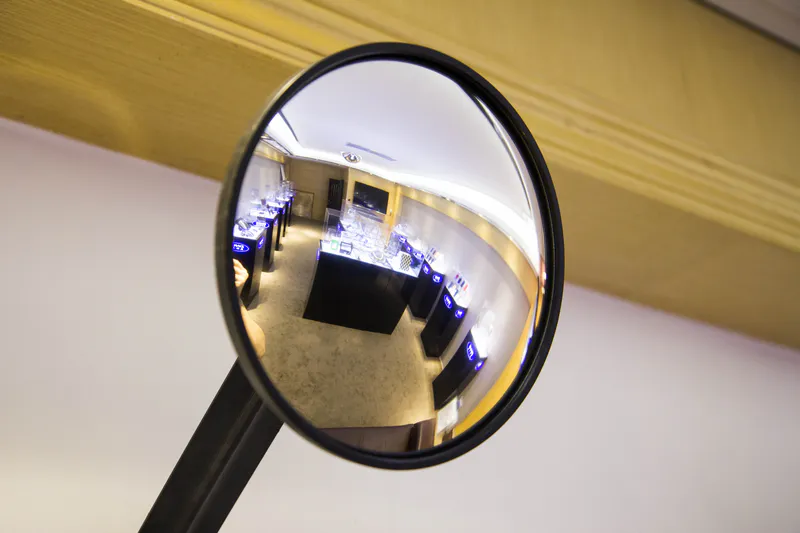
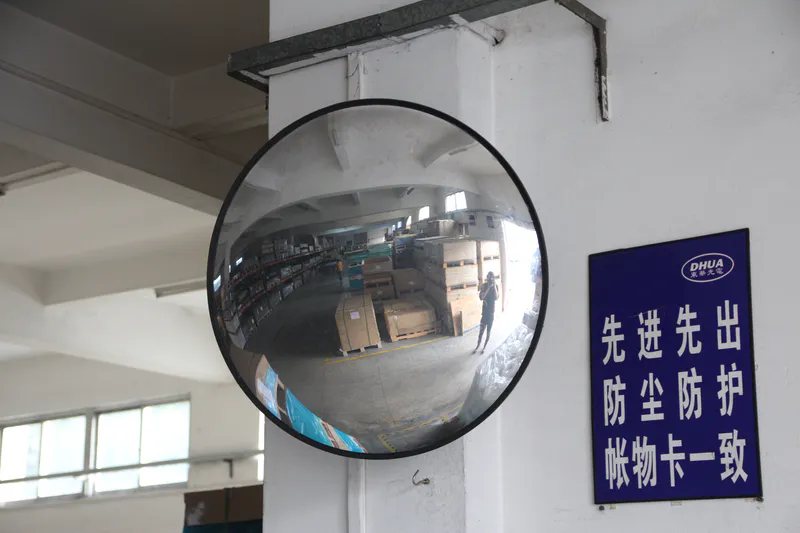
What Is an Indoor Convex Mirror?
First, let’s talk about indoor convex mirrors.
They are usually installed inside buildings to expand the field of view and help detect details in blind spots. Compared with products that are exposed outdoors for long periods, they are generally less affected by direct sunlight, rain, and strong winds. Therefore, product selection focuses more on viewing effectiveness, installation methods, and daily usage needs, and sometimes even on appearance characteristics.

Indoor convex mirrors have higher requirements for reflected image quality. In manufacturing, this is reflected in the quality of the mirror materials and coatings.
Taking actual production as an example, if outdated materials are used to make convex mirrors, the inferior texture inherent in the material itself may affect the mirror’s light transmission. Insufficient light transmission can create a blurry appearance.
For how convex mirrors are manufactured, please refer to: How are Acrylic Convex Mirrors Manufacturing?
What are their purposes of use
From the perspective of usage purposes, indoor convex mirrors can serve several different functions:
- Helping detect traffic blind spots. They allow people on both sides of a corner to notice each other in advance and also make it easier to observe moving objects such as carts and transport equipment.
- Expanding the range of routine inspection. They allow staff to observe more areas from a fixed position, reducing line-of-sight obstruction caused by shelves, partitions, or equipment.
- Decoration and visual interaction. They use convex reflections to create interesting spatial effects and are commonly seen in wall decoration or display design.
The first two functions are the most common and can be achieved by the same observation mirror.
When installed in a store, the mirror can help expand the monitoring range; when moved to a warehouse corner, it may also assist with passage visibility. Therefore, “store mirrors” and “warehouse mirrors” are not necessarily products with different structures.
Decorative convex mirrors, however, should be considered separately. Although they can also create wide-angle reflections, many decorative convex mirrors are usually printed on the mirror surface. This means they do not need to meet the imaging quality, coverage range, and installation requirements necessary for traffic observation.
Decorative convex mirrors are often available in more than just silver; colors like gold and rose gold are also widely used for decorative purposes.

Their ability to serve as decoration is the biggest difference between them and outdoor convex mirrors. At the same time, this is also their unique advantage.
Only after clarifying the purpose can you determine how large a mirror should be, what curvature it should have, and how it needs to be mounted.
What Is an Outdoor Convex Mirror?
Now that we’ve finished discussing indoor use, let’s take a look at outdoor convex mirrors.
Outdoor convex mirrors also expand the field of view through convex reflection, but their specifications must further take outdoor exposure conditions into account: whether the mirror surface can withstand sun exposure, whether the rear structure can handle long-term rain exposure, whether it remains stable after installation, and whether it is resistant to being shifted by wind.
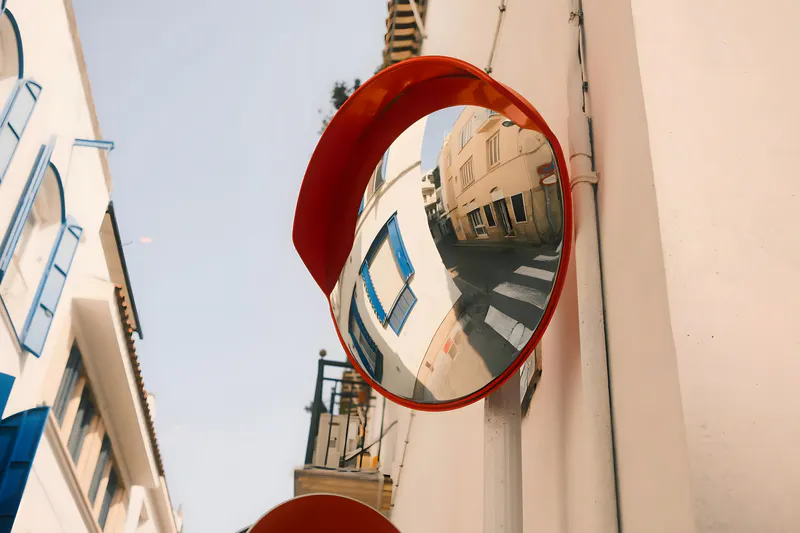
In other words, outdoor suitability is reflected in the entire product system. The mirror itself is only one part of the product, but it is important to note that mirrors used indoors and outdoors are two different specification types.
Parking Mirrors and Road Mirrors Often Serve the Same Task
Convex mirrors installed at parking lot exits, factory road corners, and lane intersections are typically used to help detect vehicles or pedestrians in blind spots. Their installation locations differ, but their core purpose is similar, and it does not fundamentally change based on whether the setting is a factory site or a parking lot. There is no need to classify them as completely different functional types solely based on location.
Another type of use is fixed-position auxiliary observation, such as areas with specifically obstructed lines of sight. In this case, the selection should be carried out around the corners where the road is mounted.
As shown in the example below, outdoor convex mirrors play a crucial role in enhancing safety.

Regardless of the task, the image in a convex mirror will appear reduced due to the wide-angle principle. It is suitable for assisting in detecting targets, but not recommended for accurately judging distance or speed; it is only suitable for rough estimation.
This is also why outdoor convex mirrors are typically made quite large; the larger the mirror surface, the greater the field of view it provides.
What Specifications Specifically Differentiate Indoor and Outdoor Use?
| Comparison Item | Common Concerns for Indoor Convex Mirrors | Additional Considerations for Outdoor Convex Mirrors |
|---|---|---|
| Mirror Size | Cover the required area within limited space without obstructing passage | Select according to observation distance and target size, while also considering installation space and wind exposure area |
| Mirror Material | Imaging quality, weight, collision risk, and cleaning method | Whether the material grade and surface treatment are suitable for long-term outdoor exposure |
| Reflective Layer and Rear Protection | Prevent damage during transport, installation, and daily contact | Whether moisture, rainwater, and edge exposure will affect the reflective layer and rear structure |
| Back Panel and Frame | Support the mirror surface, maintain shape, and facilitate installation | Weather resistance, corrosion risk, drainage, and reliability of connection points |
| Mounting Accessories | Whether the angle can be adjusted appropriately and whether the installation position is secure | Whether the angle can remain stable after wind exposure, and whether clamps, brackets, and fasteners are properly matched |
The distinctions here are not absolute; they are based on our experience working with customers.
In some cases, large indoor warehouses may also require large-diameter mirrors. Outdoor observation points at very short distances may not necessarily require the largest model.
The principle it generally follows is: size follows observation needs, while weather-resistant configuration follows environmental conditions.
What Are the Specifications for Indoor Convex Mirror Scenarios?
For indoor selection, it is often better to start by comparing smaller sizes. When the viewing distance is short and the installation space is limited, smaller mirrors are usually easier to arrange, and the indoor layout also tends not to require frequent changes.
However, “small” should be the result of meeting the viewing requirements. If the mirror is chosen too small simply to save space, an awkward situation may occur: the mirror does reflect the target, but people can hardly see it clearly.
As mentioned earlier, indoor convex mirrors can also be used for decoration. For mirrors used for decorative purposes, there is generally no need to focus strictly on visibility clarity.
How to choose a small size?
Small sizes are the most commonly used specifications for indoor convex mirrors. They are usually applied in scenarios that do not require extensive wide-angle reflective viewing. The table below can serve as a reference:
| Comparable Size | Main Task or Usage Condition | Key Points to Confirm During Selection |
|---|---|---|
| About Ø140–200 mm | Small wall decorations, combined visual displays | Appearance proportions, edge finishing, rear fixing method |
| About Ø300 mm | Local blind spots with short viewing distance and concentrated range | Whether the target can be detected from the actual viewing point, whether the mirror surface is blocked by door frames or equipment |
| About Ø450 mm | Obtaining a larger usable image within limited space | Whether the target is clear enough, whether the mirror curvature and coverage range are appropriate |
Taking our products as an example, our indoor decorative bubble convex mirrors include small single-unit and combined designs, making them suitable for selection from a decorative layout perspective. Buyers of such products are usually less concerned about wide-angle imaging issues and pay more attention to product color.
For observation purposes, you can refer to the structural configuration of actual products.
Here we reference the 300 mm and 450 mm models in DuraVision’s standard convex mirror series, which use 2 mm acrylic mirror surfaces, 4 mm aluminum-plastic composite backing panels, and are equipped with brackets for wall or ceiling installation.
This helps illustrate that even small observation mirrors require complete rear support and installation structures.
When should larger sizes be considered?
After discussing small-size specifications, let us now look at larger-size specifications.
For convex mirrors of the same diameter, different curvatures will produce different viewing ranges and image sizes. A more curved surface can usually cover a wider area, but the image of the target in the mirror will also become smaller.
Large indoor convex mirrors are most commonly used in indoor parking facilities. Layout planning in parking structures tends to be rather intricate, as indoor spaces demand a high premium on efficient space utilization. The greater the complexity, the more essential convex safety mirrors become as an assistive measure.
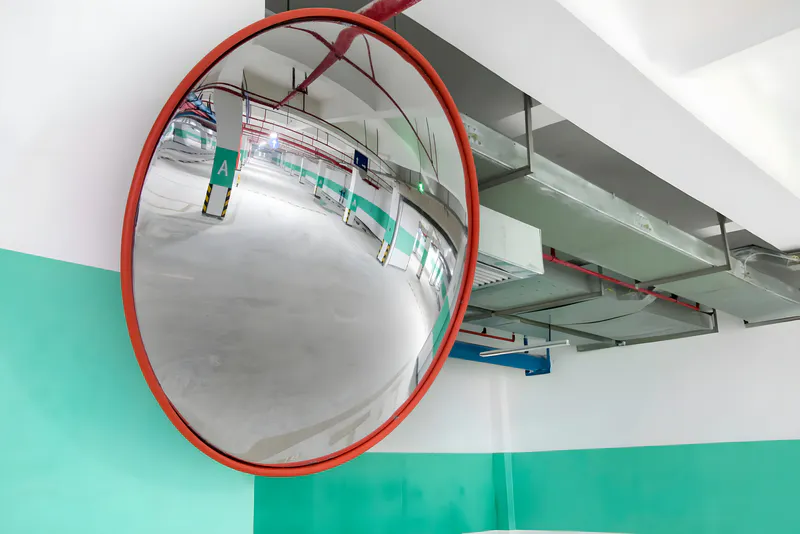
When considering larger-size specifications, confirmation can be carried out in the following order:
- Determine the observation position. Will the observation be made while sitting behind a checkout counter, or while walking toward a corner?
- Determine the target that needs to be detected. Is it a whole person, a cart, or activity between shelves?
- Adjust the mirror position and angle. First ensure that the key area appears in the mirror, then judge whether the size and curvature are appropriate.
- Check obstructions during normal use. Open doors, restocked shelves, and moving equipment may all change the observation effect.
If the viewing distance increases, or if the target that needs to be identified is smaller, indoor applications may also require mirrors of 600 mm or even larger. For more detailed selection ideas, you may refer to the convex mirror size and viewing distance buying guide.
In decorative observation application scenarios, buyers generally rarely choose large-size convex mirror specifications. This may be related to the fact that larger sizes make it easier for the human eye to notice the quality of wide-angle reflective clarity.
In addition, if mirror surface processing is required for large-size specifications, the cost will also increase. If it were you, would you consider using a large convex mirror for indoor decoration?
What Are the Specifications for Outdoor Convex Mirror Scenarios?
Outdoor convex mirrors are exactly the opposite of indoor ones. Outdoors, viewing distances are often longer, and the available installation space may also be larger, so larger sizes such as 600 mm, 800 mm, and 1000 mm are more likely to be chosen by buyers.
People generally seem to believe that outdoor convex mirrors are more practical. This can be seen from the application of traffic wide-angle mirrors.
Once a product is designed with practicality in mind, the requirements placed on it become particularly high.
How to Choose Large Sizes?
Among large-size options, we selected three relatively classic sizes:
| Comparable Size | Conditions That Can Be Prioritized | Content That Also Needs Verification |
|---|---|---|
| Ø600 mm | The observation area is relatively concentrated, and the installation space or bracket extension space is limited | Whether the target size is sufficient at the actual viewing distance, and whether the installation angle is adequate |
| Ø800 mm | A larger image is desired under an appropriate curvature, and the installation position also allows for a larger mirror body | Back panel support, bracket rigidity, and the load-bearing conditions of the pole or wall |
| Ø1000 mm | Smaller samples cannot meet observation needs, and the mirror surface needs to be enlarged further for comparison | Environmental impact and whether the site is suitable for installing a large-size mirror body |
Usually, the required size of outdoor convex mirrors is determined according to the actual application. It is uncommon to directly purchase standard sizes and use them in a scenario without further consideration.
Once practicality is taken into account, the related safety issues must also be included. Without an on-site inspection of the location, directly selecting standard sizes involves many additional risks that need consideration.
Here we still use DuraVision’s Outdoor DeLuxe series as an example. Its 600 mm, 800 mm, and 1000 mm products use 3 mm acrylic mirror surfaces combined with Celuka back panels, steel hoods, and galvanized pole mounting brackets.
This is the configuration of a complete outdoor convex mirror product. Compared with indoor versions, it can be seen that more accessories are included.
This is also one of the reasons why outdoor series products are more expensive than indoor series products.
Material Differences
Outdoor convex mirrors can use additional materials. Besides the mirror lens material, the back panel and frame materials can also be replaced. However, based on our experience, many buyers usually consider replacing the mirror lens material.
Acrylic and polycarbonate are both common materials for convex mirror lenses. Acrylic usually has good optical performance and weather resistance; polycarbonate is commonly used in designs that place greater emphasis on impact resistance.
Acrylic materials can be modified through processing techniques to achieve better strength or resistance. Polycarbonate is the most commonly used material for outdoor convex mirrors, as its inherent strength is already sufficient.
Under default material conditions and at the same thickness, polycarbonate has higher strength than acrylic. Materials are not fixed and unchangeable; applying more complex processing techniques can further improve their strength.
It is still necessary to confirm whether the material has corresponding UV-resistant configurations and whether the surface has appropriate protective treatment. Impact resistance, scratch resistance, and UV resistance are also different properties, and one cannot replace the other two.
If the project is still in the material comparison stage, you can narrow the selection range by referring to the Acrylic and Polycarbonate Mirror Material Guide, and then verify the actual structure of the finished mirror.
Back Panels and Frames
The back panel of an outdoor mirror needs to support the mirror surface and provide other protection for the mirror in outdoor environments. At the same time, it protects the rear reflective layer and installation connections.
The most commonly used options are plastic, fiberglass-reinforced materials, or metal back panels. Which one to choose needs to be evaluated within the context of the specific structure and usage environment.
Our company has manufactured outdoor convex mirrors featuring fiberglass-reinforced backings, making the products far more resilient against environmental wear and tear in outdoor settings.
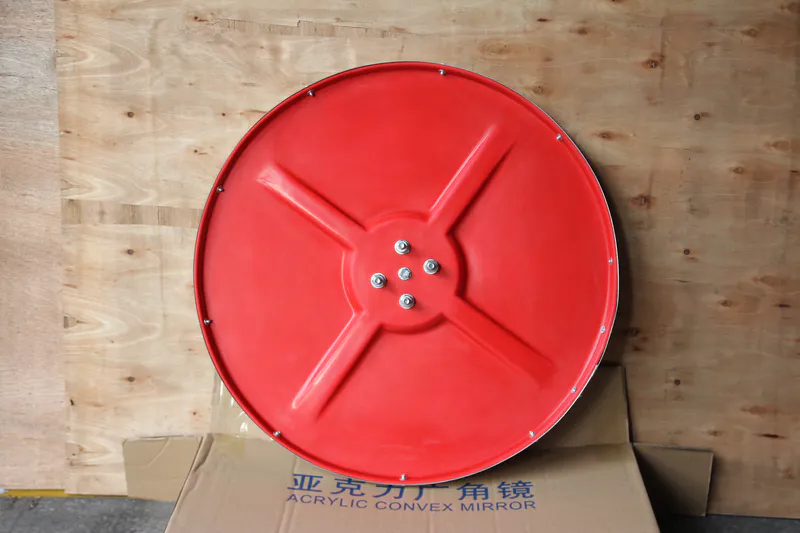
Based on our experience, compared with simply asking “what material is it,” the following questions are closer to actual use:
- How are the mirror edges and rear reflective layer protected?
- Is rainwater likely to accumulate at the connection points?
- Is the connection between the back panel and the bracket secure?
- If installed in coastal or humid areas, what anti-corrosion measures are used for the metal parts?
The hood can reduce some direct sunlight and rain exposure, but this does not guarantee that the mirror surface will not fog or frost. If the project involves low temperatures, high humidity, or frequent fogging conditions, anti-fogging and anti-frost measures should be raised as separate requirements.
How Should You Choose Convex Mirrors for Semi-Outdoor Areas?
In practical applications, environments do not always neatly fall into indoor or outdoor categories. When it comes to semi-outdoor spaces, we bring a unique perspective to the table.
The areas where mistakes are most easily made often lie in the threshold between indoor and outdoor: for instance, covered loading docks, open-air parking structures, or warehouse entrances near rolling shutter doors.
Here we find a prime example of bad design: while the environment where this convex mirror is placed clearly calls for outdoor use, the product’s overall weatherproofing simply doesn’t measure up to outdoor standards.
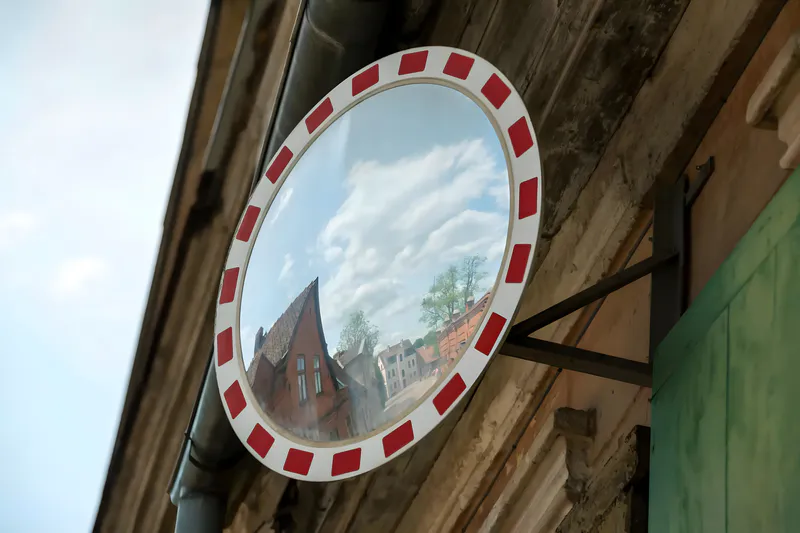
While these locations offer some shelter, sideways rain can still blow in, and sunlight may strike the mirror directly during certain times of the day. The roof blocks part of the weather, but it doesn’t turn the entire environment into an indoor space.
When dealing with such locations, you can evaluate the configuration by asking three questions:
- What forms of moisture will it encounter? Beyond rainwater, one should also consider condensation, washdown water, and prolonged humidity.
- What kind of sunlight and wind will it endure? Observe how exposure changes throughout the day, especially at entrances and building corners.
- Are there any additional corrosive factors? Coastal salt, detergent splashes, or specific production environments can all impact component selection.
Conversely, certain washing areas located entirely indoors also require structures that are more resistant to moisture and corrosion than a standard office setting.
Given these conditions, we generally recommend using outdoor-grade convex mirrors for such areas. This outdoor specification can be streamlined, or it can simply follow standard outdoor specifications directly.
As a rule, we also discuss the specific environmental conditions of the application to tailor the most suitable solution for the exact use case.
How Do Maintenance Requirements Differ for Indoor and Outdoor Convex Mirrors?
Most manufacturers pay little attention to maintenance. Whether intended for indoor or outdoor use, convex mirrors are generally treated as maintenance-free.
Why? Because these products are inherently designed as disposable items from the production stage onward. Manufacturers focus entirely on initial quality, with no consideration given to future upkeep.
Interestingly, however, indoor convex mirrors are frequently in demand of maintenance. We once received an inquiry from a buyer asking about how to maintain a convex mirror, which prompted us to explore this issue further.
For indoor mirrors, the primary concerns are dust, fingerprints, and changes in the field of view. Adding a shelf or relocating equipment can easily obstruct a previously well-adjusted mirror. Therefore, whenever the indoor layout is rearranged, you should re-evaluate the viewing angle from your observation point.
Outdoor mirrors typically require no maintenance, but if you do feel the need to clean or service them, keep an eye on the following:
- After strong winds, check whether the mirror has shifted and if the viewing angle has changed;
- Inspect brackets, mounting clamps, and fasteners for looseness or corrosion;
- Check the back panel, frame, and edges of the mirror for damage;
- Ensure that mud, fallen leaves, or overgrown vegetation are not obstructing the line of sight.
Carry out maintenance based on these conditions. Upkeep for the mirror surface primarily involves cleaning, while maintaining external components focuses on inspection and replacement.
Outdoor convex mirrors are rarely cleaned because the external environment makes constant cleaning unnecessary. However, the brackets and fasteners used for mounting require special attention to ensure the mirror remains secure.
Indoor convex mirrors are quite the opposite; the focus is usually on cleaning the mirror surface and the outer frame, which is much like dusting indoor furniture.
Semi-outdoor convex mirrors are generally handled the same way as outdoor ones, with maintenance focusing primarily on installation stability.
When cleaning acrylic mirror surfaces, standard cleaning solutions will suffice. The only thing that requires caution is the mirror’s specific coating. Certain specialized coatings must be kept away from specific chemicals to prevent structural damage that could impair performance.