
The word “shatterproof” gets used a lot in mirror marketing, often without much precision behind it. Some products are genuinely close to unbreakable. Others are simply harder to break than glass. A few are sold as shatterproof when they really only meet a basic impact-resistance standard that a determined person, could still defeat.
This article will mainly discuss it. We’ll cover what “shatterproof” actually means in the context of acrylic mirrors, how the impact-resistance numbers compare to glass and other materials, the safety standards that apply when these mirrors are specified for sensitive applications (traffic safety, infant products, public spaces), and what to look for when ordering for a use case where breakage isn’t acceptable.
If you’ve already read our acrylic vs. glass mirror comparison, the basic impact-resistance argument will be familiar. This piece focuses specifically on the safety-critical end of the spectrum — applications where the consequences of a broken mirror are serious enough that material specification really matters.
What “Shatterproof” Actually Means
Shatter-Resistant vs. Truly Unbreakable
There’s a useful distinction worth drawing at the outset, because the marketing language blurs it.
Shatter-resistant means the material is significantly harder to break than glass and, when it does break, doesn’t fragment into sharp shards. Most acrylic mirrors fall into this category. They can be broken with sufficient force — a hammer blow, a heavy impact at the wrong angle, repeated stress — but they won’t produce flying glass injuries when they fail.
Truly unbreakable is a higher bar. Polycarbonate (a different plastic, often sold under the Lexan brand) is sometimes described this way, with National Safety Mirror citing 250 times the impact resistance of glass for polycarbonate mirrors. Acrylic, by comparison, is roughly 10 to 17 times more impact-resistant than glass — substantial, but not in the same category.
For most safety applications, shatter-resistant is sufficient. The benefit isn’t that the mirror never breaks; it’s that the consequences of breakage are dramatically reduced. Acrylic that fails typically cracks, crazes, or splits into a few large pieces with edges that aren’t dangerous. Glass that fails produces hundreds of small, sharp fragments that can cause serious injuries.
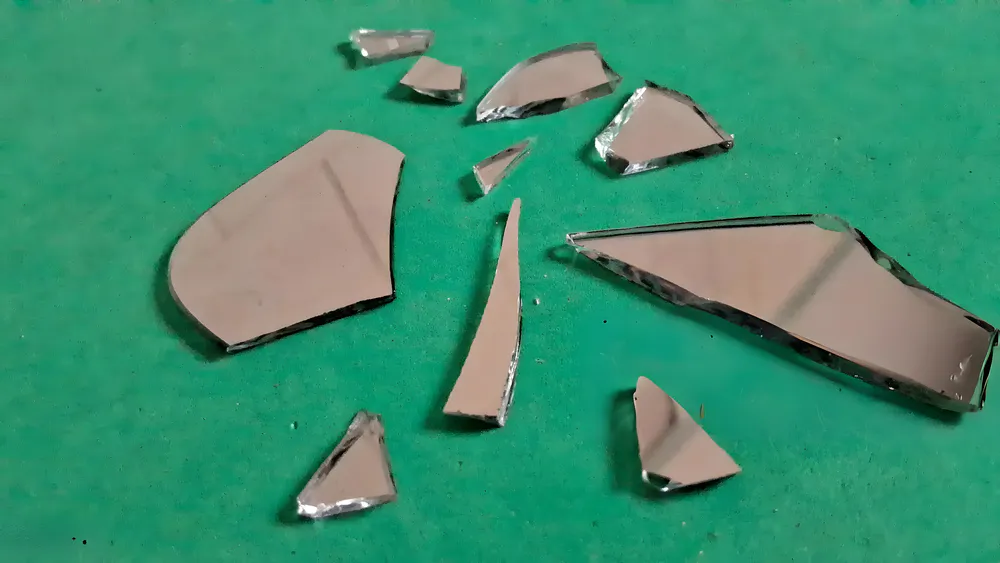
The purpose of shatterproofing is to prevent incidents like the one shown in the image below, as sharp edges of lens fragments can pose a threat to human safety.
The Numbers Behind the Claim
The 10x and 17x impact-resistance figures both appear in supplier literature, and they’re consistent with what’s documented in materials testing. The variance comes from grade — standard PMMA acrylic is typically rated at 10x glass, while mirror-grade and reinforced acrylic can push the upper end of the range.
OLFA Plastic publishes impact resistance data showing acrylic mirror at 17–22 kJ/m², which they describe as 15 to 20 times stronger than glass. These figures align with general industry consensus and should be treated as a working range rather than an exact specification.
In practical terms: a glass mirror exposed to the kind of impacts that occur in normal use environments — a stray ball, a dropped tool, a forceful slam — will eventually break. The same impacts on an acrylic mirror typically leave a scratch or scuff. The mirror keeps doing its job.
Where Shatterproof Acrylic Mirrors Genuinely Matter
There are some categories where the safety profile of the mirror isn’t a nice-to-have feature — it’s the primary reason for specifying acrylic in the first place. Two of these deserve careful attention.
Traffic Safety and Convex Security Mirrors
Convex mirrors used for traffic safety, driveway visibility, parking lot monitoring, and warehouse security are almost universally made from acrylic or polycarbonate rather than glass. The reason is straightforward: these mirrors are mounted in environments where impact is not just possible but expected.
A convex mirror at a blind driveway intersection will eventually be hit. A warehouse safety mirror at a forklift turn will eventually catch a load. A parking lot mirror will eventually be struck by a passing vehicle door, a thrown rock, or weather debris. Glass mirrors in these positions don’t just break — they create secondary hazards from falling shards onto roadways and walking paths.
National Safety Mirror’s product line illustrates the standard category split: indoor security applications typically use acrylic convex mirrors with hardboard backing, while outdoor traffic and high-impact applications often specify polycarbonate variants for additional toughness. Both materials share the basic shatter-resistance benefit; polycarbonate adds extreme impact tolerance for the most demanding installations.
The standard configurations:
Indoor acrylic convex mirrors — used for retail loss prevention, warehouse blind-spot coverage, and corridor visibility. Hardboard backing keeps the mirror lightweight and is sufficient for indoor environments where weather isn’t a factor. Sizes typically range from 12 to 36 inches in diameter, with the standard rule of thumb being 1 inch of mirror diameter per 1.5 feet of viewing distance.
Outdoor acrylic convex mirrors — same lens but with weather-resistant backing (HDPE plastic or galvanized steel). Used for driveways, parking lots, traffic intersections, and loading bays.
Dome mirrors — full-dome (360°), half-dome, and quarter-dome variants used in retail and warehouse environments where wide-area surveillance matters more than directional visibility. Acrylic is the dominant material across this category for the same shatter-resistance reasons.
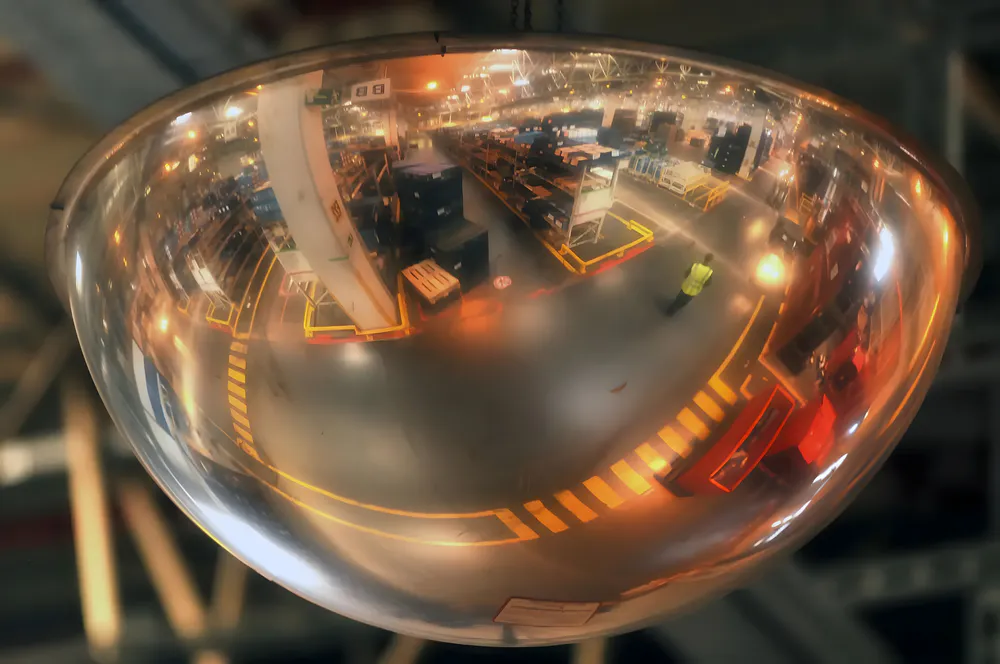
For specifying convex traffic mirrors, the typical decision factors are size (matched to viewing distance), backing material (indoor or outdoor rated), and lens material (acrylic for most general applications, polycarbonate for high-impact or vandalism-prone locations). The general overview of the curved mirrors category covers the variants in more detail.
Baby Toys and Infant Safety Products
This is the application where shatter-resistance moves from “useful” to “non-negotiable.”
Baby and infant mirrors — Montessori floor mirrors for tummy time, crib-mounted attention mirrors, baby-safe wall mirrors in nurseries, and the mirrored toys that hang from car seats and strollers — are essentially never made from glass. The reason is obvious: a glass mirror in any product designed for an infant under twelve months represents an unacceptable injury risk if it fails.
Acrylic is the dominant material in this category, and rightly so. The shatter-resistance profile means that even if a mirror is dropped, sat on, struck against another object, or otherwise stressed beyond design tolerance, the failure mode is cracking rather than dangerous fragmentation. Combined with the lightweight nature of acrylic — typically half the weight of an equivalent glass mirror — this makes it the natural choice for any product that will be handled, mouthed, dropped, or thrown by a small child.
Safety Standards That Apply to Children’s Mirrors
For manufacturers and importers of mirrored products intended for children under 14, the relevant U.S. standard is ASTM F963 — Standard Consumer Safety Specification for Toy Safety. This standard was made mandatory under the Consumer Product Safety Improvement Act of 2008, and it covers a comprehensive range of toy safety considerations including mechanical hazards, materials testing, and impact requirements.
For products intended for children twelve and under, third-party testing through a CPSC-accepted laboratory is required, and the manufacturer or importer must issue a Children’s Product Certificate confirming compliance. This isn’t optional for products sold in the U.S. market.
The international equivalents include EN 71 in Europe, ISO 8124, and various country-specific standards. Most reputable acrylic baby mirror manufacturers will test against multiple standards simultaneously to facilitate global distribution.
What this means practically for buyers: a baby mirror sold by a major retailer in a regulated market has typically been tested against drop, impact, and use-and-abuse criteria. The mirror itself isn’t simply “made of acrylic” — it’s a finished product that has been subjected to standardized testing to confirm it remains safe across a range of foreseeable failure scenarios.
What Quality Baby Mirror Products Actually Look Like
Looking at the design language used by reputable baby mirror manufacturers — companies whose products have been tested and certified to ASTM F963 — a few common features stand out:
- Shatterproof acrylic mirror surface (rather than glass)
- Rounded edges and corners with no exposed sharp points
- Frames built from solid wood or impact-resistant plastic
- Non-toxic, child-safe finishes free from BPA and phthalates
- No small detachable parts that could pose choking hazards
- Stable design for floor-standing models that prevents tipping
- Secure mounting hardware appropriate for the wall type for wall-mounted variants
Alphabet Trains’ Montessori mirror line is a representative example — their products specifically cite ASTM and CPSC certification compliance and are designed around the safety priorities listed above.
For anyone sourcing acrylic mirror sheets for the production of baby toys or infant products, the underlying material specification matters less than the finished-product testing program. A high-quality acrylic mirror substrate is necessary but not sufficient — the finished product still needs to pass the relevant impact, edge-radius, small-parts, and chemical-content testing required by the applicable jurisdiction.
Other Applications Where Shatter-Resistance Matters
Beyond the two primary cross-sell categories above, there are several other contexts where acrylic mirrors are specified primarily for safety reasons. Brief overview:
Public restrooms and changing facilities. Mirrors in public spaces are subject to vandalism, accidental impact, and wear that glass simply doesn’t tolerate well. Acrylic is the standard specification for most municipal, transit, and educational facility installations.
Mental health facilities and treatment centers. Glass mirrors in these environments are not just unsuitable but actively dangerous. Acrylic and polycarbonate variants — sometimes with anti-ligature mounting hardware — are the standard.
Correctional facilities. Polycarbonate is more common than acrylic in this context due to higher impact requirements, but the underlying logic is identical.
Marine and boat installations. Acrylic mirrors handle the impact of waves, dropped equipment, and the general hostility of marine environments better than glass. UV-rated outdoor acrylic is the typical specification for exposed installations.
Photography studios and event production. Large mirror surfaces in these environments are frequently moved, repositioned, and transported. The combination of shatter-resistance and lightweight construction makes acrylic the dominant choice for working professionals.
Inspection and security mirrors. The compact handheld mirrors used for under-vehicle inspection, security sweeps, and infrastructure work are uniformly made from acrylic for the same impact-resistance reasons.
When Acrylic Isn’t the Right Answer
Honestly speaking, because alternative situations are very important.
If the application requires a high-impact environment with vandalism risk — prisons, certain school environments, areas with documented vandalism history — polycarbonate is generally the better specification than acrylic. The trade-off is that polycarbonate is more expensive, scratches more easily, and can yellow over time more readily than acrylic. But for genuinely high-stress installations, the additional impact resistance is worth the trade-offs.
For environments where impact isn’t a meaningful concern but reflection accuracy matters at close range — vanity mirrors, designer wall installations, certain decorative applications — glass still has the edge. The shatterproof argument isn’t relevant if there’s no realistic risk of impact in the first place.
And for very large flat reflective surfaces, regardless of impact considerations, the surface waviness inherent to acrylic above roughly 60–80cm in any dimension produces noticeable distortion. Our large mirror sheets product range is specified accordingly, with thicker stock and rigid mounting recommendations for installations where size and reflection quality both matter.
Practical Considerations When Specifying Shatterproof Acrylic Mirror
A short checklist for buyers:
1. Confirm the actual material specification. Some products marketed as “shatterproof mirrors” are actually safety-backed glass — glass with an adhesive film on the rear that holds shards together if it breaks. This is different from acrylic. Both are legitimate safety products, but they have different properties and typically different price points. Confirm with the supplier which type you’re getting.
2. Match thickness to expected impact. A 1.5mm acrylic sheet is shatter-resistant compared to glass but won’t survive the same kind of impacts that a 6mm sheet handles easily. For traffic and security applications, 3mm or 6mm material is the typical specification.
3. Verify edge protection. Acrylic mirrors with exposed edges can chip or crack at the corners under repeated stress. For high-impact applications, look for rubberized edge trim or framed mounting that protects the perimeter. Steelman Tools’ rubber-trimmed convex mirrors are a good representative example.
4. Confirm the mounting hardware. A shatterproof mirror mounted with inadequate hardware can fail at the mount before the mirror itself fails. For commercial and public installations, the mounting system should be specified to handle the same load profile as the mirror itself.
5. For children’s products, verify certification. ASTM F963 testing for the U.S. market, EN 71 for Europe. Don’t assume a manufacturer’s claims; ask for documentation.
6. For specialty applications, consider variants. Two-way mirrors in observation rooms, anti-fog mirrors in shower environments, and curved mirror variants for wide-angle visibility all share the same shatter-resistance benefit as standard acrylic mirror sheets, but the choice between them depends on the specific application requirements.
Acrylic mirrors are genuinely shatter-resistant in any meaningful sense of the term. They’re not unbreakable — that’s polycarbonate — but they’re substantially safer than glass in any application where impact is a realistic possibility, and they don’t produce dangerous fragments when they do fail. For traffic safety installations, security and surveillance mirrors, and infant and children’s products, this safety profile isn’t a marketing feature; it’s the fundamental reason the material is specified at all.
The mistakes that happen in this category are usually about specification rather than material. A shatter-resistant mirror specified at the wrong thickness, mounted with inadequate hardware, or installed in an environment that exceeds its design parameters can still fail. Get the spec right, and acrylic does what it’s supposed to do — quietly, for years, in environments where glass would have failed long before.
One Response