
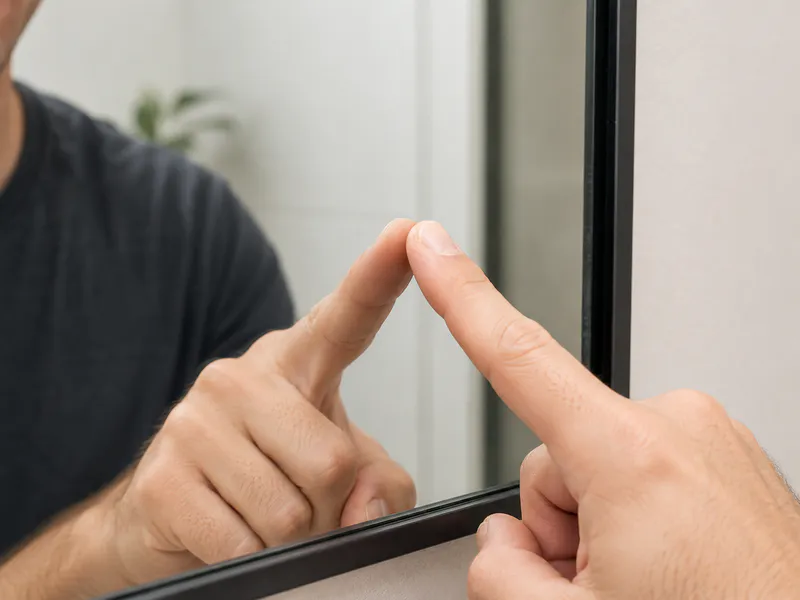
There is a widely known method for testing two-way mirrors, called the fingernail test.
Have a person stand in front of a mirror and press their fingernail against the mirror’s surface. If there is no gap between the fingernail and its reflection, then it is a two-way mirror.
As it stands, this testing method makes no logical sense.
A gapless reflection can reveal some information about the position of the reflective layer. However, it cannot tell you what is behind the mirror, whether the surface is translucent, or whether someone is observing it.
So, can someone see through a two-way mirror to the other side? Yes—under the right lighting conditions. However, no single fingernail test, tapping test, dye test, or flashlight test can, on its own, prove that the mirror is two-way.
It’s best to distinguish between three separate questions: Is the surface partially transparent? Do the lighting conditions allow for seeing through it? Is there actually a viewing space behind the mirror? Let’s address each of these in turn.
A two-way mirror does not have a permanently private side
A “two-way mirror” reflects some of the light that strikes its surface while allowing other light to pass through the panel. It works this way in both directions. The so-called “one-way” effect stems from the difference in brightness on either side.
People on the brighter side will primarily see their own reflection in the mirror. People on the darker side, however, may be able to see those on the brighter side directly. If the lighting conditions are reversed, the observable direction may also reverse.
This is why reflective privacy glass may be effective during the day but ineffective at night. Window Film Depot’s explanation of one-way mirror projects notes that when indoor lights are on and it is dark outside, people outside may be able to see inside. In situations requiring continuous privacy, curtains or blinds are usually needed in addition to the film.
Both glass and acrylic allow some light to pass through. In an observation room, the side being observed must be brighter, while the side where the observer is located must be significantly darker. Our Two-Way Mirror Lighting Guide explains how daylight, open doors, and screens can disrupt this balance.
When people ask us whether two-way mirrors provide privacy, our first concern is not the mirror itself, but the lighting conditions on both sides.
What the fingernail test really tells you
The fingernail test is often presented as a simple rule: if your nail touches its reflection, it is a two-way mirror; if there is a gap, it is a normal mirror.
That rule is too confident.
A conventional back-coated mirror is a second-surface mirror: light passes through the glass before reaching the coating, creating visible distance between an object and its main reflection. A first-surface mirror has its coating at the front. Edmund Optics’ explanation of first- and second-surface mirrors describes this distinction directly.
A no-gap result suggests that the dominant reflective layer is near the surface. It does not prove partial transparency or observation use. First-surface optical mirrors and surface-coated acrylic mirrors can produce the same result.
The reverse assumption is also unsafe. Depending on product construction and installation direction, a partially reflective panel may place its coating away from the person testing it. The supplier TwoWayMirrors.com shows this limitation in its fingernail-test guide, noting that some acrylic two-way mirror and smart-mirror products can resemble a conventional second-surface mirror when installed with the coated side facing away.
No gap is not proof of surveillance. A gap is not proof of privacy.
The fingernail test is a clue about mirror construction, not a verdict about what is behind the wall.
What do the other tests reveal?
| Check | What it may tell you | What it cannot prove |
|---|---|---|
| Fingernail gap | Whether the main reflective layer may be near the front or behind a transparent substrate | Whether the panel is partially transparent or anyone is behind it |
| Tint comparison | Whether the mirror looks darker or more transmissive than a normal mirror | Whether the colour comes from a two-way coating or another mirror type |
| Gentle tapping | Whether the panel may have an open cavity behind it | Whether it is a two-way mirror or an observation space |
| Controlled-light check | Whether reducing reflections makes anything behind the surface more visible | Whether the test reproduced the actual hidden-side conditions |
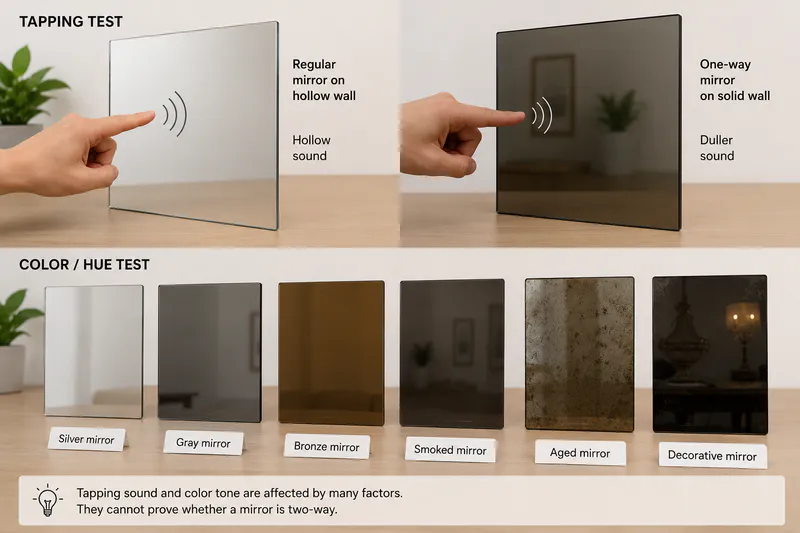
Tapping and color tests are not conclusive
A hollow sound says more about the wall itself than about the coating. A regular mirror may be mounted on a hollow partition, while a one-way mirror may be securely framed. Darker hues are also only weak evidence: gray, bronze, smoked, aged, and decorative mirrors may all appear darker than standard mirrors. The sound produced by tapping is affected by material thickness, while even more factors influence judgments about color tone.
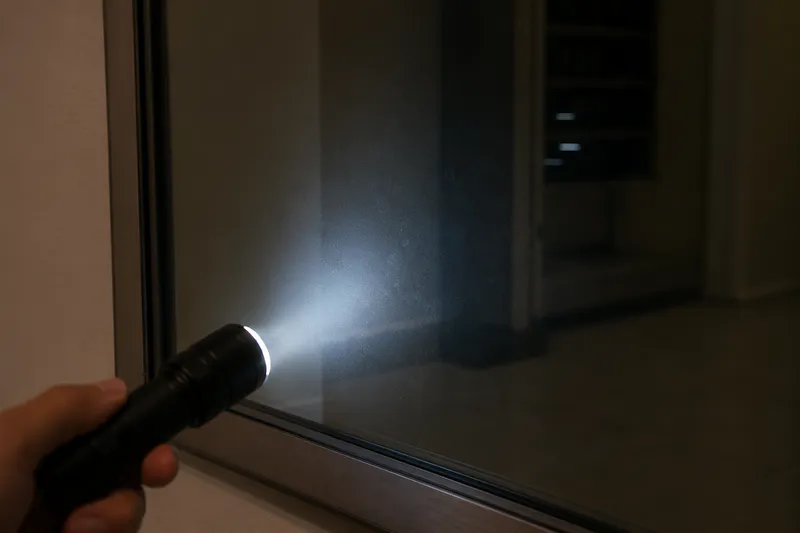
A flashlight test may still fail to provide conclusive results
When it is safe and permitted, dimming the lights on your side and holding a flashlight close to the surface may reduce reflections and reveal what lies behind the panel. Seeing a space is meaningful; seeing nothing proves very little. Low light transmittance, unlit cavities, dark back panels, or poor viewing angles can all lead to inconsistent test results.
A sensible way to check a mirror without damaging it
Start by looking at the big picture—don’t rely on just one type of test.
Observe how the mirror is mounted. Is it flush against the wall, or set into a deeper, window-like frame? Can you see an opaque backing panel along the edges? Are there adjacent rooms or unusually thick walls nearby? These clues aren’t definitive proof, but they can provide context.
Examine the surface without scratching it. Gently touch the surface with your fingertips to see if the main reflection appears on the surface; another mirror can help you compare the tint. Do not run your fingernails across the acrylic surface—it scratches easily.
Only then should you adjust the lighting. Do not pry open the frame, remove any hardware, scratch the coating, or tap the mirror.
Two-way mirrors do not ensure privacy
Another common mistake for architects, installers, and buyers is overpromising.
Two-way mirrors are not permanently opaque privacy screens. Daylight, indoor lighting, open doors, and screens can all diminish or reverse their effect.
To achieve controlled visibility, lighting, framing, coating orientation, and room design must all work together. Guide to Two-Way Acrylic Mirrors explains how proportions, tints, thickness, and dimensions affect performance, while our Installation Guide covers frame installation and light control.
To ensure reliable privacy protection under all lighting conditions, add blinds, curtains, opaque shades, or a properly specified switchable system. Avoid problems caused by special circumstances.