
When we talk about acrylic wall mirrors, we are not referring to hanging one entire large acrylic mirror sheet on the wall like a glass mirror.
We are referring to a mirror wall made up of individual acrylic mirror pieces. These pieces can be square, rectangular, circular, curved, strip-shaped, letter-shaped, or custom shapes. After being cut, they can be arranged on the wall to form a decoration.
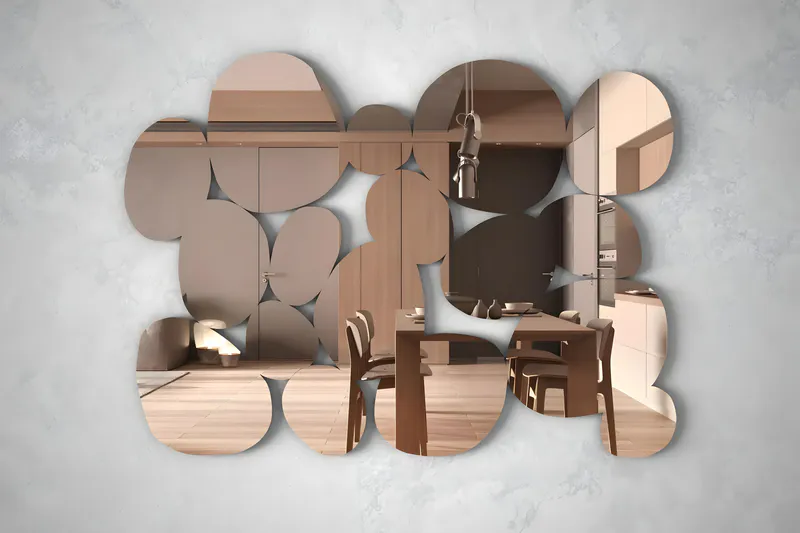
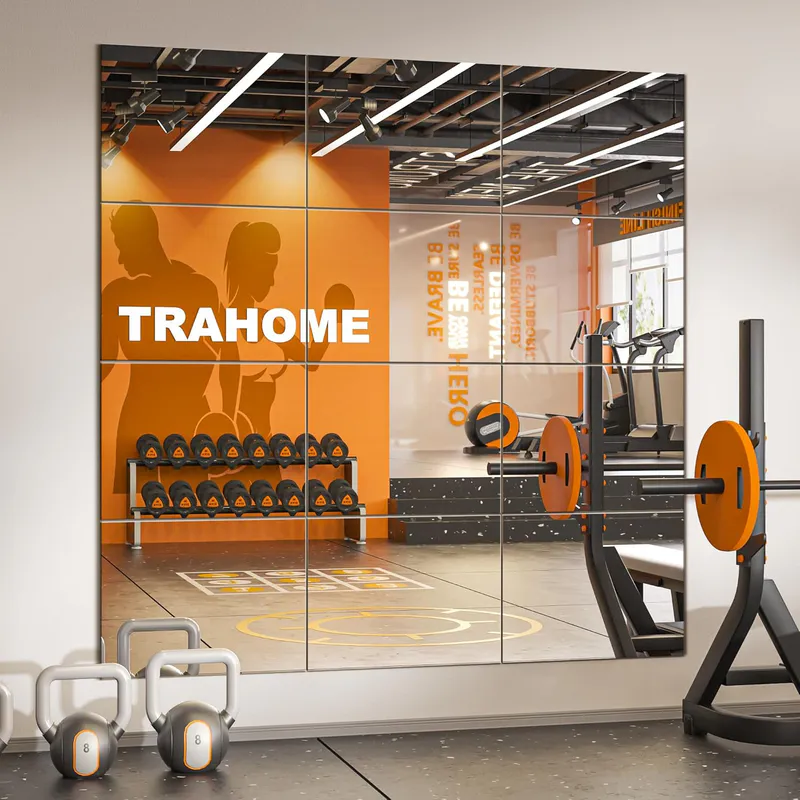
Just like the following two pictures, the “mirror wall” composed of multiple acrylic mirrors is mainly characterized by its stylish design, and it is relatively common in home decoration.
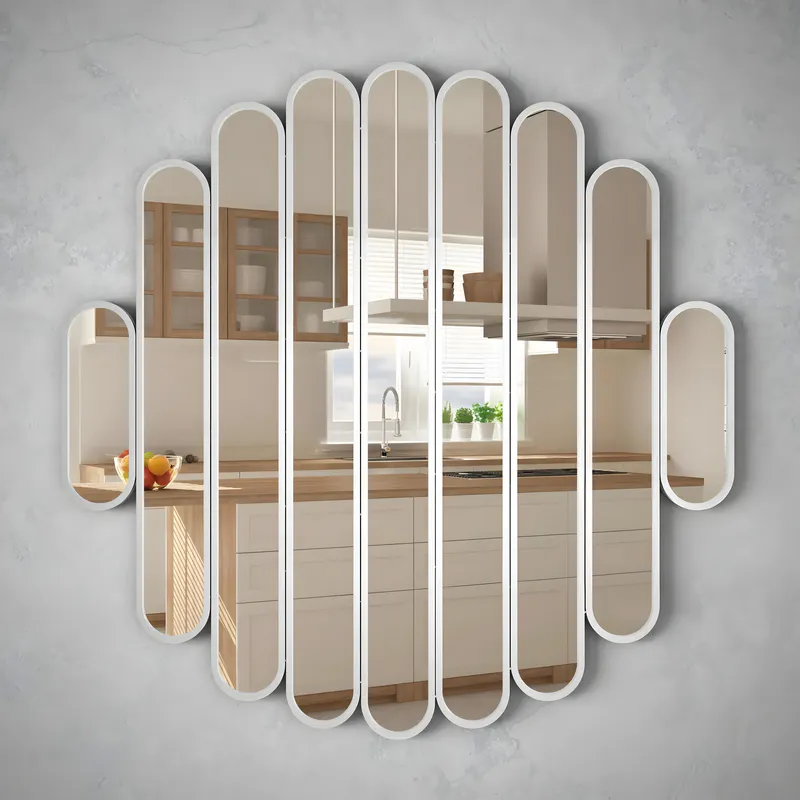
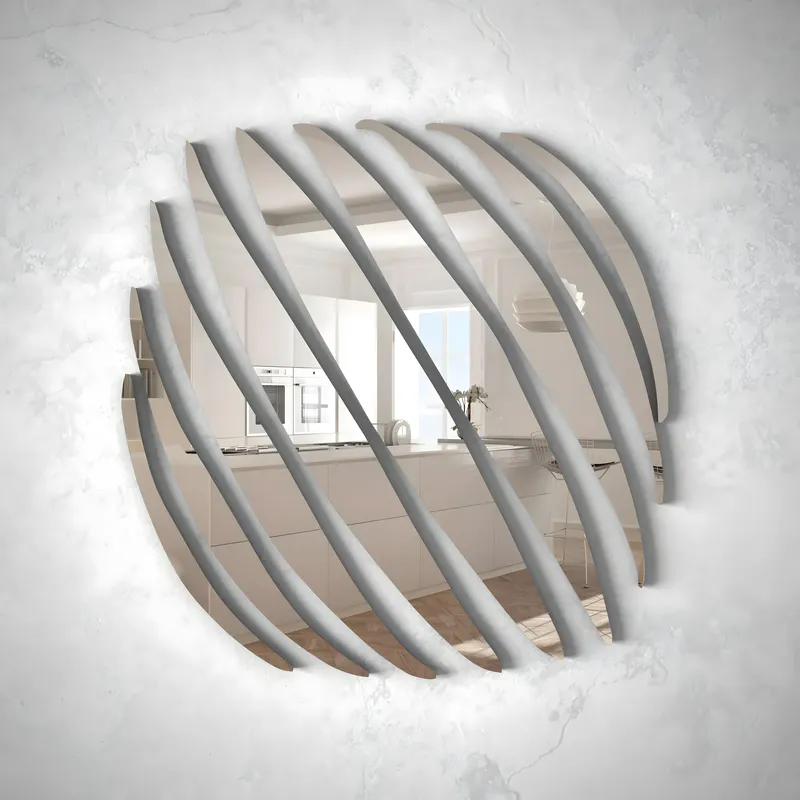
Many customers, when looking for acrylic mirrors, believe that simply purchasing one large mirror sheet can solve the problem of installing a large mirror area on the wall. But in reality, this is not the case.
The most important function of a mirror is to clearly reflect images, but the flexibility of acrylic material itself determines that it cannot provide a flat reflection. This has been explained in detail in our previous article: see What Is an Acrylic Mirror?
So how did acrylic wall mirrors come about? This will be the topic we discuss next.
Why We Build Acrylic Wall Mirrors From Multiple Panels
Large acrylic mirror sheets are a very practical raw material, but they cannot be used directly on a wall as a mirror. This is because acrylic is softer than glass. The larger a single mirror sheet is, the harder it becomes to maintain a flat and consistent reflection. Glass is a rigid material, which ensures a flatter mirror reflection. By comparing the two images below, you can get a more intuitive sense of this. In terms of reflection flatness, the glass mirror on the left is clearly better than the acrylic mirror on the right.
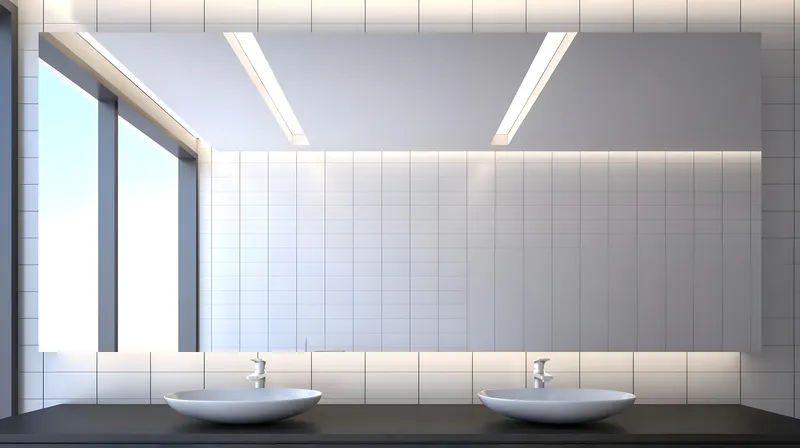
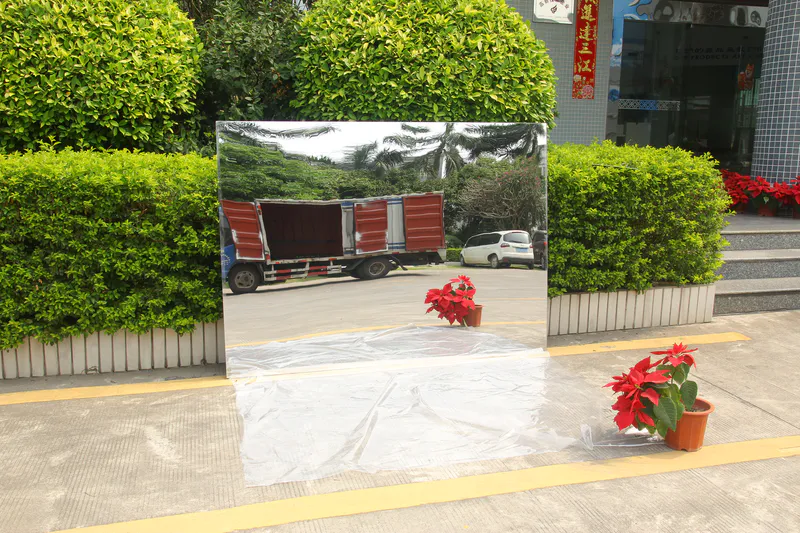
Does this mean acrylic mirrors cannot achieve the same effect? The answer is no. We can divide the mirror into multiple identical pieces, reducing reflection flatness issues by decreasing the size of each mirror section.
When acrylic mirrors are kept within 60 cm to 80 cm, arranging them together on a flat surface can also achieve a similar effect. In addition, because they carry a certain sense of design, they can also serve as a decorative style. Narrow and consistent gaps can create a clean and sharp architectural grid aesthetic.
Another consideration is logistics and transportation costs. Each piece is easier to cut, inspect, package, align, and support. If one piece is damaged during installation, it can also be replaced individually without needing to remove the entire wall.
Smaller components also allow us to achieve certain designs that would become overly complicated or too costly to manufacture if made with glass.
Therefore, adopting a strategy of combining multiple mirror panels is inevitable. When you decide to use acrylic mirrors as wall mirrors, for large-size applications we can only recommend using this multi-panel mirror approach. This is also to achieve a more ideal reflection effect.
If what you need is one completely seamless single-piece mirror, then we can only recommend choosing glass. However, a glass mirror of that size will usually have very high weight and transportation costs.
How We Determine Acrylic Wall Mirror Panel Size and Shape
As mentioned above, we recommend keeping the size within or below 60 cm to 80 cm. For each acrylic mirror wall, there is no such thing as one so-called correct size. If the customer clearly wants to create an acrylic mirror wall, we will choose the size of each piece based on the actual situation and visual effect. This usually depends on how large the actual project area is.
Another relatively critical point is whether you can confirm the flatness of the wall surface. We often confirm this issue with customers, because even at a size of 60 cm, acrylic mirrors placed on uneven walls will still produce reflection distortion.
Sometimes, the size does not necessarily have to be fixed. A random combination of sizes paired with a specific display design is more beneficial to the overall effect. Smaller panels will create more seams and form a more decorative surface, making them suitable for children’s room designs, retail backgrounds, letter designs, and complex patterns. Like the bubble-shaped wall mirror shown below, the design is not as neat and orderly as the product shown above, but stylistically it might be more appealing to people.
Medium-sized panels can provide a stronger reflective effect while maintaining the modular visual appearance of the wall; we usually use them in entryways, living rooms, hair salons, and branded interior spaces. Larger panels can reduce seams, but they require higher wall flatness and stricter installation control.
The influence of shape on the decision is just as important as size. Curved shapes, waves, leaves, clouds, and custom-shaped patterns can make the entire wall more decorative, and when paired with colored acrylic mirrors, the overall style becomes more striking. This is exactly where acrylic mirrors show their value. We can cut repeatable custom shapes from a whole sheet of large acrylic mirror panel without being limited by the common specifications of glass mirrors.
How We Select Thickness for Acrylic Wall Mirror Panels
The amount of thickness can improve the issue of reflection distortion. In extreme cases, for a size of around 100 cm, using a thickness of 10 mm can reduce reflection distortion.
However, we usually do not recommend that customers decide on the thickness right away. Sometimes customers choose the thickness before the product dimensions have been determined. For this reason, we recommend understanding the project details first and then deciding on the thickness.
Why? Mainly because increasing the thickness of acrylic involves additional cost. Based on actual requirements, choosing the thickness first may be a waste. Unless the customer already has a certain understanding of the project in advance, looking at thickness first is generally not a good choice.
Sometimes there are exceptions. For example, we once worked on a gym wall mirror project. Projects like this are usually more suitable for glass materials, but some customers place greater emphasis on safety concerns. In such cases, when choosing acrylic mirrors, we prioritize discussing thickness with the customer. If the thickness is too low, the flatness of the reflection will inevitably be affected. If the thickness is too high, the overall cost will increase.
We determine the thickness based on the longest dimension, narrow areas, installation method, backing board, viewing distance, and edge appearance. Choosing the thickest sheet cannot compensate for poor layout or uneven walls; it will only increase cost and weight. Our Acrylic Mirror Thickness Guide introduces the general options, but for wall panel combinations, we prefer to review the drawings first rather than make recommendations based solely on a single number.
How We Turn Drawings Into Finished Acrylic Wall Mirror Panels
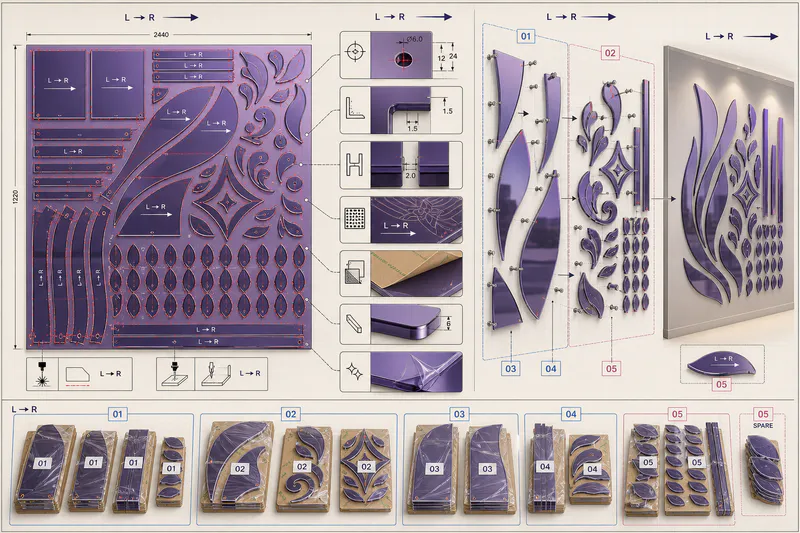
After confirming the basic details, we will inspect the narrow areas, inner corners, hole positions, and fine details, then arrange each component onto the raw material sheets. Depending on the material, thickness, shape, edge requirements, and quantity, we may use laser cutting or CNC machining. Simple rectangles do not require the same production process as complex decorative shapes.
We will maintain consistency in the visible direction, especially for colored mirror surfaces, printed details, and asymmetrical shapes. Any left-to-right orientation must remain clear throughout the entire process from cutting to installation.
We can also plan for:
- Self-adhesive backing suitable for small and medium-sized parts;
- Printed details or logos;
- Hole positions for mechanical fastening when required by the design;
- Numbered parts for complex layouts;
- Grouping by wall area or installation sequence;
- And spare parts for repeating patterns.
The protective film will remain unchanged during processing, packaging, and alignment. We will label the parts on the backing paper or packaging; clear numbering can save a great deal of time on site.
Our custom cutting and printing service demonstrates the basic process from blank mirror sheets to finished cut components. Wall projects follow the same processing principles, but with one additional requirement: all parts must work together as a complete installation.
Acrylic Wall Mirror Installation Method
The wall surface should be sound, clean, dry, and should meet the flatness requirements demanded by the selected component size.
For regular patterns, we usually establish a horizontal baseline and a vertical centerline first. For irregular designs, full-scale paper templates or projected outlines are often more useful. Installers should check the complete arrangement before removing all release films.
The installation sequence we commonly use is:
- Confirm wall dimensions against the production drawings;
- Mark centerlines, baselines, and outer boundaries;
- Position templates or temporary guide devices;
- Perform dry checks on key components and edge conditions;
- Begin installation from a defined reference point rather than from a convenient corner;
- Use consistent spacers to maintain design gaps;
- Apply even pressure to each component without forcing it to conform to localized wall defects;
- Remove the surface protective film only after alignment work is complete.
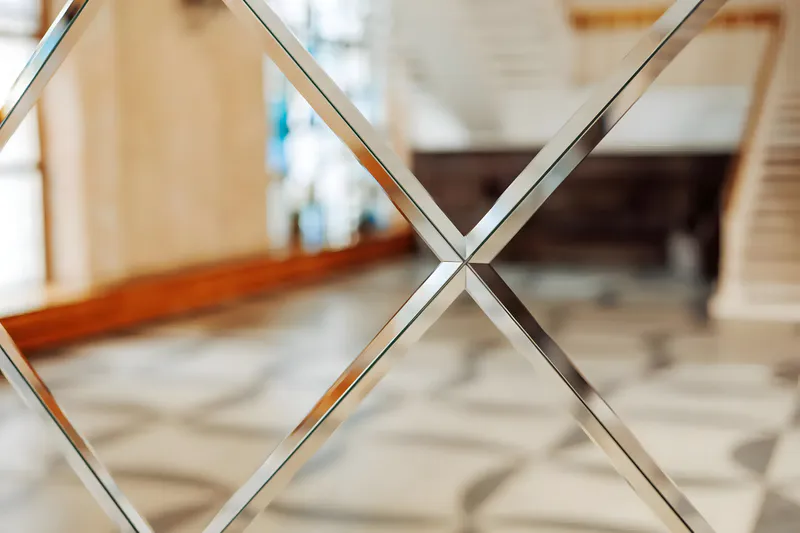
Among the projects we have encountered, this type of wall mirror with beveled edges is the most popular. Mirrors like this are also easier for us to install.
Where We Recommend Wall Mirrors
For entryways, we like a set of vertical mirrored strips or staggered arches. This kind of design can increase the sense of height and reflective effect of the space, while not pretending to be a traditional framed mirror.
For living room feature walls, circular, curved, or mixed geometric panels work better than complete reflective rectangles. The mirror becomes part of the wall decoration and can echo shape elements already present in lighting fixtures, furniture, or shelving.
For children’s spaces, we tend to prefer rounded clouds, animals, stars, letters, or simple educational shapes. Acrylic can reduce the risk caused by broken glass, but the entire installation still needs to be firmly secured, have safe edges, and use appropriately sized components.
For retail spaces, we often combine silver or colored acrylic mirrors with brand logos or repeating brand patterns. Gold, rose gold, bronze, and black do not replace neutral fitting mirrors; they are design materials with reflective effects.
For salons, changing areas, gyms, and dance spaces, we are more cautious. If the client needs accurate and continuous reflective effects across a large area, glass may still be the better choice. When the project can accept visible modular seams and places greater importance on lighter weight, custom shapes, color, or reducing the risk of glass breakage, acrylic makes more sense.
Situations We Do Not Recommend
We would not recommend one oversized acrylic sheet when the buyer expects a seamless wall mirror with glass-like flatness.
We would not install a precise grid directly onto a heavily textured or damaged wall and expect the adhesive to correct it.
We would not approve production from a room photo without a dimensioned layout.
We would not let an installer decide the gaps only after the pieces arrive.
We would not mix an untested construction adhesive with a mirror backing simply because the adhesive bonds ordinary plastic.
And we would not describe every decorative acrylic mirror wall as suitable for exercise, dressing, or other tasks that depend on accurate reflection. A product can be attractive and successful without being the right mirror for every purpose.
One Response