
If you’ve ever researched what kind of mirrors to install in a gym or home gym, acrylic mirrors have likely been presented as a good option. They are lighter than glass, nearly shatterproof, and cost less per square foot. On the surface, they seem far superior to glass.
But in actual use, acrylic gym mirrors come with a problem that most buyers don’t discover until the mirrors are already mounted on the wall: reflection distortion. I dare say that anyone who has used acrylic mirrors to solve gym mirror installation issues has definitely run into this problem—the mirrors get installed but end up unusable. Don’t worry just yet; this blog may help answer some of your questions.
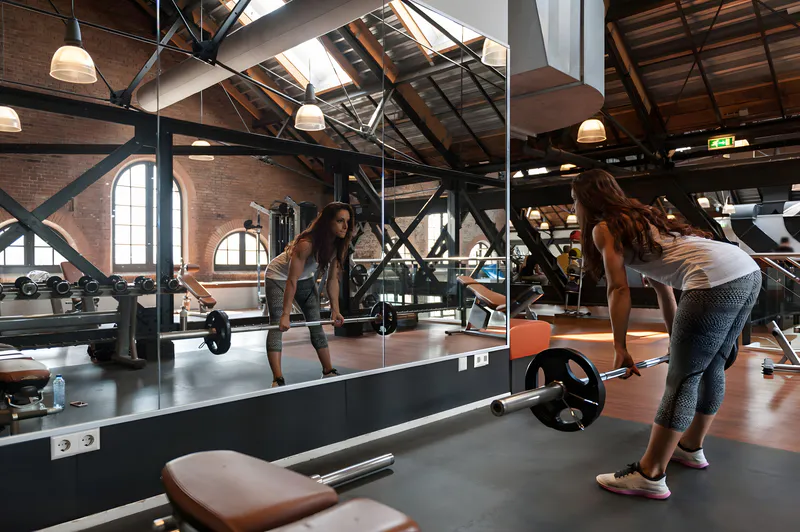
However, this does not mean acrylic has no place in environments like gyms. What you really need is a proper understanding of how acrylic mirrors should be used in a gym setting. Below, I’ll explain why this approach doesn’t work, what methods installers actually use, and how to determine whether acrylic mirrors are suitable for your project.
Why Acrylic Gym Mirrors Distort Your Reflection
The fundamental issue lies in the material’s rigidity — or more precisely, the lack of rigidity.
Acrylic (PMMA) is a thermoplastic material with inherent flexibility. A 3 mm thick sheet will visibly bend under hand pressure, and even a 6 mm thick panel will bow when installed vertically at the scale of a gym wall. According to Plastics International, cast acrylic has a flexural modulus of approximately 3,100 MPa — only about one twentieth the rigidity of standard float glass.

The impact caused by the material’s flexibility is so significant because gym mirrors typically need to cover large wall areas. A typical studio wall is about three to six meters wide and around two meters high. At this scale, an acrylic mirror responds to every unevenness in the wall surface. Minor wall undulations cause the panel to conform to those contours, rather than spanning across them and leaving gaps the way rigid glass does.
This is not a manufacturing defect — it is a physical property of the material. The larger the unsupported span, the more obvious the deformation becomes, which is why acrylic mirrors work well as bathroom vanity mirrors but struggle to serve as full-wall mirrors required in gyms.
Temperature changes further exacerbate the problem. Human bodies, sunlight, and inadequate ventilation in gyms all generate heat. Acrylic’s coefficient of thermal expansion is about eight times that of glass, so the panels undergo noticeable expansion and contraction as temperatures fluctuate.
In hot yoga studios or sun-facing garage gyms, large acrylic mirrors may develop visible bowing within just a few weeks after installation.
Other Drawbacks of Acrylic Gym Mirrors
Reflection distortion is the most direct issue, but in a gym environment, other problems are equally demanding for acrylic mirrors.
Surface Scratches
By default, acrylic has a hardness of about 2–3 on the Mohs hardness scale, while glass is close to 5.5. In a gym, this difference becomes apparent very quickly. Dumbbells placed too close, cable machine attachments swinging after being released, or even a zipper on a gym bag lightly brushing the surface can all leave marks that are difficult to polish out. Over time, the accumulation of fine scratches reduces clarity and makes the mirror appear hazy under bright overhead lighting.
This issue can be addressed by hard-coating the acrylic, but the problem is that increasing the hardness of acrylic significantly raises the cost beyond simply purchasing glass directly. In addition, hard-coating increases thickness, but increased thickness does not improve reflection imaging issues. Therefore, it is not cost-effective.
Static Electricity and Dust Attraction
Acrylic materials generate static electricity, which attracts dust and lint from the air—both of which are everywhere in a gym environment filled with chalk powder, mats, and towel fibers. Glass can be wiped clean in seconds, but acrylic requires more careful cleaning methods, including the use of non-abrasive cloths and ammonia-free cleaners to avoid further worsening scratch issues.
Long-Term Yellowing
Ordinary acrylic may develop slight yellowing after many years of ultraviolet exposure, commonly known as “yellowing.” Gyms with large windows or skylights will accelerate this process. Although UV-stabilized grades of acrylic exist, they are more expensive, and in terms of stability over several decades, they still cannot compare with tempered glass. At present, requirements regarding acrylic yellowing are more applicable to outdoor scenarios.
Individually, each issue can be managed. But in a high-frequency-use gym environment, these problems compound and create a maintenance burden that many owners underestimate when making a purchase.
Why Glass Mirrors Remain the Industry Standard for Gym Walls
Given these limitations, one cannot help but ask: why do most commercial gyms, dance studios, and martial arts dojos still use glass?
The rigidity of glass is the primary factor. A 6 mm thick tempered glass panel can remain flat and distortion-free across spans large enough to cause acrylic to bend. Installers place full-height glass panels side by side, leaving only narrow seams, while the reflection remains true from any angle. For ballet dancers who need to observe outward-turning movements, or weightlifters who need to check knee tracking, this flatness of reflected imagery is non-negotiable.
Tempered glass also addresses the safety concerns that led people to turn to acrylic mirrors. When it breaks, it shatters into small, blunt-edged particles rather than dangerous sharp shards. Its impact resistance is not as high as acrylic, but in properly managed facilities, as long as mirrors are positioned behind buffer zones, the risk of breakage is low. The ASTM C1048 standard was specifically established for tempered glass used in architectural safety applications of this kind.

If glass is capable of doing the job, then why does the discussion around acrylic mirrors continue to keep appearing?
When Acrylic Gym Mirrors Are Still a Reasonable Choice
Despite all of the issues mentioned above, in some situations acrylic is still the right choice—or at least the only practical one.
Children’s facilities and school gymnasiums. Some regions require shatter-resistant surfaces in spaces used by minors. Acrylic does not shatter at all when impacted, providing a higher level of safety than tempered glass. In these settings, slight reflection distortion is less important compared to completely eliminating the risk of breakage, and people’s safety is the top priority.
Temporary or movable setups. Using glass materials in a gym may mean that relocating the space is not easy. This is not suitable for pop-up fitness studios or touring dance groups. They need mirrors that can be repeatedly transported and dismantled. Properly sized acrylic mirrors have greater advantages in handling requirements and can withstand treatment that glass cannot tolerate.
Home gyms located in high-rise buildings or rental spaces. A 2 m × 1 m tempered glass mirror weighs about 30 kilograms, while an acrylic mirror of the same size and 3 mm thickness weighs around 7 kilograms. For tenants who cannot drill and install heavy-duty fixtures, lightweight acrylic mirrors used with mirror safety adhesive provide a removable alternative.
Special color options. Acrylic mirrors can also offer other color choices. Some gyms prefer using gold acrylic mirrors, which do not affect the quality of the reflected image while also giving the gym a distinctive appearance. When a gym owner wants their venue to have a more premium visual feel, acrylic mirrors in different colors become an option.
In all of these situations, the key is that acrylic mirrors are used under the premise of “how to avoid poor reflection results”—which leads to the methods or scenarios where acrylic mirrors are truly effective.
How to Use Acrylic Mirrors Without Creating Reflective Distortion
The biggest mistake consumers make when buying acrylic gym mirrors is ordering one or two oversized mirror sheets and expecting them to perform like glass. That is not the case. The solution is to completely abandon the idea of large single mirror panels and instead treat the mirror wall as wall tiles made from smaller acrylic mirror panels. As shown below:
In fact, this is exactly how professional installers handle acrylic in commercial fitness facilities. By keeping each individual panel within a sufficiently small size range and “working with” the material’s properties, reflection distortion becomes negligible.
Choosing the Right Panel Size
The goal is to keep the unsupported span short enough that the panel cannot bend. As a practical guideline, a single acrylic mirror panel used in tiled gym wall installations should ideally not exceed about 60 cm × 60 cm for 3 mm material. If upgrading to thicker sheets — 4.5 mm or 6 mm — the size of each tiled panel can be increased to approximately 90 cm × 90 cm without noticeable distortion.
These numbers are not arbitrary. They reflect the critical point at which the panel’s own rigidity is sufficient to span minor wall unevenness without deforming. Breaking the installation into smaller panels also means that if one tile panel becomes scratched or damaged, you only need to replace that single piece rather than the entire wall.
Wall Preparation
Because acrylic conforms to whatever surface is behind it, wall preparation is far more important than with glass installation. Use a long straightedge to check wall flatness — any deviation greater than 2–3 mm over a one-meter span will appear as visible waviness. For uneven drywall, skim coating may be used; for concrete or cinder block walls commonly found in garage gyms, it is recommended to first install a 12 mm MDF or plywood backing layer. This intermediate substrate is the most effective measure for preventing distortion.
Installation and Joint Treatment
Each tiled panel should be mounted using a combination of high-bond mirror mounting tape and neutral-cure silicone (never use acetic-cure silicone, as it will corrode acrylic). The adhesive should be applied in vertical strips rather than full-surface coverage, allowing trapped air to equalize and escape — a fully covered adhesive layer may exert outward pressure and create visible bulges.
A consistent 1–2 mm gap should be maintained between adjacent tiled panels. This joint accommodates thermal expansion and contraction, preventing panels from pressing against each other and warping, while also creating clean, intentional grid lines. Open joints are generally easier to maintain than silicone-filled joints, which tend to collect dust.
The Bottom Line: Match the Material to the Application
In the demand for large-sized mirrors, glass does indeed have a clear advantage in reflection imaging accuracy. Acrylic gym mirrors are not a bad product; they are an alternative and decent product, but they are being used in a demanding application scenario that exposes the limitations of the material.
If the budget allows, tempered glass should still be the first choice for gyms. If the budget is somewhat limited, then choosing acrylic mirrors is also feasible when used correctly. Both glass mirrors and acrylic mirrors have their own advantages. Our Acrylic Mirror vs Glass Mirror discusses this aspect and is worth reading.
However, if safety, load-bearing limitations, portability, or budget make you lean toward acrylic, then the tiled panel approach can turn the material’s disadvantages into a viable solution. Keep the panel size small enough to maintain flatness, carefully prepare the installation surface, and intentionally plan the seam layout. The final result will not be exactly the same as glass in optical performance, but except for scenarios with extremely high demands for motion correction, it is close enough—and it is lighter, safer, and far more fault-tolerant when problems arise.
Frequently Asked Questions
Are acrylic gym mirrors as clear as glass mirrors?
At small sizes, acrylic mirrors offer excellent optical clarity — up to 92% reflectance for cast acrylic. However, at the large dimensions gym walls require, the material’s flexibility causes surface irregularities that distort the reflected image. Glass maintains consistent clarity regardless of panel size, which is why it remains the standard for professional fitness facilities.
Why do large acrylic mirrors warp on gym walls?
Acrylic has roughly one-twentieth the flexural stiffness of glass. When mounted as a single large panel, it conforms to any unevenness in the wall behind it rather than bridging over it. Temperature fluctuations in gym environments further amplify this effect because acrylic expands and contracts at about eight times the rate of glass.
What size acrylic panels avoid distortion in a gym?
As a practical guideline, keep 3 mm acrylic mirror tiles to approximately 60 cm × 90 cm or smaller. With thicker material (4.5–6 mm), you can extend to roughly 90 cm × 120 cm per tile. At these sizes, the panel’s own rigidity is sufficient to resist visible bowing.
Can I use a single large acrylic mirror in a home gym?
It’s not recommended. Even in a small home gym, a single acrylic panel wider than about one meter will show some degree of waviness, especially if the wall surface isn’t perfectly flat. The tile-panel approach described in this article delivers a much more consistent reflection with the same total coverage area.
How do I prevent acrylic gym mirror tiles from scratching?
Position the mirror wall behind a buffer zone of at least 30 cm from any equipment. Avoid placing dumbbell racks directly against the mirrored wall. Clean with a soft microfiber cloth and an ammonia-free solution — never paper towels or glass cleaners containing alcohol, which can haze the surface over time.