
Through our investigation, we found that the vast majority of bathing environments today still use glass mirrors. Why does this situation exist? One very direct reason is that the most essential function of a bathroom mirror is still to provide clear and stable reflective imaging. Whether for daily washing, skincare, makeup, or grooming, users tend to care a great deal about whether the mirror surface is flat and whether body proportions appear normal. Glass itself has relatively high rigidity and can maintain good flatness under common bathroom mirror sizes, which is why it has long been the most common material used for bathroom mirrors.
As market demand has changed, mirrors made from acrylic materials have also gradually appeared in settings such as bathrooms. Compared with traditional glass mirrors, acrylic mirrors are lightweight, resistant to shattering, and easy to cut and process, giving them certain advantages in applications that place greater emphasis on safety, installation convenience, and customized shapes.
However, considering the practical requirements for mirrors in bathroom environments, mirrors made primarily from acrylic are not considered the most ideal choice. The reason lies in the fact that acrylic itself has a certain degree of flexibility. As the mirror surface becomes larger, if the panel thickness, installation method, and rear support are not properly controlled, the mirror surface becomes more prone to slight bending, which can ultimately cause stretching, waviness, or localized distortion in the reflections of human contours, straight lines, and surrounding objects.
This issue may not be especially obvious in ordinary decorative mirrors, but bathroom mirrors are different. People usually observe their faces and bodies at a relatively close distance from the mirror, and therefore have higher requirements for imaging accuracy. As a result, even relatively minor bending of the mirror surface may directly affect the actual user experience.
So, what exactly has made products like acrylic bathroom mirrors possible? That is the topic I want to discuss today.
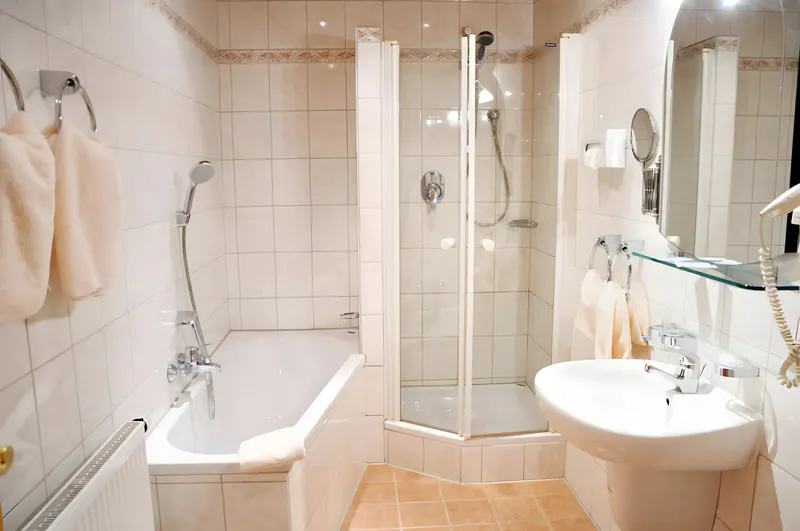
Glass Mirrors Dominate Bathrooms, but They Still Have Certain Limitations
From the perspective of reflection quality, glass mirrors are indeed very suitable for bathrooms. Glass has relatively high rigidity, so even when the mirror surface is large, it is still comparatively easy to keep flat, allowing it to provide stable and natural reflective images. This is why, even today, most bathrooms still primarily use glass mirrors.
However, a bathroom is not an ordinary indoor environment.
The large amount of steam generated during bathing can quickly push the bathroom into a high-humidity state. After the hot water stops, the air temperature gradually drops, and the moisture condenses again on mirrors, walls, and other cooler surfaces. As a result, a bathroom mirror may go through multiple cycles every day of “heating, humidity, cooling, condensation, and drying.”
Glass itself is not easily damaged by this moisture. What truly requires attention are the reflective layer and protective coating behind the glass mirror.
Traditional glass mirrors usually form a metallic reflective layer on the back of the glass and then cover it with a protective coating. Under normal conditions, these structures can remain stable for many years. However, if the mirror’s edge sealing is insufficient, or if the protective backing becomes scratched or aged, long-term moisture may gradually penetrate the reflective layer from the edges or damaged areas.
This is also why some bathroom mirrors that have been used for a long time first begin developing black spots, blackened edges, or localized loss of reflectivity around the edges. This phenomenon is commonly referred to as “desilvering” or corrosion of the mirror surface. Especially in bathrooms with poor ventilation and mirrors that remain in damp conditions for extended periods, these issues are more likely to gradually accumulate. Homes & Gardens, when discussing bathroom mirror condensation problems, also mentioned mold and maintenance issues caused by long-term moisture and standing water around mirrors.
A user from Reddit also shared a similar situation and sought solutions in the community. The images shared by this user can also help us better understand this phenomenon.
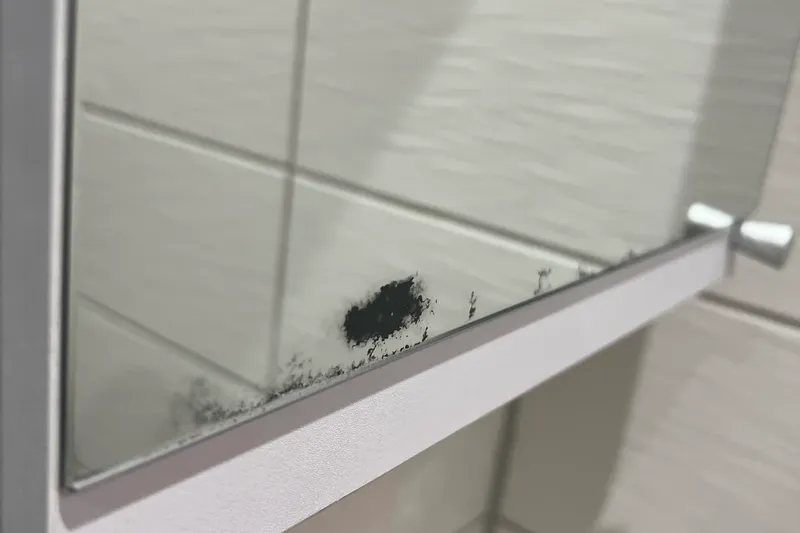
Therefore, the impact of the bathroom environment on glass mirrors is not that “glass will be damaged when it comes into contact with water,” but rather that repeated long-term humidity and condensation continuously test the protective capability of the mirror’s edge sealing and rear reflective layer.
In addition to humid conditions, glass mirrors also have two other fairly obvious characteristics: weight and breakage risk.
At the same size, glass mirrors are noticeably heavier than acrylic mirrors. The larger and thicker the mirror, the greater the requirements placed on the wall, mounting hardware, and installation structure. On concrete walls or structurally solid surfaces, this is usually not a major issue. However, in lightweight partition walls, older buildings, mobile homes, or places where extensive drilling is inconvenient, installation becomes much more troublesome.
In addition, glass mirrors may shatter when subjected to strong impact. Bathrooms also happen to be spaces where people often walk barefoot and where floors are easily slippery, so if a mirror breaks severely, the safety risks caused by shattered fragments are more concerning than in ordinary rooms.
In other words, although glass mirrors solve the most important issue in bathroom use scenarios — reflective imaging quality — this does not mean they are without disadvantages in terms of weight, safety, installation convenience, and adaptability to long-term humid environments.
And these disadvantages happen to correspond to the advantages of acrylic mirrors.
Acrylic mirrors are lighter, less likely to shatter like ordinary glass, and much more convenient for cutting, drilling, and custom shape processing. From these perspectives, they seem highly suitable for bathrooms.
But the problem returns to the point mentioned at the beginning of the article:
Although acrylic mirrors solve the problems of weight and safety, they must first solve the issue of reflection distortion in large mirror surfaces before they can truly become bathroom mirrors suitable for normal use.
Therefore, what acrylic bathroom mirrors truly need to solve is not “how to replace glass mirrors,” but rather how to take advantage of acrylic’s lightweight, shatter-resistant, and easy-to-process properties while still allowing the mirror surface to deliver normal reflective imaging performance.
How to Properly Use Acrylic Bathroom Mirrors to Replace Glass Bathroom Mirrors?
As mentioned earlier, the real issue that acrylic mirrors need to solve is not weight, safety, or processing difficulty, but rather how to keep the mirror surface sufficiently flat in order to achieve normal and stable reflective imaging performance.
Therefore, if you want to use an acrylic bathroom mirror to replace a traditional glass bathroom mirror, you cannot simply install an ordinary acrylic mirror sheet directly onto the wall. The truly feasible approach is to control deformation simultaneously through several aspects: mirror size, material thickness, mirror structure, and installation method.
Size
The first thing that needs to be determined is the size of the acrylic mirror.
One of the biggest differences between acrylic and glass is the difference in material rigidity. At the same thickness, acrylic is more prone to bending, so the larger the mirror surface, the more easily slight fluctuations in the sheet itself will be amplified in the reflected image. For smaller mirrors, this kind of variation is usually easier to control; however, as the length and width of the mirror continue to increase, the requirements for sheet thickness, rear support, and installation flatness also increase accordingly.
Therefore, when designing an acrylic bathroom mirror, bigger is not necessarily better. Instead, a reasonable mirror size should be determined based on the actual viewing distance and imaging requirements. If a larger wall area needs to be covered, it is also possible to consider combining multiple mirror panels rather than relying solely on one oversized thin acrylic mirror sheet.
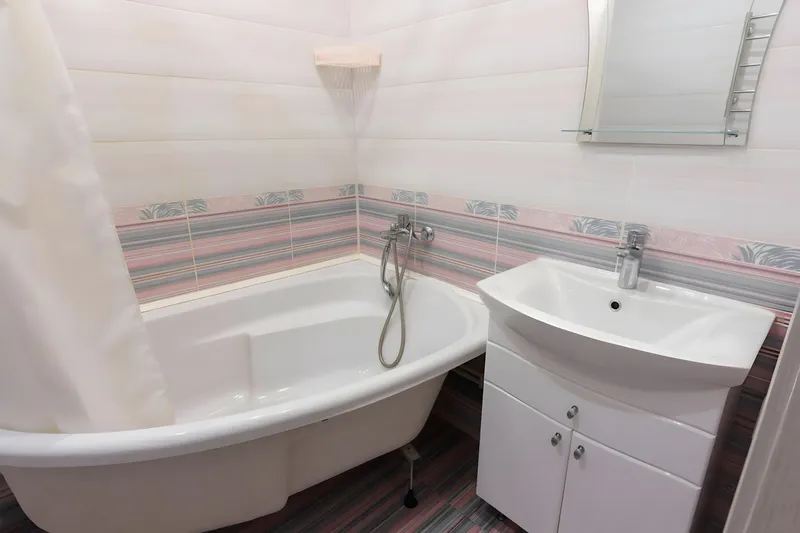
Thickness
After determining the size, the second factor that needs to be considered is the thickness of the acrylic mirror.
Thickness directly affects the rigidity of the sheet. Thinner acrylic mirrors are lighter in weight and easier to process, but as the area increases, they are more easily affected by their own weight, uneven walls, and installation stress, which can lead to slight bending.
Appropriately increasing the thickness of the acrylic substrate can improve the structural stability of the entire mirror, making it easier for the mirror surface to remain flat. However, thickness alone cannot determine the final reflection performance. Even when using thicker materials, the mirror surface may still deform if rear support is insufficient or if the installation surface itself is uneven.
Therefore, size and thickness should be considered together: the larger the mirror surface, the higher the requirements are usually for material thickness and structural stability.
Lamination Process
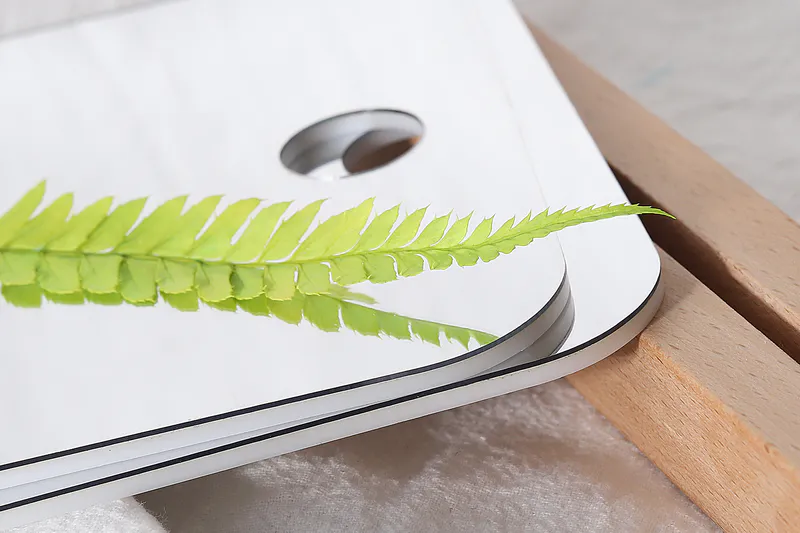
In addition to single-layer acrylic mirrors, the overall stability of the mirror can also be further improved through a lamination process.
The so-called lamination process can be understood as bonding two acrylic sheets together, with the metal reflective layer placed between the two layers of material. Compared with a single-sheet mirror structure, this method can increase the overall thickness and rigidity of the mirror body while also providing additional protection for the reflective layer.
For environments such as bathrooms that are exposed to moisture and humidity over long periods, this structure also has an additional advantage: the metal reflective layer is not directly exposed to the external environment, which can reduce the effects of moisture, cleaning agents, and daily wiping on the reflective layer.
However, it should be noted that lamination does not mean the mirror surface will definitely not deform. Its role is more about improving overall structural stability, while the final reflection performance still depends on the flatness of the sheets themselves, the lamination process, and the stress condition after installation.
Installation Method
The last factor, which is often overlooked yet extremely important, is the installation method.
Acrylic mirrors themselves have a certain degree of flexibility, so any local unevenness in the wall, uneven adhesive thickness, or inconsistent stress at fixing points may be transferred to the mirror surface. If the mirror is forcibly pressed onto an uneven wall during installation, even a mirror sheet that was very flat when leaving the factory may develop localized bending after installation.
Therefore, acrylic bathroom mirrors are more suitable for installation on flat and stable base surfaces, while ensuring that the back of the mirror receives as even support as possible. For larger mirrors, additional flat backing panels or other support structures can also be added to prevent the mirror surface from bending due to partial unsupported areas.
In other words, an acrylic mirror that can truly replace a glass bathroom mirror is not achieved simply by relying on a single material parameter.
In reality, it needs to simultaneously satisfy several conditions: reasonable size control, sufficient material thickness, stable mirror structure, protected reflective layers, and the ability to remain flat over the long term after installation.
Only when all of these conditions are properly controlled can the advantages of acrylic—light weight, shatter resistance, and easy processing—be fully realized without significantly sacrificing the most important characteristic of a bathroom mirror: reflective imaging performance.
At this point, acrylic mirrors are no longer merely a mirror material that is “safer and lighter than glass,” but a genuine alternative that can truly be applied in bathrooms.
Disadvantages of Acrylic Bathroom Mirrors
The lightweight nature, shatter resistance, and ease of processing mentioned above are indeed some of the most obvious advantages acrylic mirrors have over glass mirrors. However, when choosing a bathroom mirror, these advantages alone should not be the only consideration. Acrylic is ultimately a plastic material, and it differs significantly from glass in terms of surface hardness, chemical resistance, and temperature stability.
Although acrylic mirrors can be used in bathrooms, that does not mean they are suitable for every bathroom environment. Understanding these limitations actually makes it easier to determine when an acrylic mirror should be chosen and when a glass mirror remains the better option. And these are precisely the disadvantages of acrylic mirrors.
The Surface Scratches More Easily Than Glass
One of the more obvious disadvantages of acrylic mirrors is that their surface hardness is lower than that of glass.
Common acrylic sheets without surface hardening treatment generally have relatively limited scratch resistance. Their hardness is roughly around 2H–3H, although the actual value can still vary depending on the raw materials, surface treatment methods, and testing standards.
For ordinary decorative applications, this level of hardness is usually sufficient for normal use, but in a bathroom environment, more attention is required.
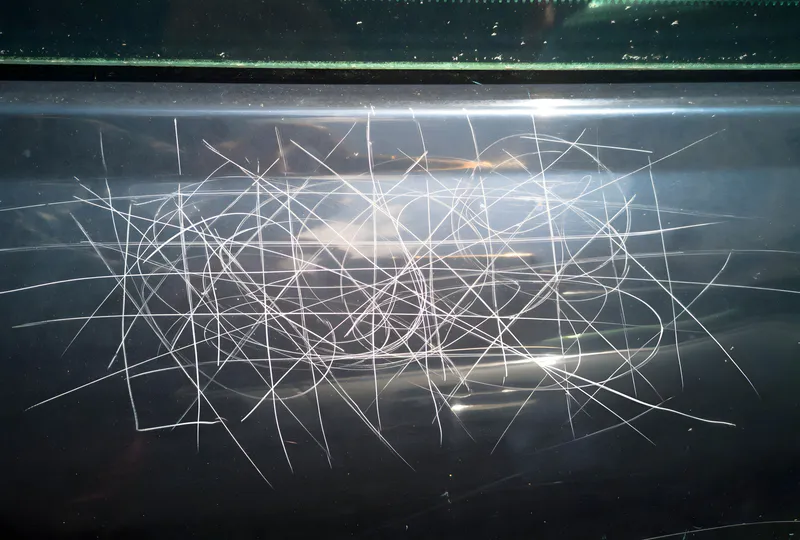
Bathroom mirrors need frequent cleaning. Water stains, toothpaste, soap residue, and fine dust particles in the air can all accumulate on the mirror surface. If hard paper towels, rough cloths, or abrasive cleaning tools are repeatedly used directly on the surface, these tiny particles may leave small scratches on the acrylic.
At first, these scratches may not be obvious, but as they accumulate over time, the mirror surface may gradually lose its original smoothness and gloss. Under lighting, some fine scratches may also produce noticeable light scattering.
If acrylic mirrors need to be used in bathrooms over the long term, this issue can be improved through surface hardening treatment or the addition of scratch-resistant protective coatings.
For example, applying a hard coating to the acrylic mirror surface can significantly improve abrasion and scratch resistance. Some products can also include protective films to reduce the risk of scratches during transportation, installation, and construction.
However, even after hardening treatment, daily cleaning is still better done with a soft microfiber cloth rather than treating it exactly like a glass mirror during cleaning.
In other words, acrylic mirrors can improve scratch resistance, but in terms of surface hardness, they are still difficult to make fully equivalent to glass.
More Sensitive to Certain Chemicals
Another issue that requires attention is that acrylic materials are relatively sensitive to certain chemical substances.
Bathrooms are places where cleaning agents are frequently used. Glass cleaners, descaling agents, disinfectants, alcohol-based cleaners, and various bathroom cleaning products may all come into contact with the mirror surface.
For glass, many common cleaning agents do not significantly affect the substrate itself, but acrylic is different.
Some solvents and strongly corrosive chemicals may cause the acrylic surface to become cloudy, lose gloss, develop fine cracks, or even experience what is commonly called “stress cracking.”
This effect may become even more obvious if the acrylic sheet already contains internal stress or is subjected to continuous bending and stretching during installation.
Therefore, acrylic bathroom mirrors cannot simply use all the traditional cleaning methods intended for glass mirrors.
For daily cleaning, clean water, mild neutral detergents, and soft cloths are generally more suitable. For strong cleaners with unclear ingredients, solvent-based products, or strong acidic or alkaline cleaners, it is necessary to first confirm whether they are suitable for PMMA acrylic materials.
This is especially important in hotels, gyms, public bathrooms, and other places that require frequent cleaning and disinfection.
In these environments, mirrors are cleaned far more frequently than in ordinary households, and staff may use a wider variety of cleaning agents. If the types of cleaning products cannot be controlled, the long-term maintenance requirements of acrylic mirrors will be higher than those of glass mirrors.
More Sensitive to Temperature Changes
Temperature changes are another factor that must be considered with acrylic mirrors.
What truly deserves attention here is not simply that “acrylic is afraid of high temperatures,” but rather that acrylic and glass differ significantly in dimensional stability when exposed to temperature changes.
Acrylic materials generally have a much higher degree of thermal expansion than glass.
In other words, when temperatures rise, acrylic sheets will expand to some extent; when temperatures drop, they will contract again.
Bathrooms happen to be spaces with relatively frequent temperature fluctuations.
For example, during winter, the bathroom may initially be cold, but once a hot shower starts, indoor temperature and humidity rise rapidly. After bathing ends and ventilation begins, the temperature gradually decreases again.
A single temperature fluctuation usually will not directly damage an acrylic mirror, but if no allowance is made for thermal expansion and contraction during installation, new problems may arise.
For example, if the edges of the mirror are completely constrained or the mounting structure is too tight, internal stress may increase as the acrylic sheet expands thermally. The larger the acrylic mirror, the more important this issue becomes.
If this occurs repeatedly over a long period, it may affect the flatness of the mirror surface or even cause slight distortion in local reflections.
Therefore, when designing and installing acrylic bathroom mirrors, in addition to considering backing boards and flatness mentioned earlier, the thermal expansion and contraction of the material should also be taken into account, and suitable mounting methods should be selected according to mirror size.
Long-Term High Temperatures May Accelerate Material Aging
Acrylic is a thermoplastic material, so it is also unsuitable for prolonged exposure to excessively high temperatures.
However, it is important to distinguish between normal bathroom temperatures and long-term high-temperature environments.
The hot steam produced during ordinary household bathing generally will not cause a properly manufactured acrylic mirror to yellow in a short period of time. High-quality PMMA itself also has relatively good weather resistance.
What truly requires attention is prolonged proximity to continuous heat sources.
For example, if the mirror is too close to bathroom heaters, radiators, warm air outlets, or other high-temperature equipment, repeated localized heating over long periods may accelerate material aging. In lower-quality acrylic materials, long-term thermal aging may also appear as color changes, deterioration of the surface condition, or changes in material properties.
If ultraviolet light, high temperatures, and long-term humidity are present at the same time, the aging process may accelerate even further.
Therefore, in normal household bathrooms, temperature is usually not the most serious issue. However, in saunas, steam rooms, high-temperature bathing areas, or situations where mirrors are very close to heating equipment, the suitability of acrylic materials should be evaluated more carefully.
Acrylic Mirrors Are Not a Universal Replacement for Glass Mirrors in Bathrooms
These issues show that acrylic bathroom mirrors are not a material that is “comprehensively superior to glass mirrors.”
They simply solve some of the problems associated with glass mirrors while introducing new limitations inherent to plastic materials.
If a bathroom places particular importance on lightweight construction, shatter resistance, safety, custom shapes, or installation convenience, acrylic mirrors can offer clear advantages.
For example, children’s areas, schools, fitness facilities, temporary buildings, RVs, boats, or certain public places that are especially sensitive to the risks of broken mirrors may value these characteristics more highly.
However, if the environment requires frequent use of strong cleaning agents, heavy daily wiping, or very high long-term scratch resistance and large-scale image quality, glass mirrors are often still the more suitable choice.
The key to choosing an acrylic bathroom mirror is not simply deciding:
“Which is better, acrylic or glass?”
What really needs to be determined is:
Does this bathroom need the hardness and imaging stability of glass more, or does it need the lightweight, shatter-resistant, and easy-to-process characteristics of acrylic more?
Only by considering the specific usage environment, mirror size, installation method, and maintenance approach together can it be determined whether an acrylic mirror is truly suitable for that bathroom.
How to Choose Acrylic Mirrors for Different Bathrooms?
Bathroom size, user groups, bathing frequency, and mirror installation locations all vary, so there is no single fixed acrylic bathroom mirror solution suitable for every scenario.
In practice, acrylic bathroom mirrors can first be divided into several common types: standard acrylic mirrors, anti-fog acrylic mirrors, and tile-style or modular acrylic mirrors suitable for large wall installations.
Standard types are more suitable for regular washing and daily use; anti-fog types are better for spaces where the mirror surface is easily covered by steam; while wall tile-style mirrors mainly solve issues related to weight, size, and reflection distortion when installing large mirror surfaces.
Therefore, the key to choosing the right mirror depends on who uses the bathroom, how large the space is, and where the mirror will ultimately be installed.
Family Bathrooms With Children
If the bathroom is mainly used by children or shared by family members, then safety should be the first consideration.
Compared with ordinary glass mirrors, acrylic mirrors are less likely to shatter into sharp fragments after impact, making them more suitable for environments where children are frequently active. Children splash water in the bathroom, throw things around, and often drop objects onto the floor.
These bathrooms usually do not require especially large single-piece mirrors, so relatively small acrylic mirrors can be selected.
Smaller sizes also provide an additional advantage: the mirror surface is easier to keep flat, and reflection distortion is easier to control. If anti-fog treatment is added, the mirror can also return to normal usability more quickly even when there is a large amount of steam in the bathroom after bathing.
For family bathrooms with children, a more suitable solution is usually: small-sized, shatter-resistant acrylic mirrors with anti-fog functionality.
If needed, a round, square, or other shaped acrylic mirror can also be added at a height where children can directly see themselves. Acrylic itself is easy to cut and process, so it is also easier than glass to produce different shapes in this kind of scenario.

Small Apartments and Rental Bathrooms
For small apartments, rental properties, and bathrooms with limited space, the weight and installation method of the mirror are often more important than complex features.
These bathrooms usually do not have especially large wall areas, and the mirror size is generally not excessive, so standard acrylic mirrors are already sufficient for most needs.
Acrylic mirrors are lightweight and place relatively lower requirements on walls and mounting structures. If the wall is drywall, a lightweight partition wall, or already tiled, making it inconvenient to install a heavy glass mirror, then lightweight acrylic mirrors are easier to handle.
Small bathrooms often encounter issues such as non-standard sink sizes, limited wall width, or complex pipe layouts.
Acrylic mirrors can be cut according to actual dimensions, for example into narrow rectangles, rounded-corner mirrors, or irregular shapes, thereby adapting to wall spaces that were originally difficult to utilize.
If the bathroom has good ventilation and mirror fogging after showers is not severe, then there is no need to forcibly add anti-fog functionality; a regular standard acrylic mirror is sufficient.
When choosing acrylic mirrors for these spaces, priority can be given to: standard acrylic mirrors that are moderately sized, lightweight, and easy to customize and install.
Small Bathrooms With Frequent Shower Use Are Better Suited for Anti-Fog Acrylic Mirrors
There is another type of bathroom that is not very large, but has a high bathing frequency and average ventilation conditions.
In this situation, what truly affects the mirror usage experience is often not the size, but fogging.
After a hot shower, a large amount of steam quickly condenses on the relatively cool mirror surface, making the mirror temporarily unusable. If users have to wait every day for the fog to dissipate or frequently wipe the mirror manually, the experience declines noticeably.
In this case, anti-fog acrylic mirrors can be chosen.
Moreover, for anti-fog acrylic mirrors, smaller sizes are usually easier to control in terms of anti-fog performance. The smaller the mirror surface area, the easier it is to maintain a consistent surface condition, while installation, cleaning, and maintenance also become simpler.
Therefore, if the bathroom itself is small and hot showers are taken frequently, then compared with pursuing one large mirror surface, using a reasonably sized anti-fog acrylic mirror is often more practical.
This solution is especially suitable for small apartment bathrooms, dormitory restrooms, gym locker rooms, and other small bathing spaces with relatively high usage frequency.
Large Mirror Surfaces in Master Bathrooms Are Better Suited for Wall Tile-Style Acrylic Mirrors
Master bathrooms, hotel bathrooms, or larger restrooms often aim for mirrors that cover the entire sink area or even form a full mirror wall.
But this is exactly where ordinary single-piece acrylic mirrors are most likely to encounter problems.
As mentioned earlier, acrylic material has a certain degree of flexibility. As the mirror size continues to increase, even if the sheet thickness is increased, it becomes increasingly susceptible to wall flatness, its own weight, and installation stress.
Therefore, if a large acrylic bathroom mirror wall is needed, it may not be appropriate to continue using the idea of a “single oversized mirror sheet.”
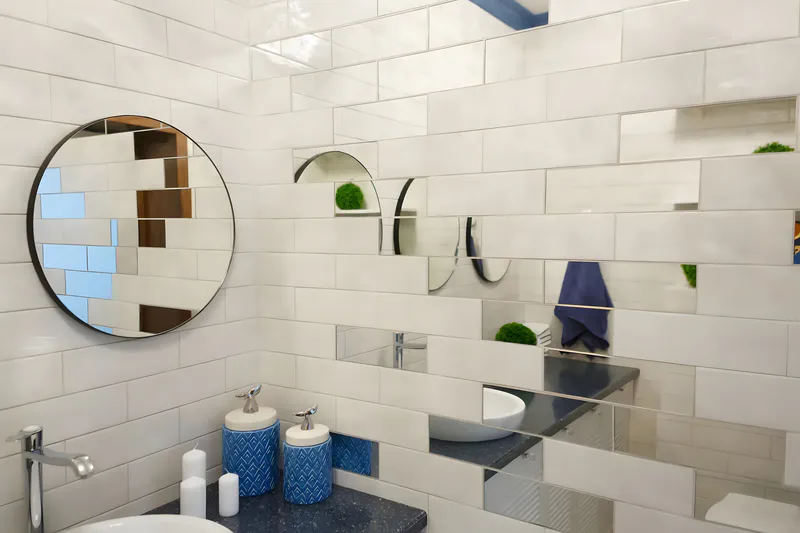
One more reasonable method is to use wall tile-style or modular acrylic mirrors.
This approach divides the originally large mirror surface into multiple relatively small mirror panels, which are then continuously installed according to the wall layout.
Because the size of each mirror panel is controlled, the degree of acrylic bending becomes easier to manage. During installation, each piece can also be adjusted according to the actual flatness of the wall, rather than allowing one large acrylic panel to bear the errors of the entire wall directly.
For example, an entire sink background wall can use multiple square or rectangular acrylic mirrors of the same size arranged together.
From a distance, it can still create the effect of a large mirror surface, but each individual mirror panel is smaller, making it easier to control flatness and reflection distortion.
Therefore, for master bathrooms that require large mirror surfaces, priority can be given to: wall tile-style and modular assembled acrylic mirrors, rather than single oversized thin acrylic mirrors.
Conclusion
Acrylic bathroom mirrors have clear advantages in being lightweight, shatter-resistant, easy to process, and customizable. Whether they can truly be used in a bathroom mainly depends on the size, thickness, mirror structure, installation method, and specific usage environment. Small-sized, anti-fog acrylic mirrors are more suitable for everyday bathroom use, while large mirror surfaces are better suited to spliced or modular installation methods to reduce reflection distortion.
If safety, weight, and customization capability are higher priorities, acrylic mirrors are an option worth considering; if greater importance is placed on surface scratch resistance, imaging stability for large sizes, and long-term low maintenance, glass mirrors still retain advantages.
Choosing which type of mirror to use is not about which material is better, but about which solution is more suitable for the specific bathroom environment.