
There is more than one type of round acrylic mirror. When most people hear “round acrylic mirror,” they think of a circular mirror. In reality, the category referred to by round acrylic mirrors may include several different types, and when you discuss such products with suppliers, the answers you receive may not always be the same.
Flat round mirrors used on bathroom walls, convex traffic mirrors used for warehouse blind spots, and full dome mirrors used on retail store ceilings are all round and made of acrylic, yet they are completely different products.
They differ in curvature, thickness, mounting hardware, and optical performance. If a buyer who needs a security dome mirror orders a flat round mirror instead (which is generally unlikely to happen), the product they receive will ultimately fail to achieve the intended function. Even though the probability of this happening is relatively low, it is still necessary to clarify the differences among round acrylic mirrors.
This guide will provide a detailed introduction to each major type of round acrylic mirror, the manufacturing specifications that define each type, the available customization and processing options, and the application scenarios best suited for each type.
Types of Round Acrylic Mirrors: Flat, Curved, and Dome
Circular acrylic mirrors can be divided into three main categories. They all use the same base material — PMMA (polymethyl methacrylate) with a reflective metal coating — but differences in geometry completely change how the mirror behaves.
Standard Flat Circular Mirrors
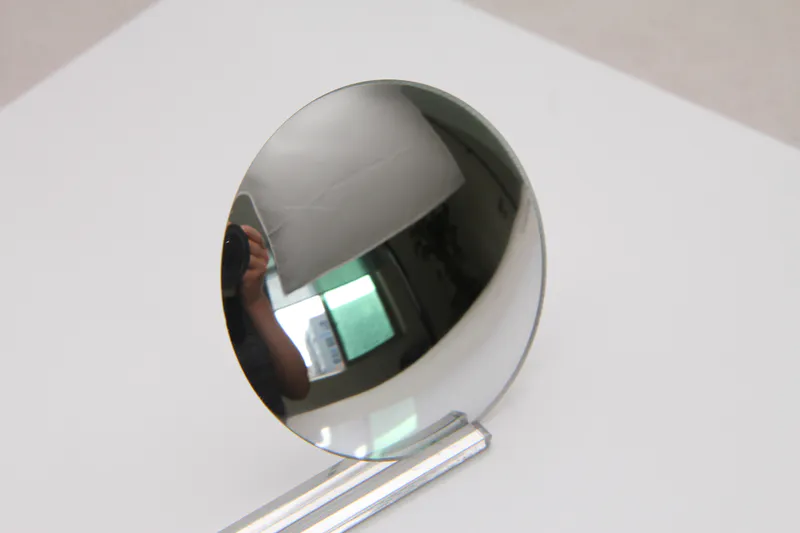
This is the most common type. Flat circular acrylic mirrors are discs cut directly from mirror sheets, featuring uniform thickness and a flat reflective surface that produces the same true 1:1 reflection as traditional glass.
Interestingly, the vast majority of acrylic mirrors are also more commonly preferred in circular form; square or rectangular shapes actually have lower demand than circular ones.
Whenever a standard style is needed, flat circular mirrors are the appropriate choice: wall decorations, vanity mirrors, furniture decoration, decorative wall arrangements, display backgrounds, and more. They are processed into circular shapes from standard acrylic mirror sheets through laser cutting or CNC engraving, so nearly any diameter can be provided as a custom order.

Convex and Concave Circular Mirrors
Curved mirrors add a third dimension. A convex mirror has an outward-bulging surface that compresses a wide field of view into a compact disc, making objects appear smaller while covering a larger area than a flat mirror of the same diameter. Convex mirrors are commonly used in safety, anti-theft, and traffic management applications. Traffic mirrors, for example, are a type of large convex mirror.
A concave mirror, on the other hand, curves inward and can magnify objects at short focal distances. It is used in vanity mirrors, optical instruments, and display installations where close-up detail is required. Concave acrylic mirrors are less common in the commercial market, but are frequently produced for specialized industrial and scientific applications. It should be noted that acrylic concave mirrors generally cannot be used in optical instruments, which require more specialized optical lenses instead.
For buyers, the distinction is simple: need a wide-angle overview of a space → convex mirror; need close-range magnification → concave mirror; need a true, distortion-free reflection → flat mirror.
This is where misunderstandings often arise. When receiving inquiries, manufacturers frequently interpret a customer’s request for a “circular acrylic mirror” as meaning they want a “convex mirror.” We ourselves have encountered this situation several times during the process, although timely communication resolved the misunderstanding.

Full Dome Mirrors
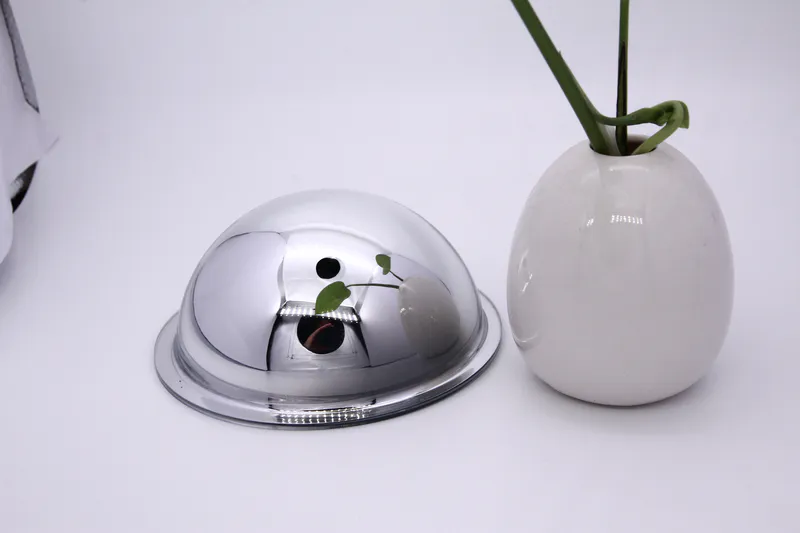
Dome mirrors are made from complete or partial hemispherical mirrored acrylic and are designed for ceiling installation to provide panoramic observation and monitoring of the area below. Full dome mirrors can provide 360° coverage from a single position, so they are widely used in retail stores, warehouses, and institutional buildings.
Half dome mirrors — hemispheres cut into a 180° arc — are commonly installed at T-junctions, hallway intersections, and the ends of aisles to cover three directions of visibility with a single mirror. A half dome mirror with a diameter of 1200mm is basically sufficient for monitoring multiple roadways inside a factory building.
Quarter dome mirrors and eighth dome mirrors also exist for specific corner installations, but these are specialized security products outside the scope of this guide. For most buyers, spherical mirrors can also serve decorative purposes, especially when paired with highly customizable materials such as acrylic. For example, some people may want multiple colored dome mirrors suspended or mounted throughout a room.
Standard Production Specifications for Round Acrylic Mirrors
After understanding the types of round acrylic mirrors, we also need to understand the following standard production specifications for these mirrors. Regardless of the type, every round acrylic mirror is defined by several core specification parameters. Understanding these parameters before ordering can help avoid specification mismatch issues.
Thickness
Flat round acrylic mirrors usually come in three standard thicknesses: 1.5 mm, 3 mm, and 5–6 mm. Thinner mirror sheets (1.5 mm) are suitable for small-diameter decorative circles, craft projects, and self-adhesive wall decorations. The 3 mm thickness range is the most versatile—it is sturdy enough for medium-diameter wall mirrors and signage while still being easy to cut. Thicker sheets (5–6 mm) provide the rigidity needed for larger diameters or freestanding applications. Our thickness guide explains the trade-offs among all mirror shapes in detail.
In addition to these standard thicknesses, flat round mirrors are also available in non-standard thickness ranges such as 0.25 mm or 10.0 mm for more customized requirements.
By contrast, curved mirrors and dome mirrors are relatively uniform in terms of thickness. Generally, anything within 3 mm is sufficient.
Why not use greater thicknesses? This is because the curvature itself provides structural rigidity, whereas a flat panel of the same thickness cannot achieve the same rigidity.
Diameter
The standard diameter range for flat round mirrors commonly spans from 1 cm to 60 cm. Custom diameters larger than 60 cm are also available, but it is important to note the deformation issues that affect all large-size acrylic products. The wider an unsupported round panel is, the more prone it is to bending.
Convex safety mirrors use standard sizes: 30 cm (12″), 45 cm (18″), 60 cm (24″), 90 cm (36″), and 120 cm (48″). Non-standard sizes are also available. Viewing distance is roughly calculated as “one foot of effective viewing distance per inch of diameter,” so a 45 cm mirror can provide an effective field of view at a distance of about 5.5 meters.
Standard sizes for concave mirrors are usually: 15 cm (6″), 20 cm (8″), 25 cm (10″), and 30 cm (12″). Although non-standard sizes are also available, demand generally does not trend toward increasingly larger sizes; concave mirrors tend to favor smaller dimensions.
The standard diameters for dome mirrors are 45 cm, 60 cm, 80 cm, and 90 cm, with larger size options available for high-ceiling spaces. Their application scenarios determine their relatively fixed sizing, though non-standard sizes are also available.
Flat round mirrors are inherently produced according to customized dimensions, while convex mirrors, concave mirrors, and dome mirrors are made according to fixed size ranges. Why is this the case?
The fundamental reason lies in market demand. Curved mirrors generally have specific application scenarios, whereas flat round mirrors have a much broader range of uses.

Special Fabrication Options for Round Acrylic Mirrors
Beyond standard production specifications, custom processing for round acrylic mirrors also involves several important considerations. Here’s a simple overview:
- Edge polishing. Standard cut edges will leave visible machining marks. For frameless wall-mounted round panels or tabletop display pieces with exposed edges, diamond polishing or flame polishing can create a smooth, glass-like surface finish.
- Pre-drilled mounting holes. Pre-drilled holes can be used for screw mounting with decorative standoffs or for fastening to installation structures. Since drilling acrylic mirrors requires specialized drill bits and backing materials to prevent cracking, factory pre-drilling is cleaner and more reliable than on-site drilling. Drilling curved mirrors can also be combined with edge-processing techniques, and the resulting effect is quite good.
- Surface printing and engraving. Logos, text, or decorative patterns can be applied through UV flatbed printing (over the reflective surface) or screen printing. Both methods are widely used for printing on mirror surfaces. Engraving is typically done with laser engraving; CNC can also be used, but laser is preferred for finer visual detail.
- Adhesive backing or backing boards. All round acrylic mirrors can be equipped with adhesive backing or backing boards. For adhesive backing, a pressure-sensitive adhesive layer can be pre-applied at the factory for peel-and-stick installation. This is commonly used for small decorative round panels and wall decal products, and is also suitable for larger custom round mirrors to enable drill-free installation. Backing boards are mainly used for stylistic treatment.
- Beveled or rounded edges. Beveled edge processing creates angled edge surfaces that enhance light reflection and improve the finished appearance. Rounded edges (bullnose edges) can soften the outline, but they are more complex than beveled edges, and most customers do not request this type of edge finishing.
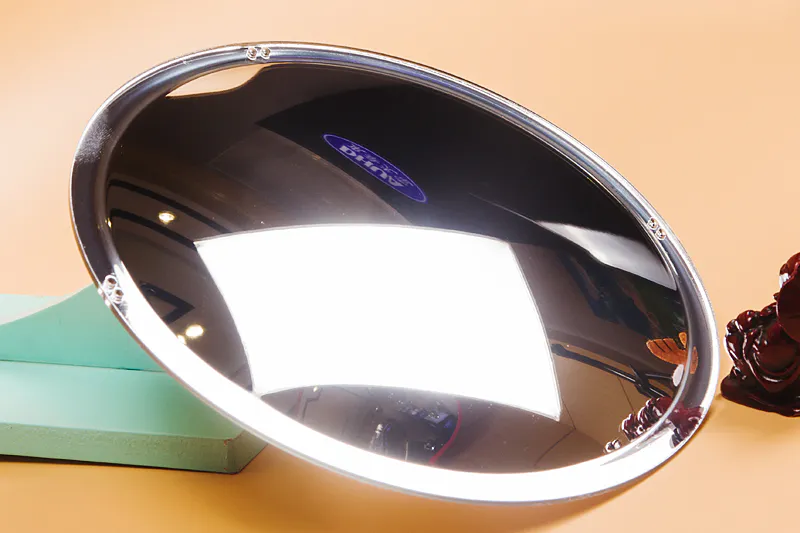
In addition to custom processing, convex mirrors and dome mirrors usually come with mounting brackets and hardware by default because of their special manufacturing process (shape-setting through thermoforming).
Where Round Acrylic Mirrors Are Used
These three types—flat, convex, and dome—are each suited to completely different application fields.
Home Décor and Interior Design
Flat round acrylic mirrors are classic elements in interior design. Hanging a large round mirror above an entryway table can create a visual focal point, while combining round mirrors of different diameters on a wall can create a gallery-style effect.
The shatter-resistant properties of acrylic make round mirrors highly practical in children’s rooms, high-traffic hallways, and earthquake-prone areas. Bohemian, Scandinavian, and mid-century modern styles all make extensive use of round mirror elements.
Flat round acrylic mirrors are very suitable for home decoration. For example, a larger round mirror can be installed in entryways, living rooms, bedrooms, and other spaces, or smaller round mirrors of different sizes can be combined and installed on walls.
Compared with ordinary glass mirrors, acrylic mirrors are lighter in weight and less likely to break, making them more suitable for children’s rooms, hallways, and areas with frequent human activity. Round mirrors also have a simple appearance and are easier to match with different types of interior décor.
Retail and Visual Merchandising
In stores, showrooms, and display cabinets, flat round acrylic mirrors can be used as part of product displays.
For example, placing mirrors beneath or behind products such as jewelry, cosmetics, and accessories can reflect different angles of the products, making the display content appear richer.
Convex mirrors and dome mirrors are more commonly used for observation and security management inside stores. For example, they can be installed at corners, shelf aisles, or ceiling positions to help staff observe areas that cannot be directly seen from normal viewing angles, reducing visual blind spots.
Safety, Protection, and Traffic Management
Convex round acrylic mirrors are commonly used in places where an expanded field of view is needed, such as warehouse intersections, parking lot turns, loading areas, factory passageways, and hospital corridors.
Convex mirrors can reflect a wider area into the mirror surface, allowing people to see vehicles, forklifts, or pedestrians on the other side of a corner in advance, thereby reducing the risk of collisions.
Depending on the curvature and structure of the mirror surface, convex mirrors can usually provide a wide viewing range. Dome mirrors can cover even larger areas; for example, a full dome mirror installed on a ceiling can observe all surrounding directions, while a half dome mirror is suitable for installation on walls or at corridor junctions.
Their wide-angle reflective range is typically 130° to 160°, allowing a single mirror to cover a field of view that would otherwise require multiple flat mirrors. Full dome mirrors and half dome mirrors further achieve overhead coverage of 360° and 180°, respectively.
Crafts, Signage, and Event Decoration
Small flat round mirrors (5–20 cm) are widely used in mosaic art, wedding table arrangements, and event center decorations. Colored mirrored discs are also commonly used as eye-catching signage elements in trade shows and brand installations. In addition to common silver mirror finishes, colored mirror discs in gold, rose gold, blue, and other colors can also be used for exhibition displays, brand signage, window decoration, and event venue arrangements. Because acrylic mirrors are relatively lightweight, they are also more convenient for cutting, bonding, and combined installation.
How to Choose the Right Round Acrylic Mirror
Because there are three main types and a range of specifications to choose from, the selection mainly depends on four questions.
What is the primary use?
- For decoration and reflective imaging, choose a flat mirror.
- For wide-angle viewing and monitoring, choose a convex mirror.
- To achieve a slight magnification effect, choose a concave mirror.
- For overhead panoramic coverage, choose a dome mirror.
What diameter is needed?
- When used for decoration, the mirror width is recommended to be one-third to one-half the width of the object beneath it.
- When used as a safety mirror, the diameter should match the viewing distance (approximately 30 cm of mirror surface for every 3 meters of coverage).
Will the edges be visible?
- If visible, consider polished edges or beveled edge craftsmanship.
- If the mirror is mounted within a frame or suspended from the ceiling, evaluate the quality of the entire product set.
Which installation method will be used?
- Options include adhesive backing, pre-drilled screw mounting, or bracket mounting (standard configuration for convex mirrors and dome mirrors).
FAQ
What is the difference between a round convex mirror and a dome mirror?
A convex mirror is a single curved disc — typically wall-mounted — providing a wide-angle view of 130° to 160°. A dome mirror is a full or partial hemisphere, ceiling-mounted, offering up to 360° panoramic coverage. Both use convex curvature, but dome mirrors wrap it into a three-dimensional shape for overhead viewing.
Can I get a round acrylic mirror in custom colors?
Yes. Flat round mirrors are available in silver, gold, rose gold, bronze, black, and vivid colors including red, blue, purple, and green. Any standard color can be cut into a custom-diameter circle.
How large can a flat round acrylic mirror be without distorting?
At 3 mm thickness, diameters up to about 60 cm maintain a reliably flat surface on a smooth wall. Beyond that, flexibility introduces subtle waviness. Upgrading to 5–6 mm thickness or bonding the mirror to a rigid backer extends the usable diameter.
Are round acrylic convex mirrors suitable for outdoor use?
Standard acrylic convex mirrors are indoor-rated. Outdoor versions with UV-stabilized coatings and weather-resistant housings are available but must be specified at order — indoor models degrade in direct sunlight and rain.