
People often want to try using acrylic in various mirror-type products, and full-length acrylic mirrors are one example. From a material standpoint, full-length mirrors seem quite suitable for acrylic. For instance, acrylic weighs only a fraction of what glass does, it will not shatter if tipped over, and it is less likely to break when impacted. However, once put into actual use, it becomes clear that acrylic has limitations when used for full-length mirrors.
Where do these limitations lie? Based on our experience, size alone presents a considerable obstacle. “Full-length mirror” actually covers a fairly wide range of dimensions, and acrylic performs very differently across different size ranges. A 60 cm × 80 cm full-length mirror leaning against a bedroom wall is sufficiently practical. But if an acrylic mirror is made into a 60 cm × 180 cm wall-mounted mirror, distortion in the reflected image becomes a problem by itself.
We do not recommend using one large acrylic mirror directly as a full-length mirror, but considering that some customers have similar needs, we wrote this blog post to answer some questions.
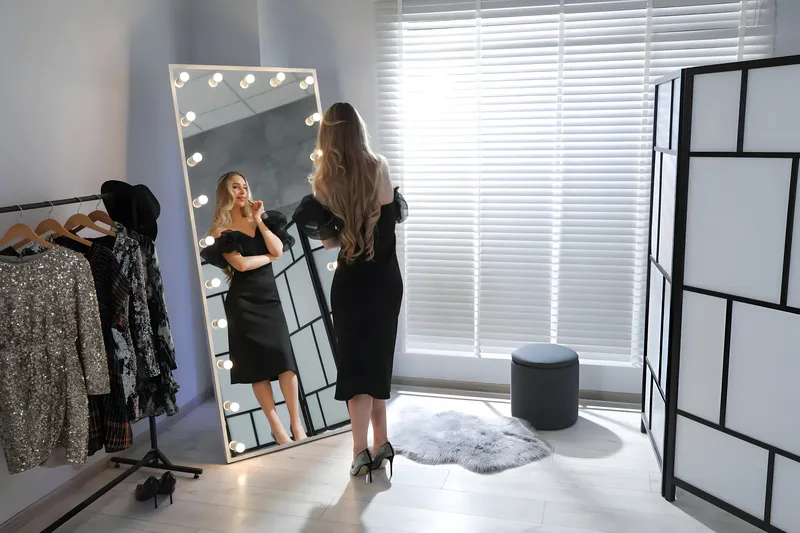
The Origin of Using Acrylic to Make Full-Length Mirrors
The full-length mirror is not a household product that only appeared in modern times. As early as the late 18th century to the early 19th century, Europe already had freestanding dressing mirrors capable of reflecting most or even the entire human body. One representative example is the Cheval Glass, a large mirror mounted between two side supports that allows the angle to be adjusted forward and backward.
The Metropolitan Museum of Art in New York currently houses a French Cheval Glass (Psyché) made around 1810–1814. Standing over 2 meters tall, it already possesses many of the defining characteristics of the modern full-length mirror. Relevant physical reference materials can be found at The Metropolitan Museum of Art – Cheval Glass (Psyché).
Early full-length mirrors of this type mainly used glass mirror surfaces. As glass manufacturing and mirror-coating technologies gradually matured, large mirrors began moving from aristocratic residences and dressing rooms into ordinary homes, eventually developing into the floor mirrors, wall-mounted full-length mirrors, and wardrobe mirrors commonly seen today.
However, glass full-length mirrors have always had several obvious drawbacks: the larger the size, the heavier the overall weight tends to be; there is a risk of breakage during transportation and installation; and when used in children’s spaces, gyms, dance studios, or public areas, additional consideration must be given to the safety risks caused by shattered glass.
The emergence of acrylic materials has provided another material option for full-length mirrors. Modern acrylic usually refers to PMMA (Polymethyl Methacrylate). Compared with ordinary glass, this material is lighter in weight while also offering good transparency, weather resistance, and processing performance. For the development history of acrylic materials, you can refer to PLEXIGLAS – History of Acrylic Glass.
After forming a reflective layer on the surface of an acrylic sheet and adding a protective backing layer, it becomes possible to manufacture what we now call an Acrylic Mirror. The significance of this type of product is not simply “replacing glass with plastic,” but rather providing another solution in scenarios with higher requirements for weight, safety, and processing methods.
Therefore, the emergence of the acrylic full-length mirror can more accurately be described as the result of combining traditional demand for full-length mirrors with modern plastic material technology. The fundamental need for full-length mirrors has not changed, but the materials have expanded from glass alone to acrylic and other plastic mirror materials.
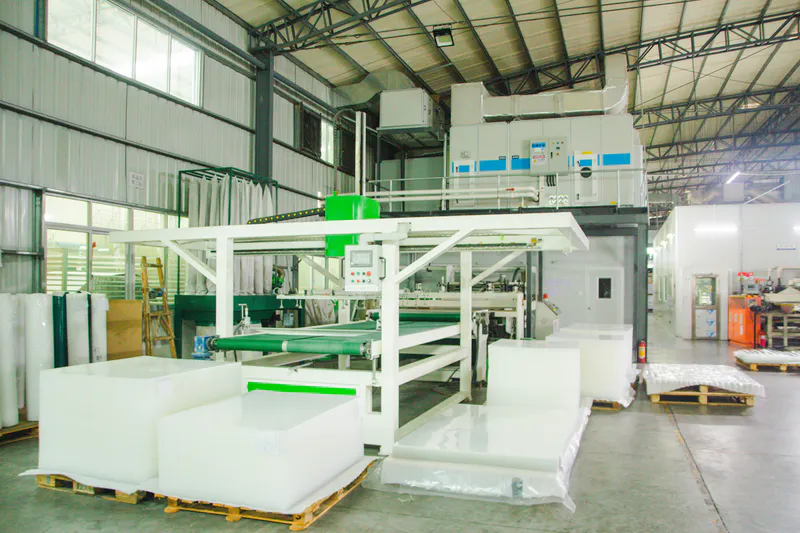
For large mirror surfaces, acrylic is lightweight, shatter-resistant, and easy to cut, drill, and shape into irregular forms. These characteristics have gradually led to its use in home decoration, fitness spaces, retail displays, children’s activity areas, and other environments where weight control and reduced breakage risk are important. However, as mentioned at the beginning, once acrylic mirrors become too large, reflection distortion can occur.
Full-length mirrors are typically 120 cm to 180 cm tall and 30 cm to 60 cm wide. However, this range is very broad — smaller sizes may only barely cover the view from the torso to the knees, while larger sizes can provide a generous head-to-toe field of view at almost any standing distance. At a size of 120 cm × 40 cm, a 3 mm thick acrylic sheet is rigid enough to remain flat when adhered to a wall or mounted inside a frame.
But at 180 cm × 60 cm, the same 3 mm acrylic may become uneven due to the flexibility of the material itself, thereby distorting the mirror surface. For any buyer, the question is not simply “How large does the mirror need to be?” but rather “At what size will an acrylic mirror still maintain undistorted reflection quality?”
Before answering that question, let us first look at what types of buyers typically consider acrylic full-length mirrors.
Who Buys Full-Length Acrylic Mirrors
The following four groups are common buyer types, and whether acrylic is truly a suitable material applies equally to them.
Renters and Students
This is the largest buyer group for full-length acrylic mirrors. Renters need a mirror that is light enough to lean against a wall, while also being portable enough to move between apartments; these buyers usually only need a fixed-size acrylic full-length mirror, with the ideal size typically ranging from 120 cm × 30 cm to 150 cm × 40 cm — tall enough for head-to-toe checking, yet narrow enough to maintain rigidity even without a frame.
At these sizes, 3 mm acrylic sheets perform well because the narrower width limits lateral bending. When placed against a wall at a slight angle, they can provide accurate, distortion-free reflections that are fully sufficient for everyday outfit checks.
Fashion, Beauty, and Content Creators
Influencers and content creators have turned full-length mirror selfies into a distinct visual style. The acrylic full-length mirrors needed by this type of buyer may come in different colors. For this group, reflection accuracy is not necessarily the priority, and the mirrors are often used for additional purposes.
The sizes they usually require (150 cm × 50 cm and above) are exactly where acrylic begins to struggle. To fully capture an outfit while leaving space for the arms on both sides, the mirror sheet must be thick enough to resist bending — requiring at least 4.5 mm or 6 mm thickness, and preferably mounted on a flat and rigid backing.
For many creators in this category, unless there is another intended use, or there are children or pets at home that truly require shatter-resistant properties, framed glass floor mirrors are usually a more suitable choice.
Dance Studios and Gym Owners
Fitness environments require the largest possible continuous mirror walls, which is precisely where single-piece acrylic mirrors fail most noticeably. We have received many business inquiries asking about gym mirror walls, but after informing them of the potential issues, most no longer intended to proceed with a purchase.
Gyms usually require coverage at least 180 cm high and extending several meters horizontally. At this scale, acrylic sheets will bend, bulge, and distort no matter how carefully they are installed. Glass mirrors are recommended as the first choice for this type of project. If acrylic mirrors absolutely must be considered, they can only be used in the manner shown in the image below; otherwise, they are not recommended under any other circumstances!
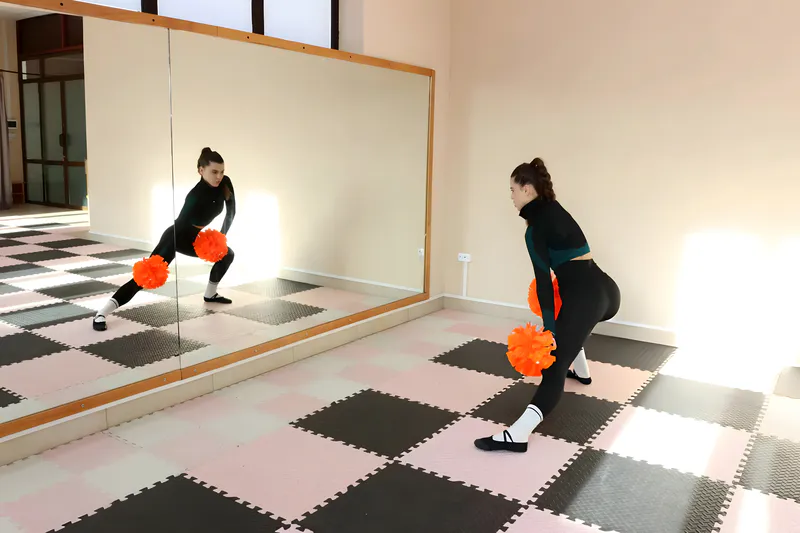
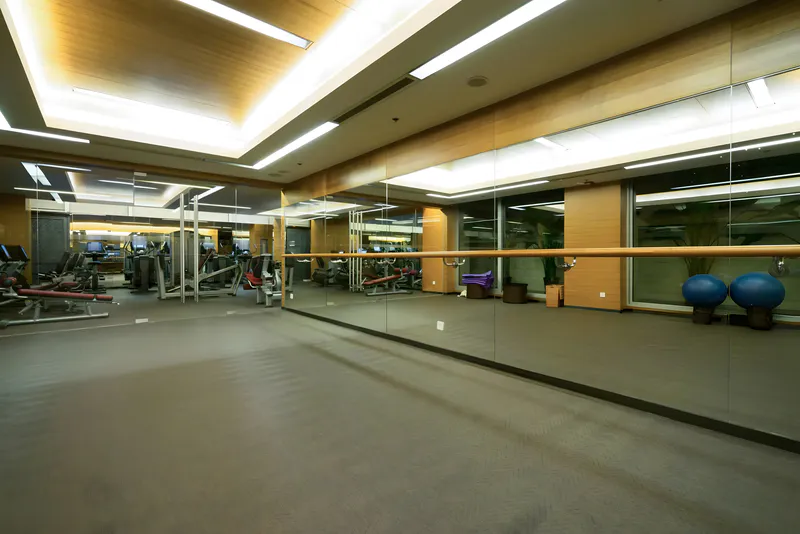
We discussed this issue in detail in the Acrylic Gym Mirror Guide: for fitness spaces, the only workable method is a tile-style installation composed of multiple smaller acrylic mirror panels joined edge-to-edge, while ensuring that each mirror piece remains small enough (around 60 × 90 cm for 3 mm material) so that bending becomes almost negligible. A single large panel is not suitable for this application.
Clothing Store Owners
Clothing stores need mirrors in two places. One is the outward-facing full-length mirror mainly used for display within the store. The other is the full-length mirror inside fitting rooms, either attached to the wall or displayed as a standard full-length mirror. For retail stores, both are used frequently. Both require image quality that remains sufficiently clear, accurate, and durable under frequent daily use. Fitting-room mirrors are typically 150 cm × 50 cm or larger, and every day they endure continuous wear from hangers, shopping bags, and occasional elbow impacts.

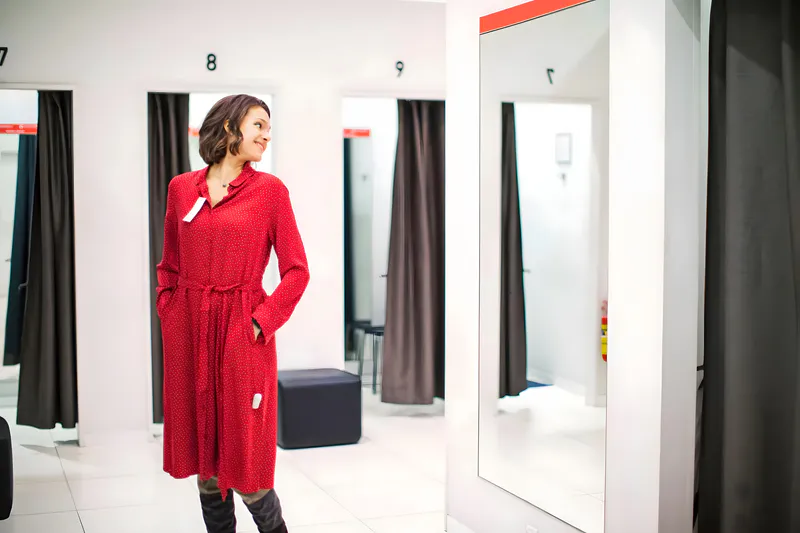
Generally, buyers in this category already understand acrylic mirror materials and are aware of the reflection imaging issues. The continued consideration of acrylic mirrors mainly comes from safety concerns. When acrylic mirror panels are installed piece by piece onto a flat backing and replaced at fixed intervals, their lighter weight makes installation across multiple fitting rooms easier, while the shatter-resistant properties reduce safety risks. However, accuracy still depends on keeping each individual mirror within the size range that allows the material to remain flat, so for full-wall coverage, tiled installations are usually used instead of single large sheets.
Why a Single Full Length Acrylic Mirror Panel Distorts Reflections
In the different types of buyers and practical applications mentioned above, a fairly obvious pattern usually appears: acrylic mirrors are relatively able to maintain good reflective performance when they are small in size, but as the mirror size continues to increase, the requirements for flatness and installation conditions also increase significantly.
The main reason for this is that acrylic itself has a certain degree of flexibility. Compared with traditional glass mirrors, acrylic sheets are not completely rigid materials. Because small mirror panels have a shorter span, even if the sheet has very slight bending, it is usually difficult for the naked eye to notice, and the reflected people and objects can still maintain relatively normal proportions.
However, when an acrylic mirror panel is enlarged to nearly the size of a full-length mirror—for example, reaching a height of 1 meter, 1.5 meters, or even taller—the same degree of slight bending will become noticeably amplified. As long as part of the mirror surface curves slightly forward or backward, the reflection angle will change accordingly, ultimately creating visual effects similar to waves, stretching, compression, or localized distortion.
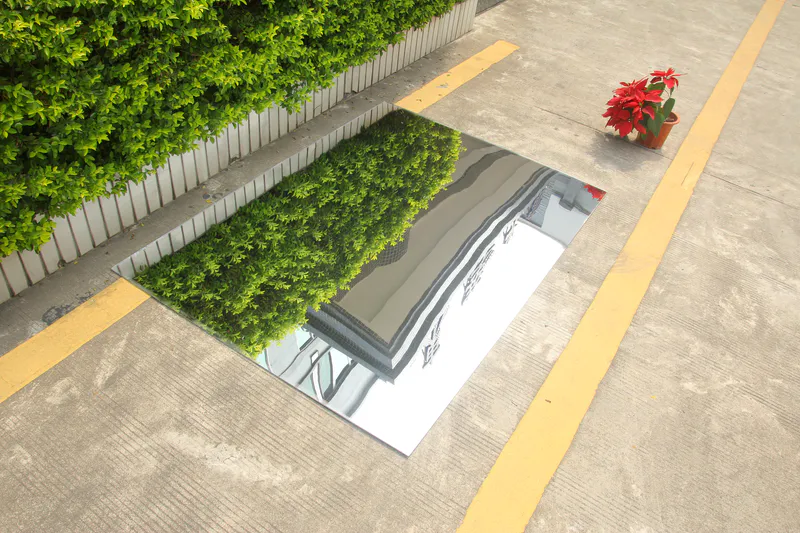
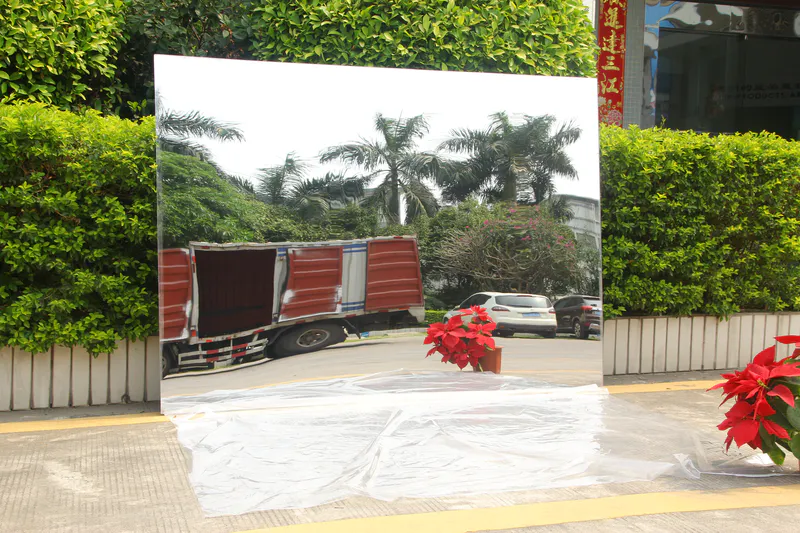
This is also why an acrylic mirror panel may appear very flat when placed on a tabletop for observation, but after it is installed vertically as a full-length mirror, the reflective effect may change. Here we will simply conduct a comparative experiment by placing mirrors respectively on a relatively flat ground surface and leaning against the uneven area beside the flower bushes, and then observing the results. Upon careful observation, it is not difficult to find that the mirror on the left placed on the ground has a better reflection effect than the one on the right.
The Larger the Panel, the More Sensitive It Is to Flatness
The reflective effect of a mirror actually depends heavily on the flatness of its surface. A slight unevenness of a few millimeters in ordinary decorative panels may not affect normal use in many situations; but for mirror materials, such changes directly alter the direction of reflected light.
The larger the mirror surface, the wider the range observed by the human eye, and the easier it becomes to notice slight surface variations.
Especially in full-length mirror scenarios, people usually stand at a certain distance from the mirror to observe their entire body. At this point, angle differences across different areas of the mirror enter the field of view simultaneously, so slight local bending is more likely to appear as changes in body contours.
For example:
- If the center of the mirror bends slightly inward, it may produce visual effects similar to a concave mirror;
- If part of the surface bulges outward, it may create magnification or stretching effects;
- If different areas of the sheet have slight unevenness, it may produce the common “water ripple” reflection effect.
Therefore, large acrylic mirrors require significantly higher flatness than ordinary decorative acrylic panels.
Sheet Thickness Also Affects the Stability of Large Mirrors
Acrylic mirrors do not necessarily develop severe distortion simply because they are large in size. Sheet thickness is also one of the important factors affecting the final result.
Generally speaking, under otherwise identical conditions, thicker acrylic sheets have greater rigidity and are less likely to bend due to their own weight or slight external forces. Thinner acrylic mirrors, while lighter and lower in cost, are more easily affected by the mounting surface, temperature, and internal stress in large-size applications.
This means that a thin acrylic mirror suitable for making a small decorative wall mirror is not necessarily suitable for directly scaling up into a full-length mirror over 1 meter tall.
As the size increases, it is usually necessary to consider simultaneously:
the mirror size, material thickness, backing board rigidity, installation method, and the flatness of the wall surface.
These factors together determine the final reflective effect, and it cannot be judged solely by whether “the mirror is large enough” to be used as a full-length mirror.
Uneven Installation Surfaces Can Also Be Replicated by Acrylic Mirrors
Another characteristic of acrylic mirrors is that they are relatively easily affected by the mounting surface behind them.
If a large, relatively thin acrylic mirror is directly adhered to a wall surface that itself has slight unevenness, the mirror panel may gradually conform to the wall’s shape under the influence of adhesive or mounting points.
For ordinary wall panels, this degree of unevenness may not be obvious, but for mirrors, even very small changes may appear in the final reflected image.
Similarly, if adhesive distribution is uneven during installation, local pressure differs, or there are too few mounting points, different areas of the mirror may experience inconsistent stress, thereby creating slight bending.
Therefore, reflective distortion in a large acrylic mirror does not necessarily mean that the mirror itself has a quality problem. In many cases, the issue comes from the lack of a reasonable match between mirror size, thickness, support structure, and installation method.
Temperature Changes May Further Affect Large Mirror Surfaces
Acrylic also has relatively noticeable thermal expansion and contraction properties.
When the size is small, such changes are usually difficult to observe directly. However, as the sheet length increases, dimensional changes caused by temperature variations gradually accumulate.
If a large acrylic mirror is completely constrained during installation without allowing reasonable expansion space, stress caused by temperature changes may cause slight bulging or bending in certain areas of the mirror.
Therefore, in large-area applications, the installation structure usually needs to allow the material a certain degree of natural expansion and contraction, rather than simply fixing the entire sheet completely rigidly in place.
This Does Not Mean Acrylic Cannot Be Used for Full-Length Mirrors
It should be specifically clarified that the issues above do not mean acrylic mirrors cannot be used for full-length mirrors.
What really needs to be avoided is suspending a very large, thin acrylic mirror without sufficient support, or directly adhering it to a wall surface whose flatness cannot be guaranteed, while expecting it to achieve exactly the same rigidity and flatness as a thick glass mirror.
The advantages of acrylic mirrors are still very clear—for example, they are lightweight, less likely to shatter like glass, and can be cut, drilled, and processed into various shapes.
The key is not simply asking:
“Can acrylic be used to make a full-length mirror?”
Instead, the more important question is:
“How can the flatness of a large acrylic mirror be controlled so that it can meet the practical requirements of a full-length mirror?”
The answer usually requires considering several aspects together, including sheet thickness, backing support, installation method, and the combination of mirror dimensions.
How Can You Use a Full-Length Acrylic Mirror?
If you’ve read this far and still want to choose acrylic because of safety, weight, or budget considerations, the solution is not to abandon the idea, but to adjust your approach.
Keep it narrow. Full-length acrylic mirrors in the size range of 120–150 cm × 30–40 cm are still within the ideal application range for this material. At this width, 3 mm sheets can resist bending and provide clear reflections. Although some left-to-right coverage is sacrificed, a narrow design is actually more practical for bedrooms or wardrobe doors.
Use a rigid frame or backing board. Bonding the acrylic to a flat substrate—such as 6 mm MDF, medium- to high-density foam board, or aluminum composite panel—can prevent the sheet from bending independently. Professional sign makers achieve flat acrylic mirror surfaces at large sizes in exactly this way, and the same method works for full-length mirrors. Even after assembly, the overall weight remains far lower than glass.
Increase width through paneling. If you need coverage wider than 40 cm, it is recommended to place two or three narrow acrylic mirror tiles side by side instead of using one large wide sheet. Each panel remains within its rigid range, while the 1–2 mm gaps between them can accommodate thermal expansion and contraction. After alignment with a laser level, the seams are nearly invisible from a normal standing distance.
Choose thicker specifications for larger panels. If you must use a single panel, then upgrade to 4.5 mm or 6 mm thick acrylic. The increase in rigidity is very noticeable—at sizes where 3 mm sheets would show obvious bending, 6 mm panels can effectively resist deformation. Combined with a flat mounting surface, the usable size range can be extended to approximately 150 cm × 50 cm before distortion starts becoming a problem.
Consider glass for critical applications. If optical accuracy is your top priority and the mirror will remain fixed in one place long term, then tempered glass is still the better material for full-length mirrors larger than 150 cm × 50 cm. Our acrylic vs. glass comparison analyzes the trade-offs in detail, but in short, glass performs better in rigidity and long-term clarity, while acrylic has advantages in weight, safety, and portability.
FAQ
What is the best size for a full-length acrylic mirror?
For most personal use scenarios—bedrooms, closets, dormitories—panels measuring 120 cm × 30 cm to 150 cm × 40 cm can provide a full head-to-toe reflection while remaining within the size range where acrylic can reliably stay flat. If you need a wider mirror surface, consider placing two narrower panels side by side, or upgrading to a thickness of 4.5–6 mm.
Can I use a full-length acrylic mirror in a home gym?
It is not recommended to use a single full-length acrylic panel for a gym, because the required size (typically over 180 cm high and several meters wide) will cause noticeable reflection distortion. A better approach is to combine multiple smaller acrylic panels on the wall so that each panel remains small enough to reduce warping distortion to a negligible level. For complete installation methods for combined panels, please refer to the acrylic gym mirror guide earlier in this series.
Are full-length acrylic mirrors easy to scratch?
Acrylic is softer than glass, so surface scratches are more likely to occur. In bedroom or closet environments, this is usually not a problem, but in high-traffic areas (retail fitting rooms, studios), scratches will accumulate more quickly. Please use a soft microfiber cloth and a non-abrasive, ammonia-free cleaner for cleaning to minimize the risk.
How do I hang a full-length acrylic mirror in a rental property?
The easiest method is to place the panel against the wall at a slight angle—acrylic is lightweight, so this is both stable and safe. If wall mounting is required without drilling holes, you can use high-adhesion removable adhesive strips suitable for the panel’s weight. The center position of the mirror should be close to eye level, which for most adults is typically about 145–155 cm from the floor. Custom-sized panels can be cut according to your available wall space to ensure a neat and attractive installation.