
People expecting to find a lightweight, shatter-resistant alternative to a big glass wall mirror — something they can hang in a studio, a gym, a hallway, or a showroom and get a good results from. But the truth is that large acrylic mirrors cannot be used as a single, seamless mirror. Once they exceed a certain size, the material’s flexibility creates visible ripples, and no amount of marketing language can change the laws of physics.
For this. We’ll cover why the distortion happens, the rigid-backing technique that reduces it, the applications where large acrylic mirror makes sense, the ones where it doesn’t, and what to specify if you decide it’s right for your project. If you’ve read the earlier posts in this series, the distortion concept will be familiar — this post is where we deal with it head-on, because the large-format application is where it matters most.
Why Large Acrylic Mirror Distorts
We’ve referenced this throughout the series — the introduction to acrylic mirrors covers the material reason, and the thickness guide explains how it scales with size. But the previous articles only used images and text to show you this phenomenon, without providing any further explanation in writing.
Acrylic is a flexible material. A mirror is only as flat as whatever it’s mounted to, plus whatever rigidity the material itself provides. At small sizes, the material’s own stiffness is enough to keep the surface flat and the reflection clean. At large sizes, the material isn’t stiff enough to hold its own shape, so it conforms to every irregularity in the mounting surface — and any bow, ripple, or uneven adhesive layer translates directly into a wavy, distorted reflection.
The plastics fabricators who sell this material are generally candid about it. As TAP Plastics explains in their mirrored acrylic guide, visual distortion is a function of viewing distance and material thickness, and while correct installation and sufficient thickness can reduce it, they “may not fully eliminate it.” An Australian supplier, Allstar Plastics, puts the mechanism plainly: when the acrylic is affixed to another surface, it “will conform to all the irregularities of the supporting surface,” and a non-planar surface causes localized bending and distortion in the reflected image. Under normal circumstances, people cannot judge with the naked eye whether a seemingly “flat” surface is truly flat.
This is why the funhouse-mirror effect appears in large acrylic installations that weren’t mounted carefully. It’s not a defect — it’s the expected behavior of a flexible material at a size where it can’t hold itself flat.
The Rigid-Backing Technique
There’s a well-established installation technique that significantly reduces large-acrylic distortion. It doesn’t make acrylic equal to glass, but it makes the difference between an unusable funhouse mirror and an acceptable large reflective surface for many applications. Note, this is “acceptable,” not flawless.
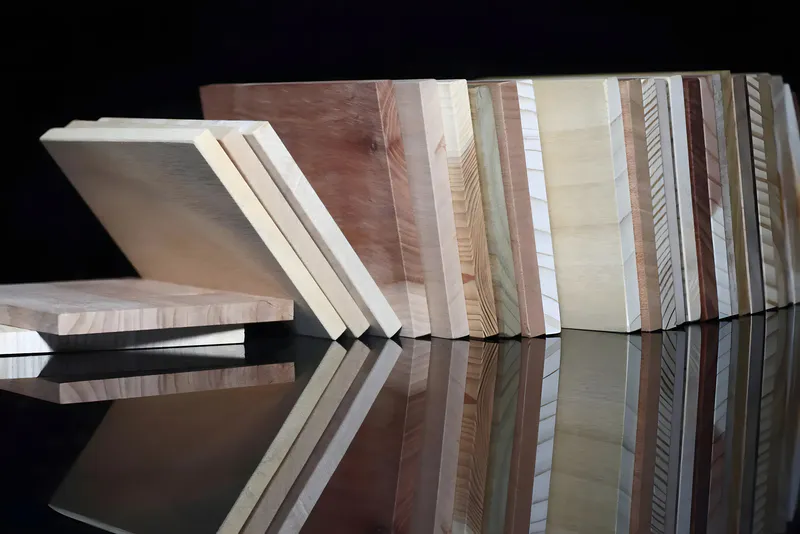
The technique is full-surface mounting to a rigid flat backing. Instead of hanging the acrylic mirror on its own or attaching it at a few points, you bond the entire back surface of the mirror to a stiff, perfectly flat panel — typically MDF or thick plywood — so the backing provides the rigidity the acrylic lacks.
Similar to the back panel of our anti‑fog mirror, its back panel uses a PS density board, and the purpose is to provide flatness for the front acrylic mirror.
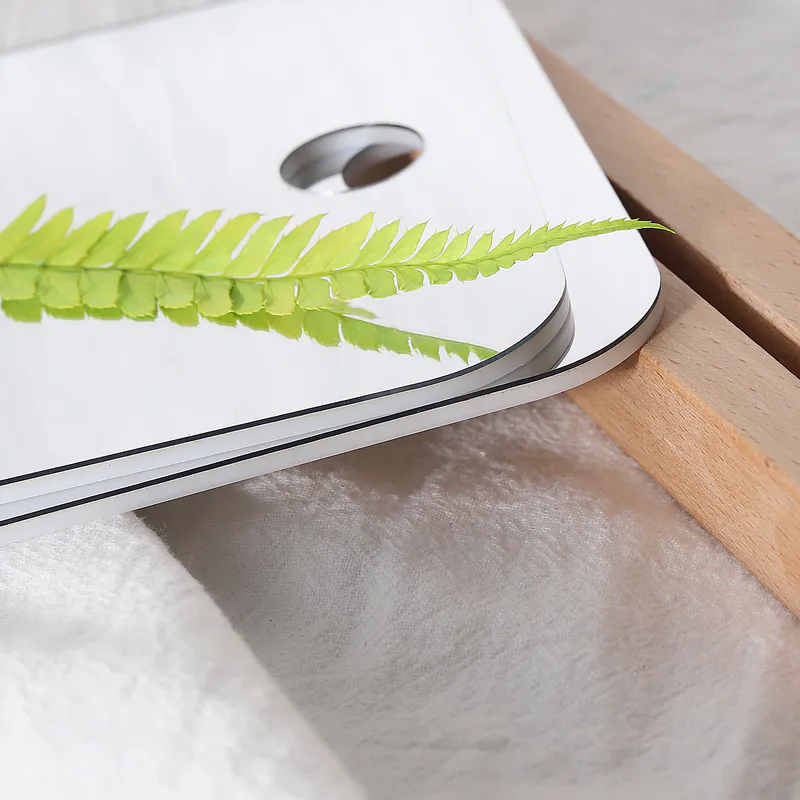
The fabrication guidance on this is consistent across suppliers. Delvie’s Plastics, in their installation guide, describes mounting to “a smooth, rigid, and sturdy backing surface” as the single most important step, and calls skipping it “the most common cause of disappointing results with acrylic mirror.” TAP Plastics specifies the backing thickness: 5/8-inch or 3/4-inch MDF, or an equally flat surface. A UK supplier, Simply Plastics, adds the application detail — they recommend 5mm thickness for sheets larger than 1200 × 1200mm, mounted to a flat sheet of plywood or MDF at least 3/4-inch thick, with the adhesive spread evenly across the entire surface (they suggest using a gloss roller) rather than applied in spots, because uneven adhesive thickness itself creates distortion.
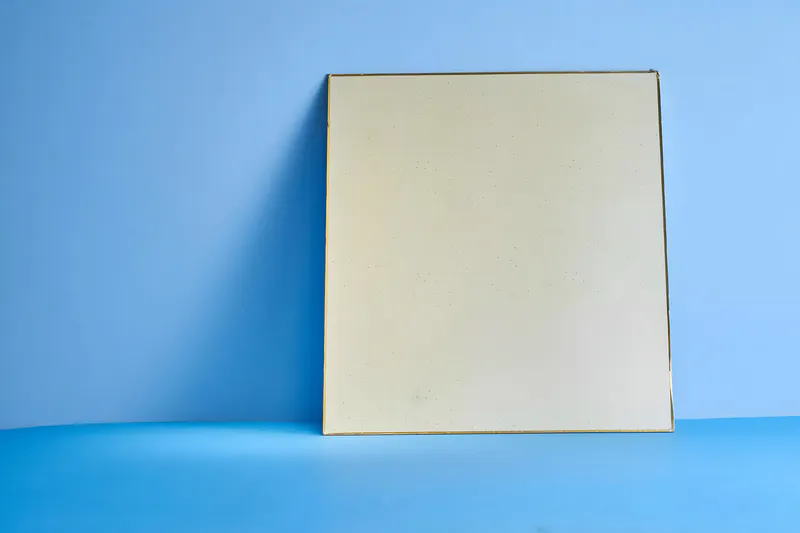
That last point matters and is worth emphasizing. Spot-applied or bead-applied adhesive — fine for small mirrors — actively causes distortion on large sheets, because each spot of adhesive holds the mirror at a slightly different depth, and the surface waves between the spots. For large acrylic, the adhesive has to be spread evenly across the whole back surface so the mirror sits in a single uniform plane.
The adhesive choice is also critical, and it’s the same warning we’ve raised before: solvent-based adhesives attack the reflective backing. Delvie’s Plastics notes in their adhesive guide that adhesives with 5% or more solvent content are not recommended, because the solvent can cause bubbling, discoloration, or complete failure of the reflective layer — and once that damage happens, it can’t be repaired. Mirror-specific mastics and high-quality VHB tapes are the safe options; standard construction adhesives often aren’t.
So the realistic picture on large acrylic mirror is: with thick stock (5–6mm), full-surface mounting to a rigid flat MDF or plywood backing, and evenly-spread mirror-safe adhesive, you can get an acceptable large reflective surface for many applications. Without those steps, you get a funhouse mirror. The technique works — but it adds cost, weight, and installation effort, and it still doesn’t match glass for flatness.
When Large Acrylic Mirror Genuinely Makes Sense
Given all that, when is large acrylic actually the right choice? There’s a real set of applications, and they share a common thread: situations where the safety, weight, or handling advantages of acrylic outweigh the flatness compromise.
Safety-critical large installations. This is the strongest case. Gyms, dance studios, schools, daycare centers, and other environments where a large glass mirror represents a real injury risk. A shattered floor-to-ceiling glass mirror in a gym is a serious hazard; the acrylic equivalent, mounted to a rigid backing, gives an acceptable reflection without the breakage risk. Fabricators position this clearly — one cut-to-size supplier describes shatterproof acrylic as “essential for gyms, schools, dance studios, and public spaces where glass poses a liability risk.” The reflection won’t be glass-perfect, but in a gym where users are several feet back and moving, the slight distortion is usually an acceptable trade for eliminating the shatter hazard. We covered the broader safety case in the shatterproof acrylic mirrors guide.
Weight-constrained installations. Where the mounting structure can’t support the weight of large glass — certain wall constructions, temporary installations, mobile or modular setups, vehicle and trailer interiors, boat interiors. Acrylic is roughly half the weight of glass, and at large sizes that difference becomes the deciding factor. A large glass mirror might simply be too heavy for the available mounting; the acrylic version, even with an MDF backing, comes in lighter.
Installations that need to ship or move. Large glass mirrors are difficult and expensive to ship, and they break in transit. For installations that need to be shipped long distances, relocated periodically, or transported as part of a touring or modular setup, acrylic’s durability in transit is a genuine advantage. Trade show exhibits, set design, and similar applications often choose acrylic for this reason.
Applications where some distortion is acceptable or even wanted. Retail and decorative installations where the mirror is a design element rather than a functional reflection surface. Some designers actively use the slightly imperfect reflection of large acrylic as an aesthetic choice. For these, the distortion isn’t a problem to solve — it’s part of the look.
What unites these is that flatness isn’t the top priority. Where it is the priority — where someone needs to see a clean, accurate, full-length reflection of themselves — large acrylic isn’t the right answer regardless of mounting technique.
What to Specify for Large Acrylic Mirror
If you’ve weighed the trade-offs and large acrylic is right for your project, here’s how to specify it well.
Thickness: 5mm or 6mm minimum. Thinner stock distorts too readily at large sizes. The added rigidity of thicker material is part of what makes a large installation acceptable. As one fabricator’s guide notes, thicker sheets reduce distortion — it’s the first lever to pull. Expect the weight and cost to scale accordingly.
Add a rigid backplate. Decide the backing material (5/8 to 3/4-inch MDF or quality plywood) and confirm it’s perfectly flat before mounting. The backing is not optional for large installations — it’s the single most important factor in the result. Budget for it as part of the project.
Specify mirror-safe adhesive and even application. Confirm the adhesive is non-solvent (under 5% solvent content), and plan to spread it evenly across the entire back surface rather than in spots. Test any adhesive on a scrap piece first — supplier guides consistently recommend a 24 to 72-hour compatibility test before committing to the full installation.
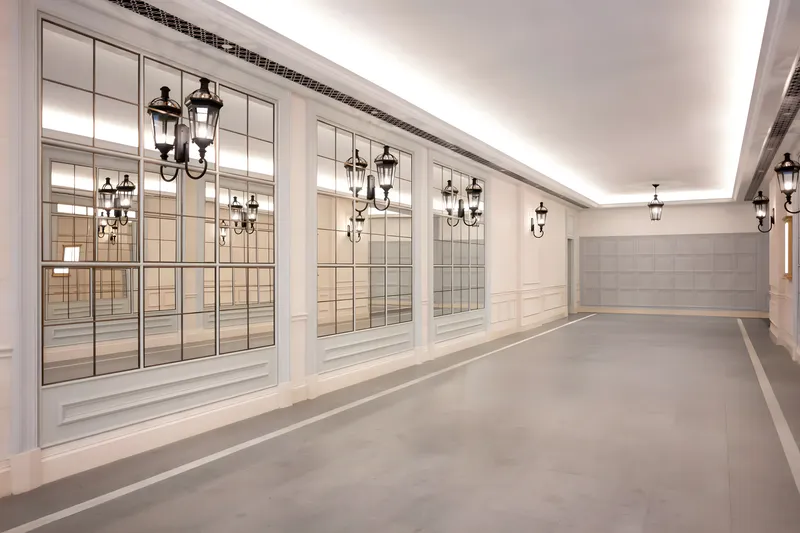
Consider segmentation for very large areas. For a mirror wall larger than the practical sheet sizes, the realistic approach is multiple panels with visible joins rather than one impossibly large sheet. This is standard practice — large mirror walls are typically segmented. Plan the seam positions deliberately as part of the design rather than treating them as a compromise.
This type is also called a mirror brick wall. Its advantage is that the overall structure is lighter, and compared with one large glass mirror, the installation cost and weight‑related risks are lower.
Account for thermal expansion in the mounting. Acrylic expands and contracts more than glass with temperature, as we covered in the thickness guide. For mechanically-fastened installations, drill oversize holes and don’t over-tighten — Allstar Plastics specifically warns that over-tightening screw fasteners causes dimpling and distortion. Full-surface adhesive mounting to a backing largely handles the expansion issue, which is another reason it’s the preferred method for large work.
Avoid overhead and ceiling installations unless properly framed. Multiple supplier guides specifically advise against ceiling or overhead acrylic mirror installation unless the mirror is held in edge-engaging frames (like T-bar suspended ceiling frames) or mechanically secured — the weight and flexibility combination makes adhesive-only overhead mounting unreliable and potentially unsafe.
When to Choose Glass Instead
For these applications, large acrylic mirror is the wrong specification and glass is the right one:
Full-length dressing and vanity mirrors where the user looks at their own reflection up close and accuracy matters. The combination of large size and close viewing makes any distortion obvious. Glass is the standard for a reason.
Premium retail and hospitality where the mirror is a quality signal. A distorted reflection in a luxury retail fit-out or a high-end hotel undermines the impression the space is trying to create. These applications use glass despite the weight and cost.
Anywhere the reflection quality is the product. Photography studios needing accurate large mirrors, fitness studios marketing themselves on a premium experience, showrooms where the mirror itself is part of the sales pitch. If the flatness of the reflection is what the application is selling, glass is the only material that delivers it.
For genuinely large flat reflective surfaces where safety is also a concern, there’s a middle option worth knowing about: glass mirror with a safety film backing. This is ordinary glass mirror with an adhesive film applied to the rear that holds the shards together if the mirror breaks.
It delivers glass flatness with much of acrylic’s safety benefit — the glass can still break, but it won’t shower the area with sharp fragments. For gyms and studios that want both quality reflection and shatter safety, safety-backed glass is often the better answer than large acrylic, despite the higher weight and cost.
Common Mistakes With Large Acrylic Mirror
It is precisely the lessons we have summed up that allowed this article to come into being. If you are experiencing the same situation, correct it in time to avoid further losses.
Hanging it like a glass mirror. The single biggest mistake — treating large acrylic like glass and mounting it at a few points or hanging it on a cleat. Without full-surface rigid backing, large acrylic distorts. The mounting method is not a detail; it’s the whole game.
Using thin stock to save cost. 3mm at large sizes distorts badly. The savings on thinner material are erased by the unusable result. For large work, 5–6mm is the floor.
Spot-applying adhesive. Bead or dot adhesive application, fine for small mirrors, causes waves on large sheets. Even, full-coverage application is required.
Using the wrong adhesive. Solvent-based construction adhesive destroys the reflective backing. The damage is permanent and often doesn’t show until after installation.
Expecting glass-quality results. Even done perfectly, large acrylic doesn’t match glass flatness. Buyers who need glass-quality reflection at large sizes should buy glass. Large acrylic is for situations where safety, weight, or handling outweigh flatness.
Large acrylic mirrors occupy a special and sometimes misunderstood place in the product range. They are not a replacement for glass, but they are not useless either. If achieving a clean, accurate, glass‑grade reflection at large sizes is the top priority, choose glass—and choose glass with a safety backing if shatter protection is also required. If shatter safety, light weight, or portability matters more than absolute flatness, then large acrylic properly mounted on a rigid backer is a reasonable option and performs well in environments such as gyms, studios, and schools.