
Regarding the question of what size convex mirror is needed, most buyers actually have a clear choice. However, in some cases, the buyer’s selection may not be entirely accurate.
Usually, it is only after product sampling that they realize the chosen size is too large or the curvature is too high. This can cause delays in the product delivery schedule, which is not a good situation for either party.
The size of a convex mirror has a significant impact on wide-angle reflection, whether it is used outdoors or indoors. We have previously discussed the choice of convex mirror materials and the choice between indoor and outdoor use. This time, we will talk specifically about choosing the right size.
When selecting the size of a convex mirror, you can first focus on three questions: Where will it be viewed from, what area needs to be seen, and what needs to be seen clearly? Once these conditions are clarified, you can then consider the size, giving you a basis for selection.
What Convex Mirror Sizes Are Available?
Circular convex mirrors are usually sized by diameter, while rectangular mirrors are sized by width and height. Here, when discussing convex mirror sizes, we are referring only to the mirror itself and not including other parts of the overall product.
Circular and rectangular are the most common shapes, and most other special shapes are basically derived from them. Therefore, we will discuss sizes mainly around these two shapes.
Common Sizes
12, 18, 24, and 36 inches are the circular mirror specifications that can be prioritized for comparison. The applications listed in the table below are intended for preliminary selection and can serve as a standardized reference, but the final choice still needs to be explained according to actual circumstances.
| Nominal Diameter | Inch Conversion Value | Common Product Names | Specific Application Scenarios |
|---|---|---|---|
| 12 inches | Approx. 305 mm | Convenience store anti-theft convex mirror, small warehouse safety mirror, office corridor corner mirror, pharmacy shelf observation mirror | Near checkout counters, narrow shelf aisles, office corridor corners, small storage areas |
| 18 inches | Approx. 457 mm | Supermarket anti-theft convex mirror, warehouse aisle corner mirror, factory workshop safety mirror, hospital corridor observation mirror | Supermarket shelf intersections, warehouse shelf ends, workshop equipment blind spots, hospital corridor corners |
| 24 inches | Approx. 610 mm | Underground parking garage corner mirror, forklift aisle safety mirror, logistics loading area observation mirror, residential driveway exit convex mirror | Parking garage ramps, factory forklift intersections, logistics loading platforms, residential parking lot entrances and exits |
| 36 inches | Approx. 914 mm | Industrial park traffic convex mirror, large parking lot safety mirror, logistics park truck turning mirror, large warehouse aisle mirror, campus pickup lane safety mirror | Industrial park road intersections, large parking lot curves, logistics park truck traffic areas, warehouse main aisles, campus vehicle entrances and exits |
The inch conversion values are not exactly the same as the 300, 450, 600, and 900 mm metric models commonly found on the market. However, they are usually used according to these sizes.
Among these common sizes, smaller sizes are usually used for short-distance indoor observation, medium sizes cover warehousing and parking lot scenarios, while larger sizes are more commonly used in logistics, industrial, and open vehicle traffic areas.

The application scenarios listed here are more practical-oriented, but convex mirrors also have a special application direction, which is decoration.
Convex mirrors used for decoration are usually custom-sized and do not have specific standard values. At the same time, they do not need to consider wide-angle reflective imaging issues.

Uncommon Sizes
In addition to the common specifications mentioned above, some projects are more suitable for choosing based on specific purposes:
Around 100 mm or smaller: Used as embedded mirror lenses in equipment or small products, focusing on auxiliary observation and decorative assembly. Similar to a product such as a toy that needs to embed a small convex mirror, this is when such a size would be considered.

Around 200 mm: Can be used for close-range visual interaction or decorative bubble convex mirrors. This size can be said to perfectly balance both decoration and wide-angle reflection. Taking bubble mirrors as an example, various combinations allow them to have both practicality and decorative value in children’s rooms.

Around 1200 mm: Can be included in the selection range for large spaces, but demands for such large sizes usually do not involve very high minimum order quantities. In our actual production deliveries, for similar or larger sizes, customers usually only require one piece to meet a specific need. For example, this type of decorative large convex mirror placed at ski resorts for welcoming guests and photo check-ins.

Among the above three sizes, only the largest 1200 mm size receives very few orders. The other two sizes, although uncommon, are still quite popular in actual demand. So why are they categorized as uncommon?
Here, we are evaluating purely from the perspective of size rather than procurement demand statistics. Therefore, uncommon sizes do not mean that these convex mirror sizes are unpopular in the market.
Rectangular Sizes
Unlike the circular convex mirror sizes above, rectangular convex mirror sizes are usually relatively fixed:
102 × 76 mm (4 × 3 inches), 152 × 102 mm (6 × 4 inches), 203 × 102 mm (8 × 4 inches): These small mirror sizes are commonly found in automotive blind spot auxiliary mirrors, truck rear-view auxiliary mirrors, forklift auxiliary observation mirrors, and small equipment observation mirrors. The size usually needs to be selected according to the product housing, installation position, and viewing angle.
457 × 305 mm (18 × 12 inches): Common products include warehouse corner safety mirrors, factory workshop passage mirrors, and low-clearance parking garage convex mirrors. Specific installation locations include warehouse shelf intersections, workshop equipment blind spots, parking garage ramp corners, and loading/unloading areas.

610 × 381 mm (24 × 15 inches): Common products include logistics center aisle safety mirrors, parking lot entrance and exit convex mirrors, loading dock observation mirrors, and industrial safety convex mirrors. They are usually used in positions where wider aisles or intersections between vehicles and pedestrians need to be observed.
Why are their sizes relatively fixed? The fundamental reason is that the “convex height” of the convex surface is relatively fixed. Circular convex mirrors can have a greater “convex height,” eventually becoming a dome mirror. But rectangular convex mirrors cannot do this.
Moreover, rectangular convex mirrors usually pursue practicality more, and they can hardly achieve breakthroughs in decoration. Looking at decorative mirrors outside, rectangular shapes are rarely used for decoration, while circular shapes are used much more often.
How Does Diameter Affect Convex Mirror Size Selection?
The diameter can be understood as the size of the viewing window, while the curvature determines the breadth of the field of view captured by this window and the degree to which the target is scaled down.
For a given diameter, a more pronounced convex surface typically encompasses a wider field of view, though the target image will also tend to appear smaller. Therefore, a careful balance must be struck between “seeing a larger area” and “discerning more detail.”
As indicated by the imaging principles of spherical mirrors, the image size depends on both the curvature and the distance to the target. A spherical mirror can be thought of here as the extreme case where the convex height (curvature) of a convex mirror is maximized.
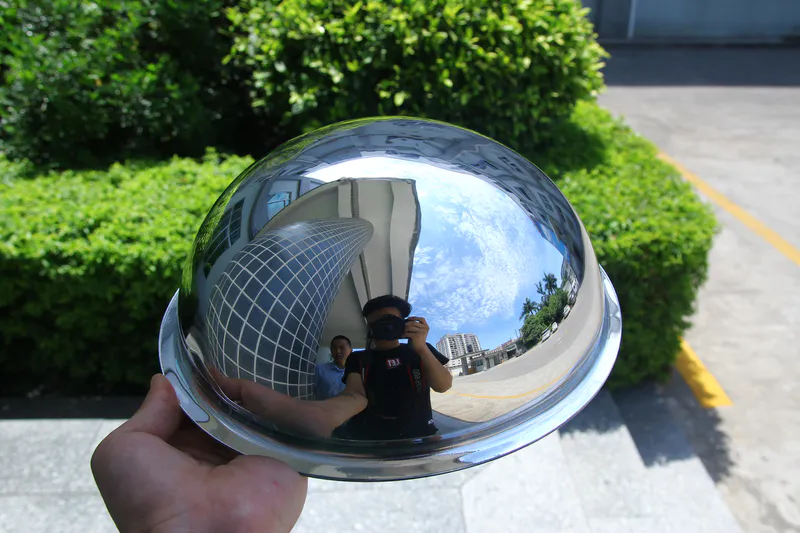
When the curvature, target, and viewing position remain constant, simply increasing the diameter does not automatically enlarge the image of the original target. When comparing different sizes, the curvature must also be taken into account.
Relationship Between Diameter and Viewing Distance
As the viewing distance increases, targets generally become harder to recognize, necessitating a combination of a larger size and an appropriate curvature. However, there is no universal “diameter-to-distance conversion formula” applicable to all products.
It is also important to pay attention to how suppliers define distance. For example, the Convex Mirror Shop size guide uses the following definition: Total Viewing Distance = Distance from Observer to Mirror + Distance from Mirror to Target Area.

Their reference guide for indoor and traffic (outdoor) circular convex mirrors is outlined in the table below:
| Nominal Size | Indoor Total Viewing Distance (Supplier Listed) | Traffic Total Viewing Distance |
|---|---|---|
| 12 in. (approx. 300 mm) | Up to 16 ft. (4.9 m) | Up to 70 ft. (21.3 m) |
| 18 in. (approx. 450 mm) | Up to 23 ft. (7.0 m) | Up to 93 ft. (28.3 m) |
| 24 in. (approx. 600 mm) | Up to 33 ft. (10.1 m) | Up to 125 ft. (38.1 m) |
| 32 in. (approx. 800 mm) | Up to 60 ft. (18.3 m) | Up to 150 ft. (45.7 m) |
| 36 in. (approx. 900 mm) | Up to 65 ft. (19.8 m) | Up to 180 ft. (54.9 m) |
| 40 in. (approx. 1000 mm) | Up to 75 ft. (22.9 m) | Up to 250 ft. (76.2 m) |
These figures serve as a selection reference for this specific supplier and should not be taken as a universal performance standard for all convex mirrors of the same size. For instance, if the distance from the person to the mirror is 4 m and from the mirror to the target area is 6 m, the total is 10 m, which is already approaching the upper limit of the 24-inch specification mentioned above.
Sizes below 300 mm are practically unviable for effective imaging and have therefore been omitted here. If you need to account for visibility issues related to convex mirror reflections, it is best to stick to sizes of 300 mm and above.
How to Choose the Right Convex Mirror Size
When choosing the size of a convex mirror, you should first determine the viewing distance, and then select the appropriate diameter based on your specific application. Bigger is not always better; the ideal size should allow the observer to clearly see the target while adequately covering the area that needs to be monitored.
1. Calculate the Total Viewing Distance
Measure the distance from the observer to the mirror and from the mirror to the target area separately, then add them together.
For example, if the observer is 4 meters away from the mirror, and the mirror is 6 meters away from the target area, the total viewing distance is 10 meters.
2. Choose the Mirror Diameter Based on Viewing Distance
For standard indoor viewing scenarios, you can refer to the manufacturer’s guidelines provided above:
- 300 mm (12 inches): Recommended for viewing distances within approximately 5 meters.
- 450 mm (18 inches): Recommended for viewing distances within approximately 7 meters.
- 600 mm (24 inches): Recommended for viewing distances within approximately 10 meters.
For instance, if the total viewing distance in a warehouse aisle is 8 meters, a 600 mm convex mirror would be the ideal choice. For traffic monitoring scenarios such as parking lots or blind corners, you should refer to vehicular viewing distance guidelines rather than relying on indoor standards.
3. Adjust the Size Based on the Level of Detail Required
Once you have determined the basic size, you also need to consider your visual requirements. Simply detecting the presence of passing pedestrians or vehicles requires a different image scale than identifying specific actions or precise vehicle positioning.
If the target in the mirror appears too small or lacks clarity, you may want to opt for a larger mirror diameter or a convex mirror with a milder curvature. However, changes in curvature will also affect the field of view, so these factors must be weighed together.
4. Verify the Actual Viewing Effect After Installation
During installation, stand at the normal vantage point to confirm whether the mirror covers the target area and whether the reflection is sufficiently clear.
If the edges of the aisle or corner are not visible, first adjust the installation position and angle of the mirror. If the field of view is already adequate but the target still appears too small, then consider upgrading to a larger diameter or a different curvature.
The distances mentioned above serve only as a preliminary reference for sizing. Convex mirrors from different manufacturers may vary in depth and curvature, meaning actual performance may differ even with the same diameter. It is always best to confirm the final specifications prior to purchase by factoring in the installation distance, operating environment, and sample testing.
What Else Matters Besides Convex Mirror Size?
Besides dimensions, other factors are equally critical. We recommend reviewing the following two aspects:
1. Mirror Material and Surface Quality: Acrylic and polycarbonate have distinct properties, and choosing the right material is sometimes even more important than size. Focusing on surface quality essentially reflects manufacturing capabilities; additional factors such as localized bubbles in the film, surface scratches, or assembly deformation must not be overlooked. For a deeper comparison, you can refer to the Mirror Material Selection Guide.
2. Application Environment and Scope of Supply: Clarify whether the application is indoor or outdoor, whether weather-resistant specifications are needed, and whether you are sourcing bare mirror panels or finished products complete with backing boards and brackets. This is especially true for outdoor convex mirrors, where you must evaluate how changing environmental factors will affect the lifespan of auxiliary accessories like brackets. Always request relevant test reports from the manufacturer to ensure these components meet your durability requirements.
When preparing your inquiry, provide the supplier with the two viewing distances, photos of the target area, and the installation dimensions. If you need a matching enclosure or a custom shape, you can start by exploring DHUA’s Custom Convex Mirrors and finalize the dimensions through sample testing.