
Of all the size-specific questions we get about acrylic mirrors, 10×12 inches comes up surprisingly often. This is one of the most consistently popular small-format sizes — more than 12×12, more than 8×10, more than most other dimensions in the small range. It’s worth understanding why, because the size isn’t arbitrary. There’s a real practical reason the 10×12 dimension has become a working standard in several specific use categories.
This post covers what the 10×12 acrylic mirror is actually used for, why it works well at this size where larger formats struggle, and what to look for when ordering — particularly the specifications that matter more for small mirrors than the broader thickness and material discussions cover. By the end, you should know whether this size fits your project, and what to specify when you place the order.
If you’re considering whether you need a larger or smaller size instead, the complete guide to acrylic mirror sheets covers the full range of standard sizes, and the thickness guide walks through the size-to-thickness matching for different applications.
Why the 10×12 Size Works So Well
The most important thing about 10×12 acrylic mirrors is that they sit comfortably inside the size range where acrylic mirror performs without compromise. We’ve covered the size-distortion limitation throughout this series — the introduction to acrylic mirrors explains why acrylic distortion more than glass, and the thickness guide covers how this becomes visible in distortion above roughly 24 inches in any dimension.
At 10×12, none of that matters. The mirror is small enough that even thin material (1.5mm or 2mm) holds its shape well, and the reflection is clear and accurate at typical viewing distances.
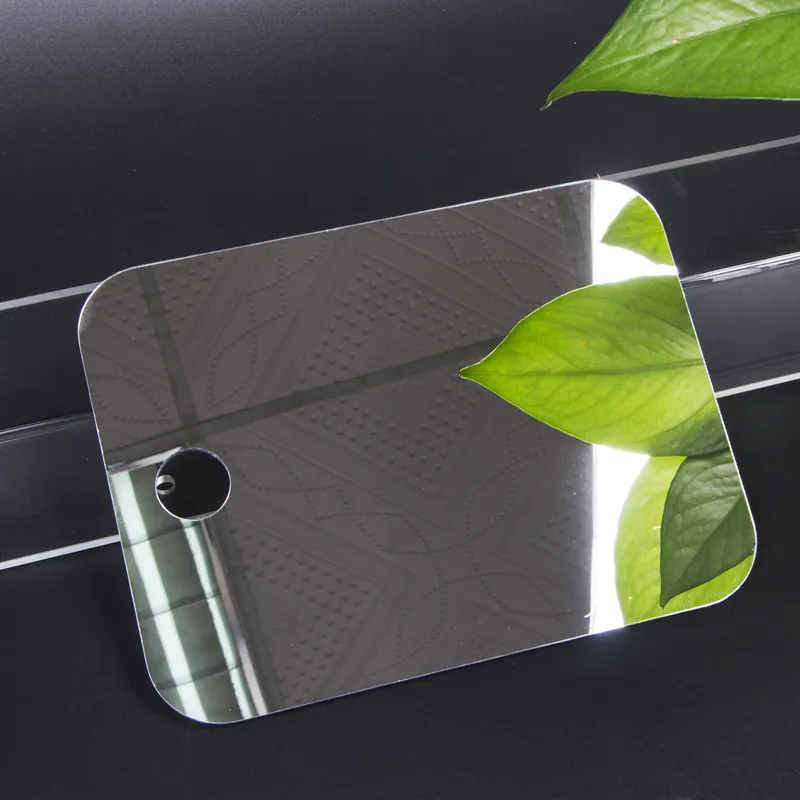
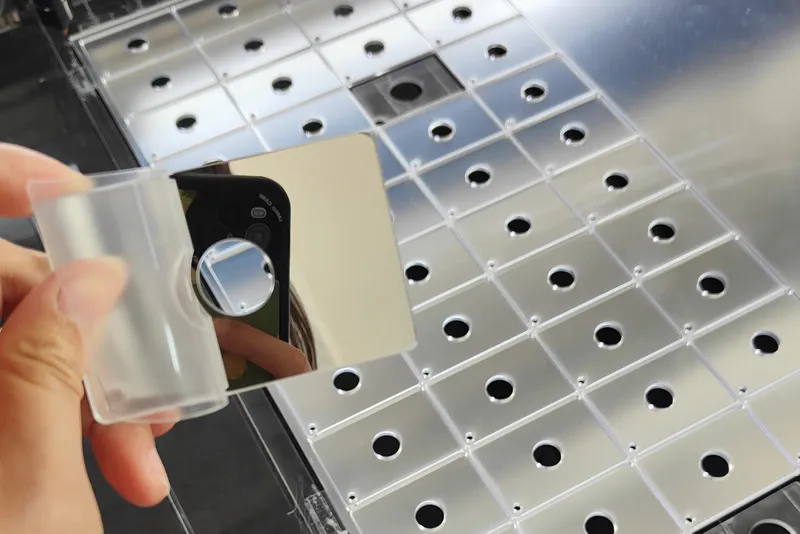
As shown in the picture below, these are the acrylic mirror panels we produce, with dimensions close to 10×12. At this size, there will be no image distortion or warping.
This is the practical reason 10×12 has become a standard size: it’s large enough to be useful, small enough to be problem-free. The same can’t be said for many of the larger sizes that customers occasionally try to specify for similar applications.
- A 24×36 acrylic mirror for a craft project will show distortion that 10×12 simply won’t.
- A 36×48 acrylic mirror for a classroom installation will need thicker stock and careful mounting to look acceptable.
- 10×12 will look right with almost any mounting approach.
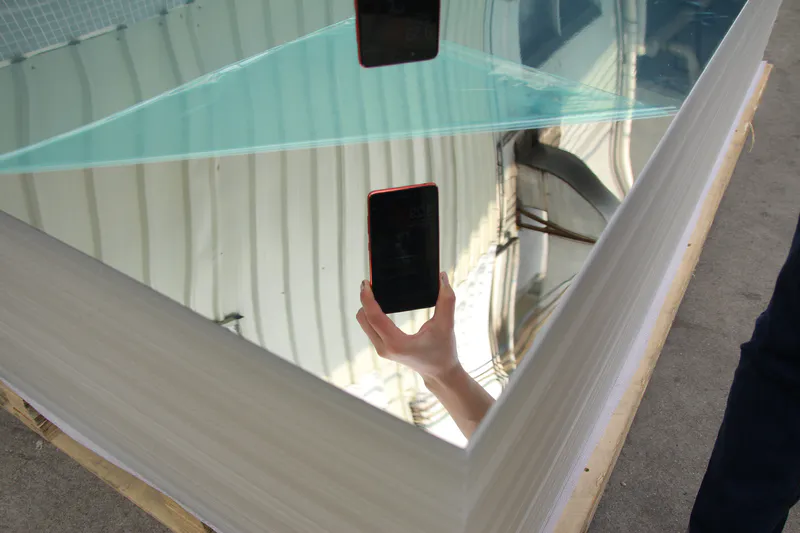
This is a large mirror panel produced in manufacturing. We peeled off the protective film attached to the mirror surface and tested its reflective effect. It can be seen that the hand and phone at a closer distance show no distortion, while the reflected image at a farther distance shows obvious distortion. These are all normal phenomena.
The size also happens to be a near-standard format in several adjacent product categories — picture frames, paper sizes, classroom display materials — which makes it easy to integrate into projects that already work with those formats.
What Buyers Actually Use 10×12 Mirrors For
The order at this size cluster into a few clear categories. Most 10×12 acrylic mirror orders fall into one of these.
Craft and DIY projects
This is the largest single category by volume. Crafters use 10×12 acrylic mirrors as the starting material for mosaic work, ornament making, jewelry components, scrapbooking elements, and various small decorative projects. The shatter-resistance matters here because the mirror often gets cut down further into smaller pieces, and acrylic cuts cleanly with tools most crafters already have — utility knives for scoring, small jigsaws, even strong scissors for the thinnest material. A glass mirror at this size would either need professional cutting or specialty tools that most crafters don’t own.
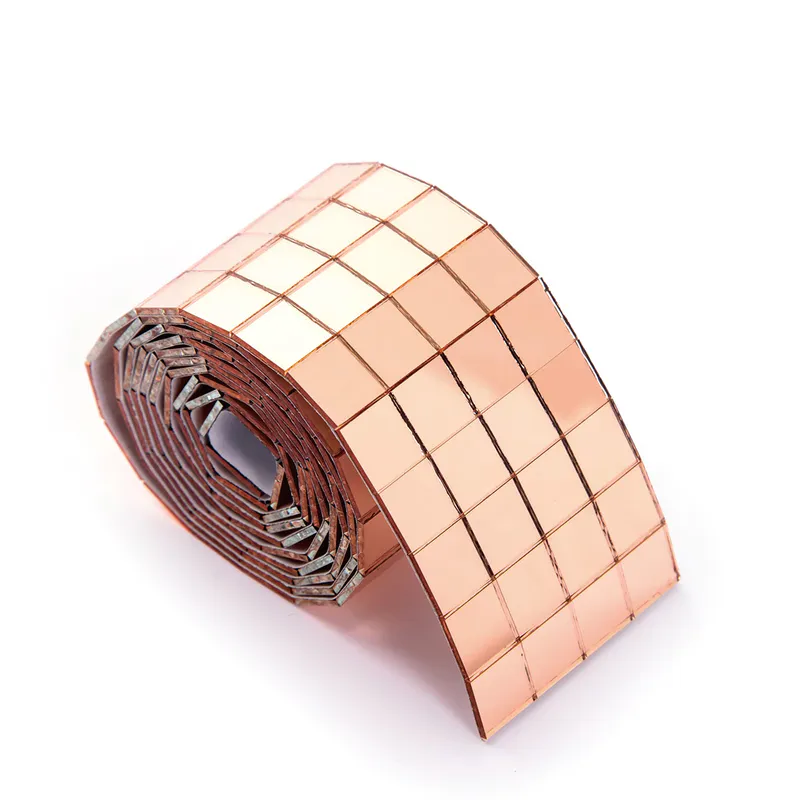
There are already products on the market that contain many small lenses along an entire strip. They are already pre-cut, and craftspeople just need to use their own creativity.

Children’s activities and education
Schools, daycares, and home-education environments use small acrylic mirrors for science experiments (basic optics, light demonstrations, mirror writing), art projects, and various developmental activities. The craft-supply market reflects this widely — Amazon listings for small acrylic mirror tiles consistently describe the appeal as “safe, especially when mounting them in areas accessible to children” because of the shatter-resistant property. The 10×12 size works well as a single demonstration mirror in a classroom setting, or as raw material to be cut down into smaller pieces for distribution to individual students.
Sensory and special-needs activities
Therapists, occupational specialists, and parents of children with sensory needs use small acrylic mirrors for mirror play, self-recognition activities, and various sensory exercises. The combination of safe construction, good reflection quality at close range, and the ability to handle the material without breakage concerns makes 10×12 a workable size for these uses. Many sensory equipment suppliers stock small acrylic mirrors specifically for this market.
Photography and small studio work
Photographers use small mirrors for various tabletop photography setups, product shots, and creative effects. 10×12 is large enough to provide useful reflection area in close-up work but small enough to position and adjust easily. The lightweight nature matters here because the mirror often gets clamped, taped, or held in position with light-duty hardware that wouldn’t support a glass equivalent.
Display and merchandising accents
Retail displays, trade show booths, and point-of-sale fixtures use small mirrors as visual accents — under product displays, behind jewelry presentations, as background elements in display cases. 10×12 is a workable size for many of these uses without dominating the display.
Mirror writing and rehabilitation therapy
A more specialized use, but a real one: occupational therapy programs use small mirrors for hand-eye coordination exercises, mirror box therapy (used in stroke recovery and phantom limb pain), and similar therapeutic applications. The size works because the patient is using the mirror at close range and the mirror is being held or supported rather than wall-mounted.
Custom signage and craft business production
Small businesses producing signage, ornaments, custom name plates, and similar bespoke products buy 10×12 mirrors as semi-finished material that gets engraved, cut, or otherwise processed into finished products. Etsy sellers and small fabricators are a meaningful part of the customer base at this size.
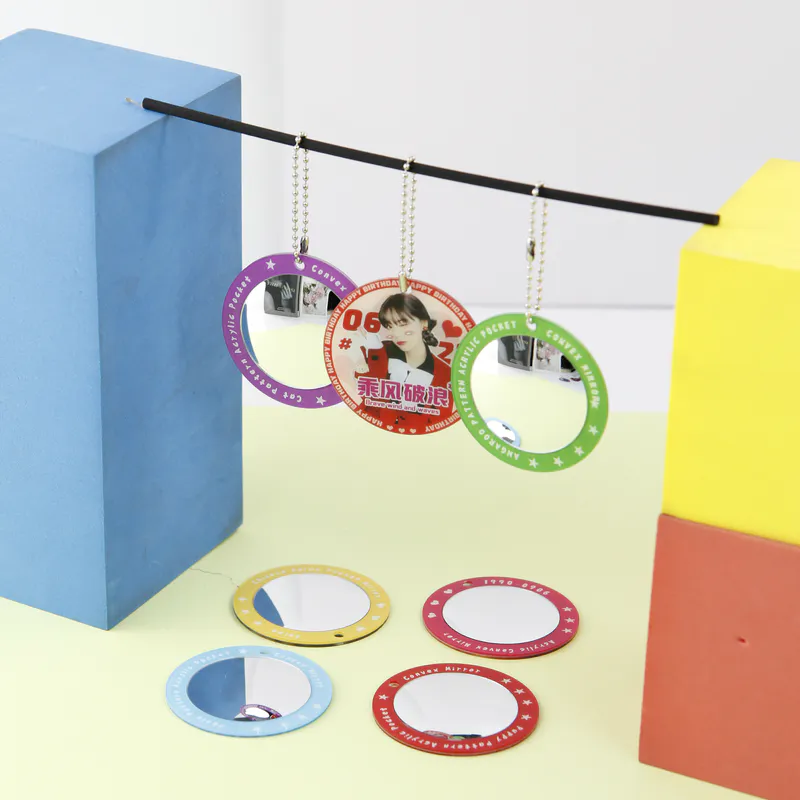
We have also made similar products. They usually require cutting and printing. The outer ring is also a mirror. After the middle circle is laser‑cut, it is divided into inner and outer parts, and then the outer part can be printed. Using UV printing can be very efficient.
Some Precautions
Most of what we’ve covered about thickness in the broader thickness guide applies here, but with some specific points worth noting for the 10×12 format.
At this size, all three standard thicknesses (1.5mm, 3mm, 6mm) work without distortion problems. The choice depends more on the intended use than on rigidity concerns.
1.5mm or 2mm is the standard for craft work and any application where the mirror will be cut down or handled extensively. The thin material cuts more easily, drills more cleanly, and works with the simple tools crafters and educators usually have. For mosaic work specifically, where the 10×12 sheet will be cut into many small pieces, 1.5mm is the right specification — thicker stock makes the cutting work harder without delivering benefits at the small final piece sizes.
3mm is the right thickness for 10×12 mirrors that will be used whole — wall-mounted as a decorative piece, used as a hand mirror, or installed in a fixture. The added rigidity matters for handling and provides a more substantial feel that buyers tend to prefer for finished products.
6mm is rarely necessary at this size. The extra rigidity isn’t needed (the size is well within where 3mm holds flat), and the additional cost and weight don’t add value. The few cases where 6mm makes sense at 10×12 are specialty applications — display fixtures where the mirror is structural rather than just reflective, or installations where the perceived premium quality of thicker stock matters for the application.
What to Specify When Ordering
A few specifications that come up regularly for 10×12 orders, beyond the basic thickness decision.
Surface finish. Standard reflective silver is the most common, but 10×12 is also a popular size in colored acrylic mirror — gold, rose gold, bronze, smoked black, pastels. The color decision depends entirely on the project; we’ve covered the broader color options in the complete sheet guide. For colored variants at this size, the visual difference between batches is small enough that single-batch ordering is less critical than at larger sizes.
Edge finish. 10×12 mirrors come from the factory with saw-cut edges — clean enough for craft and educational use, but visibly unfinished if the edges will be exposed in a finished product. For applications where edges will be visible, flame-polished or sanded edges are available at a small additional cost. For applications where the mirror will be framed, mounted, or further cut, the standard edge is fine.
Corner radius. Standard 10×12 mirrors ship with square corners. For applications involving children or where the mirror will be handled extensively, rounded corners are available — typically a small radius (5–10mm) that eliminates the sharp 90-degree corner without changing the overall dimension significantly. Most education-market suppliers offer this as a standard option.
Adhesive backing. A meaningful portion of 10×12 acrylic mirrors are sold with self-adhesive backing already applied. This is the dominant format in the craft and DIY market — the buyer just peels the protective film and presses the mirror onto the target surface. For applications where the buyer plans to use mechanical mounting (frames, brackets, fixtures), the adhesive backing isn’t needed and adds unnecessary cost.
Protective film. All quality acrylic mirrors ship with a peel-off masking film protecting both faces. Keep the film in place during handling, cutting, and any pre-installation work. Remove only at the final installation stage.
Quantity packaging. 10×12 mirrors are often sold in multi-packs — sets of 4, 8, 12, or more — because the typical use cases (craft, classroom, display) usually call for multiple pieces. Per-piece pricing at multi-pack quantities is meaningfully lower than single-piece pricing. For projects needing more than two or three mirrors, ordering as a multi-pack is almost always more economical.
Cutting and Modifying 10×12 Mirrors
Because so many 10×12 buyers cut the material down further, a quick note on the practical methods. For straight cuts in thinner material (1.5mm or 2mm), a score-and-snap approach works well. Use a sharp plastic-cutting knife or utility blade, score deeply along a straightedge multiple times, and snap the sheet along the scored line. The result is a clean enough cut for craft work, though the edge may need light sanding for premium applications.
For curved cuts or complex shapes, a small jigsaw with a fine-tooth blade designed for plastic works for hobbyist applications. The cutting speed needs to be slow enough to avoid heat buildup that melts the cut edge. For higher-volume work or finer shapes, laser cutting (available at most maker spaces and many small fabrication shops) produces the cleanest edges and works well with the 1.5mm and 3mm thicknesses common at this size.
We at DHUA mainly use laser cutting, which is more suitable for the process and the mirror edges. But if the mirror thickness you need is very thin, then we may use a stamping process.
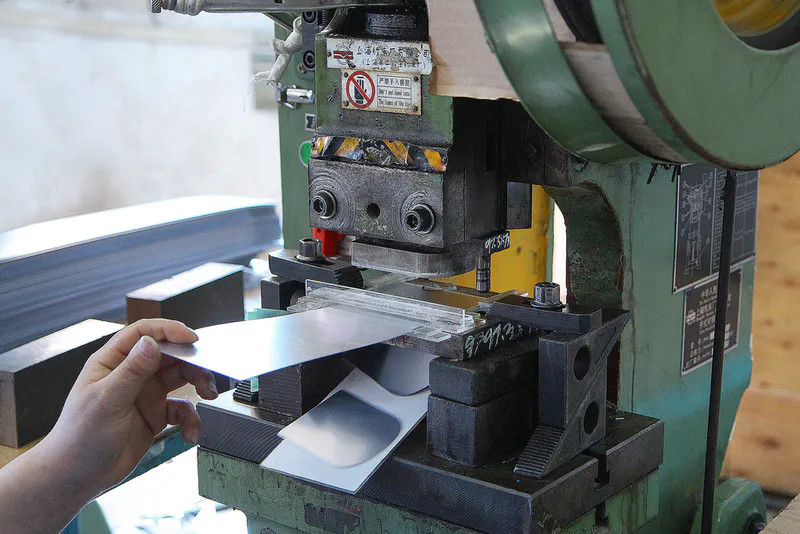
We covered the broader cutting methods in the 4×8 sheets post for buyers working at larger scales, but for 10×12 work, the simpler hand-tool approaches are usually sufficient.
When to Specify Something Other Than 10×12
If the project needs multiple pieces of a different size, ordering at the size that minimizes cutting waste makes more sense than starting with 10×12 and cutting down. For pieces under 6×8, ordering at 12×12 or smaller standard sizes and cutting often produces less waste. For pieces over 12×15, ordering at 12×24 or 24×24 is usually more economical.
If the project needs a single larger piece, ordering 10×12 and combining pieces doesn’t work — the seams between mirrors are visible and the reflection across joined pieces won’t align. For single pieces above 12 inches in either dimension, order at the next standard size up. For pieces above roughly 24 inches in any dimension, the size-distortion considerations we’ve covered repeatedly become relevant, and the large mirror sheets range covers what’s practical at those dimensions.
If the project specifically needs a square mirror, 12×12 is the natural standard size and is typically priced similarly to 10×12. The slight area difference rarely matters for craft or display applications.
If the project needs the mirror to be perfectly flat against a curved or irregular surface, acrylic at this size will conform to small surface irregularities — that may be a feature or a problem depending on what you’re trying to do. For decorative mosaic work where slight surface conformity is fine, it doesn’t matter. For applications where the mirror needs to stay perfectly flat (display measurements, photography reference, optical work), specify thicker stock (3mm or 6mm) to maintain rigidity against the underlying surface.
A Practical Note on Pricing
10×12 acrylic mirrors are inexpensive at single-piece level and very inexpensive at multi-pack quantities. Per-square-foot, this size is more expensive than larger formats like 24×36 or full sheets, because the pricing accounts for the cutting and packaging labor involved in producing small pieces. But the per-piece price stays low because each piece is small.
For projects that need only a few mirrors at this size, the per-piece convenience usually outweighs the per-square-foot premium. For projects that need many small mirrors and want to cut them down further, ordering at a larger size and cutting is more economical — but the savings only matter past a certain volume, and the cutting work needs to be factored in.
Where the 10×12 size loses to other formats is in projects that need exactly that area in a different aspect ratio. A project needing a 6×18 strip mirror, for instance, has roughly the same surface area as a 10×12 but is shaped wrong for the cut. In those cases, ordering a custom-cut piece or cutting from a larger sheet usually makes more sense.
Quality Considerations at This Size
Most quality issues that show up in 10×12 acrylic mirrors are at the manufacturing level rather than the material level. A few things worth checking when you receive an order:
Surface defects
Inspect each piece for specks, pinholes, or coating irregularities. Reputable suppliers grade their sheets and reject defective material; bargain suppliers don’t always. If you’re ordering for premium applications — bespoke craft products, custom signage, professional photography work — pay for grade-A material and inspect on arrival. The cost premium is small.
Edge condition
Saw-cut edges should be clean and consistent across all pieces in an order. Significant edge damage, chipping, or rough finish indicates a quality problem with the cutting process. Multi-pack orders from quality suppliers should have visually consistent edges across the set.
Reflection accuracy
Hold the mirror up to a reference (a clear bookcase edge, a window frame) and check that the reflection is straight without visible waviness. At 10×12, any visible waviness indicates either a manufacturing defect or improper storage that left the sheet bowed.
Coating durability
The reflective coating on an acrylic mirror sits behind a protective backing, but the backing itself can be damaged in transit. Inspect the back of each mirror for scratches, dents, or coating exposure. Minor backing damage doesn’t usually affect the reflection but indicates handling issues.
In short, 10×12 acrylic mirrors are one of the easiest products in the broader acrylic mirror range to specify correctly. The size is small enough to avoid the distortion problems that complicate larger formats, the applications are well-defined and consistent, and the material choices are forgiving for most uses. Most of the buyer mistakes that happen at larger sizes (wrong thickness for the application, wrong substrate for the environment, oversized for the actual need) don’t really happen at this size — the size itself constrains the relevant decisions.
The right approach for most 10×12 orders is: pick the thickness that matches the use (1.5mm for craft and cutting, 3mm for whole-piece use), pick the color and finish that fits the project, order in multi-packs if you need multiple pieces, and accept the standard edge finish unless edges will be visible in the finished product. That covers most decisions.
For projects that don’t fit the 10×12 dimension cleanly — different aspect ratios, larger sizes, smaller pieces — adjacent standard sizes (12×12, 8×10, 12×24) or custom cuts from larger sheets are usually the better path. The 10×12 size is one of those products that just works for the things it’s designed for. Get the basics right at the order stage and the material does its job.