
“Can you produce acrylic framed mirrors?” is a question customers often ask us.
Whenever we receive a similar inquiry, we usually first clarify what kind of “frame” the customer is referring to. Do they want a decorative border around the mirror surface, or do they need a solid frame structure that can be assembled together with the mirror?
These details directly affect the product design, processing method, and quotation. In actual communication, customers’ requirements vary greatly. What different customers refer to as an “acrylic framed mirror” may correspond to completely different product needs.
Some customers emphasize the lightweight nature and ease of processing of acrylic mirrors, some focus on the decorative effect of acrylic frames, and some already have an appearance design prepared and hope the manufacturer can help determine a suitable combined structure.
There is no clear definition of what constitutes a framed mirror. We could even consider an acrylic traffic mirror to be a type of framed mirror. However, this type of product mainly serves visibility and outdoor usage needs, which differs from the design focus of decorative mirrors.
Simply using the description “framed” is not enough to determine what kind of product the customer actually needs.
As an acrylic mirror manufacturer, we prefer to first clarify these requirements before discussing how to manufacture the product. Next, let’s talk about the different forms acrylic framed mirrors can take, and how to choose the right solution for your own product.
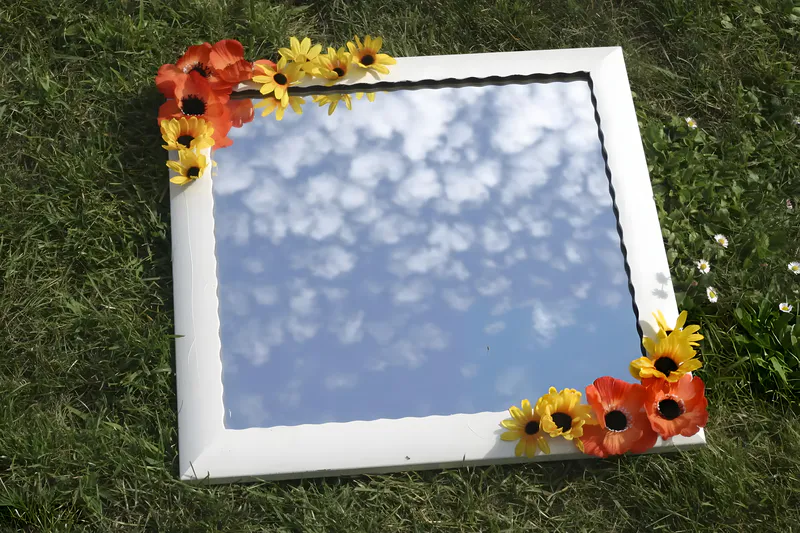
Types of Acrylic Framed Mirrors
Continuing from the previous distinctions, acrylic framed mirrors can be divided into three categories based on “how the frame is formed”: composite structure type, printed frame type, and solid frame type.
Each of these three solutions has different design priorities. When choosing, you can first decide whether you value material combinations, decorative patterns, or a complete frame shape more, and then discuss dimensions and processing details. The following size calculations are all design examples to help illustrate the differences between the various structures.
Composite Structure Acrylic Framed Mirror
This type of solution combines the acrylic mirror surface with other panels through openings, connectors, or verified bonding methods. The frame effect can come from the exposed backing board around the mirror surface, or from separately processed decorative components.
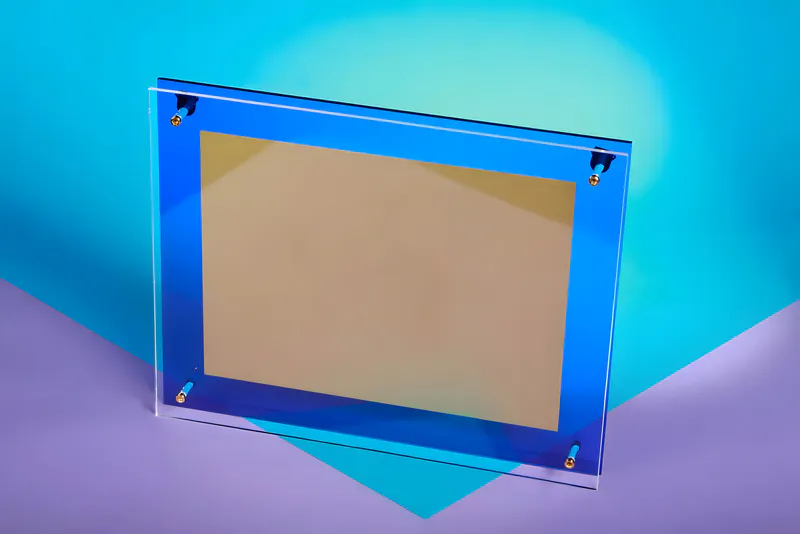
As shown in the figure, if a mirror surface measuring 360 × 560 mm is centered on a backing board measuring 400 × 600 mm, an exposed area of 20 mm will remain on each side. This border area can use a different color or material from the mirror surface to create a visual frame.
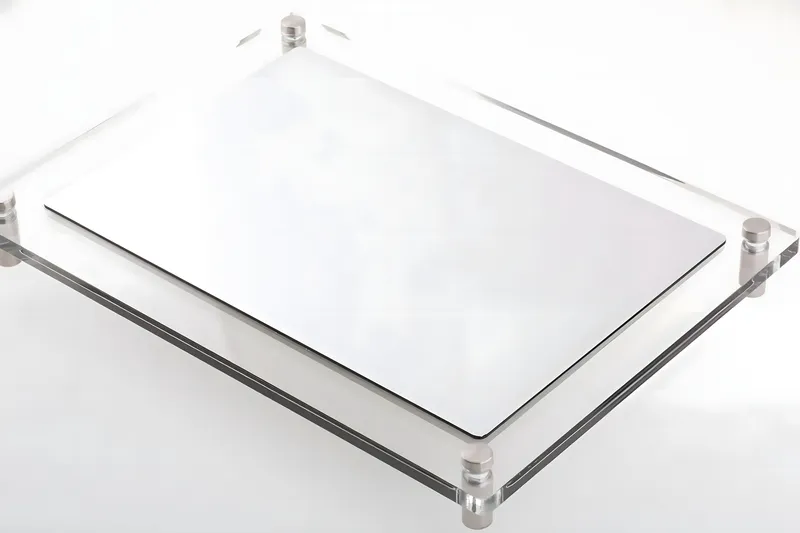
Usually this frame layer is decorated separately, and decorative elements can be added for embellishment. The frame can also be designed directly through printing. Mirrors with this structure usually use acrylic as the backing board because it is easier to integrate.
It is suitable for designs requiring material contrast, layering effects, or brand decoration. Since the mirror surface and backing board are processed separately, it is also convenient to apply different appearance requirements to the two components. If the appearance is still being developed, our collection of decorative acrylic mirror ideas can provide a starting point for discussing the design.
When customizing, it is recommended to specify separately:
- Mirror surface dimensions and thickness: Determines the specifications of the mirror itself.
- Backing board dimensions and thickness: Determines the outer contour and the layered effect after assembly.
- Connection method: Specify whether openings are required, whether connectors are exposed, and whether spacing is retained between components.
Printed Frame Acrylic Mirror
A printed frame is created by adding colors, patterns, or text around the mirror surface, making a single acrylic mirror appear to have a frame. It is a visual decoration method suitable for products that want to maintain a flat outline while incorporating brand logos or decorative graphics.
We will use images as examples. The product on the left is a mirror sign made by printing on a circular flat acrylic mirror, with certain areas exposing the mirror surface to give the sign more texture. The product on the right is a common mirror product. The edge of the apple-shaped mirror is not decorative plastic; rather, the entire mirror is cut into the shape of an apple, and the edges are then printed to create this final style.

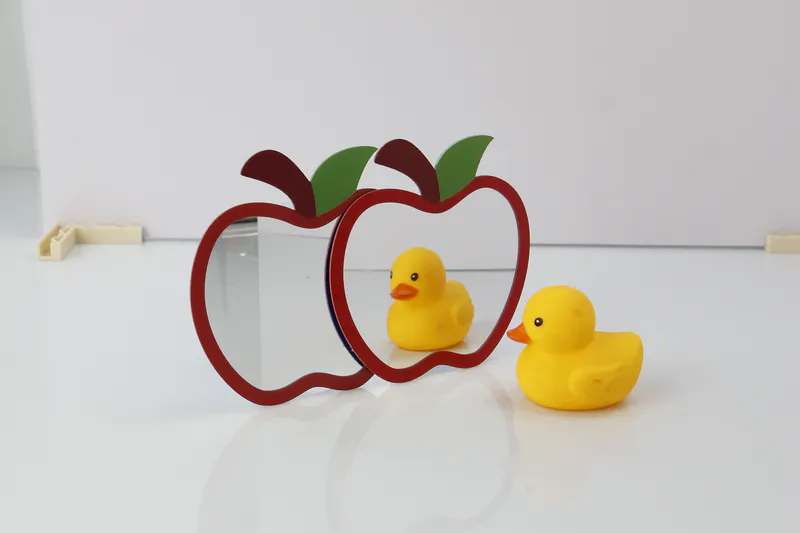
Depending on the design and material conditions, printing is usually done through methods such as screen printing or digital printing. ACRYLITE’s Acrylic Printing Technology Guide points out that the compatibility between ink and sheet material affects adhesion performance. Whether a specific mirror surface and its coating are suitable for printing should be confirmed through sample testing.
For this type of mirror, the width of the frame usually directly affects the usable mirror area in the center. Taking a rectangular acrylic mirror measuring 400 × 600 mm as an example, assuming opaque printed borders of equal width are applied on all four sides:
| Width of Printed Border on One Side | Visible Central Mirror Size | Visible Mirror Area as Percentage of Total Panel |
|---|---|---|
| 10 mm | 380 × 580 mm | Approx. 91.8% |
| 20 mm | 360 × 560 mm | 84% |
| 30 mm | 340 × 540 mm | 76.5% |
Using printing technology to create the frame effect for acrylic mirrors offers efficiency advantages for integrated mirror products. However, its disadvantages are also obvious. The most common issue is that the adhesion of the printing ink deteriorates and begins to peel off. Choosing high-quality printing ink will also increase the overall cost.
If you are considering this method for making framed acrylic mirrors, it is recommended that you produce samples first and test them before considering further production.
Solid Frame Acrylic Mirror
Solid frame products have an independent frame structure. The mirror panel is assembled into the frame through embedding, edge pressing, rear fixing, or similar methods, forming a complete framed mirror product.
Here it is necessary to further clarify the material combinations:
- Acrylic mirror with frames made from other materials: “Acrylic” refers to the mirror material, while the frame material can be selected separately according to the design.
- Acrylic frame with mirror panel: “Acrylic” refers to the frame material, while the mirror panel can be either glass mirror or acrylic mirror depending on requirements.
- Acrylic frame with acrylic mirror: Both components use acrylic, but material grade, thickness, and processing requirements still need to be confirmed separately.
For solid frame customization, it is necessary at minimum to distinguish between the overall finished dimensions, the front opening dimensions, and the mirror panel cutting dimensions.
As shown in the figure, for a mirror with an overall finished size of 400 × 600 mm and a front frame width of 10 mm on all four sides, the front opening size is 380 × 580 mm. However, the mirror panel cutting size must also take into account the overlap inside the frame and assembly clearance, so it cannot be ordered directly according to the opening size. Our guide to ordering custom-cut acrylic mirror panels can help you prepare the mirror-panel specifications separately from the frame requirements.
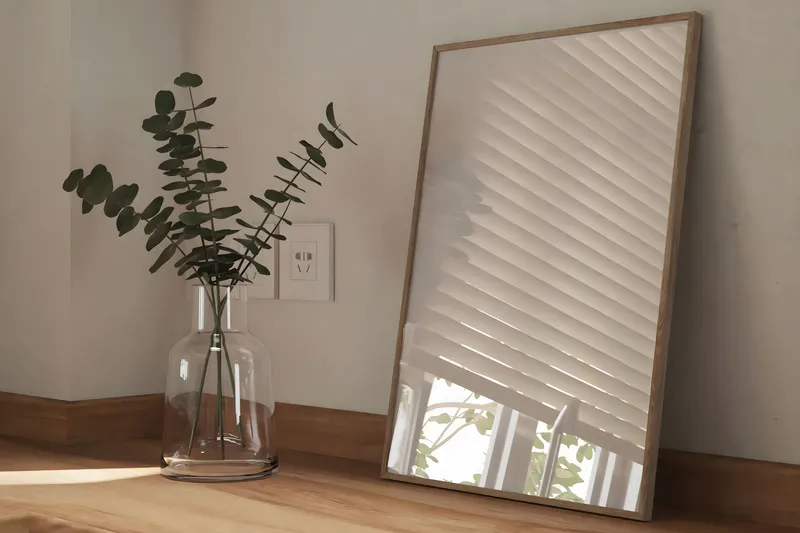
Thickness should also be confirmed separately. For example, suppose the mirror portion of the product uses thicknesses of 3 mm and 5 mm, but this does not represent the frame thickness or the total finished thickness. Normally, an overall finished thickness is provided, and the manufacturer then determines the mirror thickness and frame thickness separately.
However, this often leads to a very common issue: manufacturers that produce acrylic mirrors may not necessarily produce the complete finished product directly. This is because the frame material may need to be sourced externally, and external sourcing can introduce certain risks. If the mirror and frame are produced separately by coordinating two manufacturers, the procedures involved become more complicated and time-consuming.
Therefore, when discussing acrylic framed mirror solutions, in addition to providing a front-view rendering, it is best to also provide side-view or structural diagrams. By separately specifying the mirror panel, frame, and overall dimensions, manufacturers can more accurately determine the processing method and provide comparable quotations.
How to Judge the Workmanship Quality of Acrylic Framed Mirrors?
After understanding the product type, requesting samples can help us further determine whether an acrylic framed mirror actually meets expectations once produced.
When examining a sample, you can inspect the mirror surface and the frame separately. For the mirror surface, focus on the reflection effect and surface condition. For the frame, focus on the outline, color, and processing details. Then evaluate the overall level of completion by combining both parts.
Mirror Surface: Observe Clarity and Image Shape
A mirror surface looking bright does not necessarily mean that the straight lines, proportions, and details in the reflection meet requirements.
For flat acrylic mirrors, you can use straight edges, grid patterns, or other objects with clear straight lines as observation references, and inspect in the following order:
- Check the surface at close range. Look for obvious scratches, spots, localized hazy areas, or defects in the reflective coating. This is to confirm the quality of the acrylic substrate.
- Observe the center and edges. Compare the reflection of the same straight line at different positions on the mirror surface, and check whether there is obvious bending or localized distortion. This is to determine the quality and flatness of the coating.
- Change the viewing distance and angle. Check whether issues that are not obvious at close range become more noticeable when viewed from farther away or from the side. This serves as secondary verification of the first two checks.
PLASKOLITE’s Acrylic Mirror Fabrication Guide points out that the visual distortion of acrylic mirrors is related to viewing distance and material thickness, and reminds users that this type of mirror is not suitable for applications requiring precise image reflection. Therefore, when confirming samples, it is best to record the viewing distance and conditions when testing reflection performance.
This method is mainly intended for flat mirrors. For products intentionally designed with convex or other curved surfaces, different testing methods are required.
Frame: Check Edges, Surfaces, and Seams
The frame is the key part of a framed mirror. It is necessary to distinguish whether acrylic is used as the main material for the frame. The workmanship of acrylic frames is often easier to identify from the sides and corners.
Front-view photos can show the overall outline, but whether the edges are processed evenly, whether joints are neat, and whether there are processing marks in transparent materials usually need to be confirmed through detailed photos or physical samples.
| Inspection Area | Recommended Points to Observe |
|---|---|
| Transparent frame | Whether the transparency is consistent across different areas, and whether there are obvious bubbles, impurities, or localized whitening |
| Colored frame | Whether the colors of different sections are coordinated, and whether the gloss is consistent across the same surface |
| Edges and corners | Whether there are obvious burrs, chipped edges, or notches, and whether rounded or beveled corners match the drawings |
| Joint positions | Whether the seams are neat, and whether there is obvious misalignment, glue overflow, or uneven gaps |
| Printed frame | Whether the pattern edges are clear, whether the widths on all four sides are consistent, and whether there are missing prints or obvious color differences |
If the frame is made from other materials, such as PS or ABS, then different methods are needed to determine frame quality. In general, you can first review the material certifications and testing reports provided by the supplier.
The evaluation of edge finishing quality should correspond to the design requirements. For example, transparent polished edges and frosted edges are inherently two different effects, so evaluation should be based on confirmed samples or drawings.
For printed frames, attention should also be paid to the adhesion performance of the pattern. Ink selection and the surface condition of the sheet material will affect adhesion performance. Before mass production, you can ask the manufacturer to explain the inspection methods used and retain the corresponding proofing results.
Overall: Check Whether Dimensions and Appearance Are Coordinated
Even if the mirror surface and frame both meet requirements individually, the combined overall effect is still worth checking. A framed mirror with internal gaps caused by non-standard dimensions results in a poor product experience.
If the design requires equal frame widths on all four sides, the actual visible frame width should be measured. If the design requires the mirror surface to be centered, the relative positions of the left and right sides and the top and bottom should be compared. For irregularly shaped acrylic framed mirrors, the finished product outline should also be checked against the approved drawings.
When confirming samples, the results can be divided into three categories:
- Requirements that must be met: such as materials, outer dimensions, mirror dimensions, frame width, and pattern content.
- Appearance ranges that require agreement between both parties: such as color differences, seams, edge gloss, and visible processing marks.
- Specific areas requiring modification: use annotated photos to explain where the problem is and the desired result.
As manufacturers, we can improve products more easily based on specific feedback such as “the seam in the upper-right corner needs adjustment” or “the printed frame on the left side is wider than the right side.” Recording these details in samples and confirmation records can also provide clearer standards for subsequent mass production.
Custom Acrylic Framed Mirrors: How to Compare Quotations from Different Manufacturers?
After determining the mirror’s structural type and understanding how to evaluate the quality of a framed mirror, the next step is to briefly understand how to compare quotations from different manufacturers.
Even for the same acrylic framed mirror with an overall size of 400 × 600 mm, the prices quoted by different manufacturers may correspond to different mirror materials, frame structures, and processing requirements. To determine whether a quotation is reasonable, suppliers should first be asked to quote based on the same product specifications. For the mirror-sheet portion of the quotation, understanding the factors affecting acrylic mirror sheet pricing helps separate material and sheet-processing costs from frame, assembly, and packaging costs.
Make Sure the Quotations Correspond to the Same Product Requirements
A reference image can help manufacturers determine the overall structure and appearance of the framed mirror, but it is usually not enough to define the complete production requirements.
For example, the black border shown in the image may be produced through printing, or it may be a separately processed black acrylic frame. The reference image may also differ from the final required product. This results in different materials, components, and processing steps being involved.
As a manufacturer, we recommend clearly specifying at least the following when requesting quotations:
| Quotation Item | Details That Need to Be Specified | Common Differences in Interpretation |
|---|---|---|
| Mirror Material | Acrylic mirror or glass mirror, including color and thickness | Even when both are described as “acrylic framed mirrors,” the actual mirror materials may differ |
| Frame Structure | Printed border, combined structure, or independent solid frame | The border effect shown in the image may be interpreted as different production methods |
| Product Dimensions | Finished outer dimensions, visible mirror area dimensions, and total thickness requirements | One party may quote based on mirror sheet dimensions, while another quotes based on finished product dimensions |
| Surface and Edge Treatment | Printing area, color, edge processing, and appearance requirements | The level of finishing included in the quotation may differ |
| Purchase Quantity | Quantity per design, and quantity distribution across different colors and sizes | The total quantity may be the same, but the product mix may differ |
| Packaging Method | Individual packaging, protective materials, outer cartons, and labeling requirements | Bare product prices may be compared together with fully packaged product prices |
After determining the requirements as clearly as possible, provide the same requirements to different manufacturers for review. Manufacturers can also be asked to quote alternative solutions separately. For the same appearance design, quotations can be provided separately for a “printed border” and a “solid frame,” with each including an explanation of the corresponding processing contents. This makes it easier to identify where the price differences come from.
Separate Sample Costs from Mass Production Costs
Quotations for custom acrylic mirrors usually also involve issues such as sample production and product adjustments. Whether these costs apply and how they are charged should be confirmed according to the specific project.
For easier cost evaluation, the quotation can be requested to separately list:
- Sample costs: including how many samples are provided, what processing is included, and whether shipping costs are included.
- Initial setup costs: such as plate-making or dedicated tooling, and whether these are charged separately and can continue to be used for future repeat orders.
- Mass production unit price: corresponding to the confirmed quantity, product specifications, and packaging requirements.
- Other costs: including separately charged packaging, transportation, taxes, and related items.
If the manufacturer offers an arrangement such as “sample fees refunded after bulk order placement,” the applicable order quantity, refund amount, and specific conditions should also be confirmed.
For projects requiring phased purchasing, tiered pricing for quantities such as 100 units, 500 units, and 1,000 units can also be requested separately. These quantities are only examples for quotation purposes; actual quantities should follow the purchasing plan, and it should also be confirmed whether the tiered pricing requires the same model, the same color, or one-time delivery.
Keep the Confirmed Specifications in the Quotation
After multiple rounds of communication, the product may undergo adjustments such as changes to frame width, mirror thickness, or packaging method. The final quotation should correspond to the final confirmed drawings and specifications, with the version or date clearly indicated.
For example, if the initial discussion involved a 20 mm wide solid frame but was later changed to 30 mm, the quotation should be updated accordingly to avoid both parties continuing to interpret the product based on different versions.
For buyers, a valuable quotation should clearly explain what kind of product can be purchased at that price, what services are included, and which changes would require re-quotation.
Once these details are clearly confirmed, the next step is to verify the actual mirror effect, frame details, and overall workmanship through samples, turning the specifications on paper into a product that can be directly inspected.
What Is the Difference Between Acrylic-Framed Mirrors and Glass-Framed Mirrors?
When discussing mirrors, a comparison between acrylic and glass materials is essential. The comparison here is specifically about whether the mirror uses acrylic or glass. Frames are not included in the discussion of differences because they can be manufactured in many different ways.
Only by separating the mirror from the frame can differences in weight, scratch resistance, and reflective performance be accurately understood.
Performance Differences Between Mirror Materials
The comparison below is based on standard non-hardened acrylic and standard annealed glass. Wear-resistant coatings, glass strengthening treatments, and different composite structures may all affect the performance of specific products.
| Comparison Item | Acrylic Mirror | Glass Mirror |
|---|---|---|
| Material Weight | For the same net volume, the weight is usually about half that of glass | Heavier for the same net volume |
| Impact Resistance | Compared with ordinary glass, it usually has better impact resistance, but may still crack or break | Ordinary annealed glass is relatively prone to breaking upon impact; tempered glass requires separate comparison |
| Surface Scratch Resistance | Ordinary surfaces are relatively prone to scratches; check whether a wear-resistant coating is provided | Ordinary glass surfaces are usually more scratch-resistant, but can still be scratched by hard objects |
| Rigidity | More likely to bend under the same geometric dimensions | Usually better able to maintain rigidity under the same geometric dimensions |
| Cleaner Compatibility | It is necessary to confirm whether cleaning products are suitable for acrylic and its surface treatments | Glass itself usually has better chemical resistance, but decorative coatings and seams still need separate consideration |
Weight
“Acrylic weighs about half as much as glass” has an important condition: the comparison is between materials of the same size and thickness.
If two mirrors use mirror panels and frame components of the same specifications, and only the frame material is changed, then the change in the total mirror weight depends on how large a proportion the frame originally accounted for.
A simplified example:
- Assume the glass frame weighs 1 kg, and the remaining components total 3 kg, making the entire mirror weigh 4 kg.
- Assume an acrylic frame of the same shape and thickness weighs about 0.5 kg, while the remaining components stay the same, making the entire mirror weigh about 3.5 kg.
- In this example, the entire mirror is reduced in weight by about 12.5%.
When comparing finished products, directly checking the net weight and the material configuration of the frame and mirror panel is more informative than only looking at the “description.”
Scratch Resistance and Impact Resistance
Scratch resistance describes a surface’s ability to resist friction damage, while impact resistance concerns how a material performs when struck. These are different properties.
Therefore, the fact that acrylic mirrors are more impact-resistant does not mean their surfaces are also more scratch-resistant than glass. If product descriptions mention “scratch-proof” or “wear-resistant,” further confirmation should be made as to whether a specialized surface coating is used and which parts the treatment covers.
The impact resistance performance of the frame also cannot directly represent the quality of the mirror itself. When reading product descriptions such as “shatter-resistant” or “impact-resistant,” confirm whether they refer to the frame, the mirror panel, or a fully tested finished product.