
Gold mirror acrylic is widely used for signs, wedding decor, retail displays, awards and decorative panels. It is lighter and easier to cut than glass or metal, while its reflective face creates a stronger visual effect than ordinary metallic gold plastic.
The main purchasing difficulty is that “gold” is not a standard color. One supplier may use the term for a bright yellow-gold mirror, while another may supply a pale champagne or darker amber finish. Product photographs make the difference harder to judge because the sheet reflects the room, the lighting and the camera.
A buyer should therefore compare more than the product name. The shade, thickness, sheet construction, edge appearance and installation method all affect the finished result.
What is gold mirror acrylic?
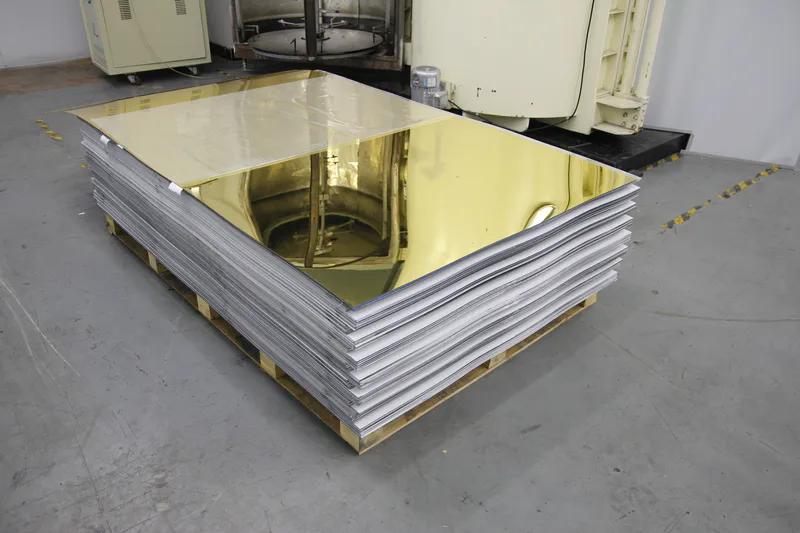
Gold mirror acrylic is a type of PMMA sheet with a gold reflective surface on the front side. It can produce a decorative mirrored effect with warm tones, rather than the near-natural reflection of a standard silver mirror. Through the image below, you can very intuitively compare the reflected conditions of its mirror surface.
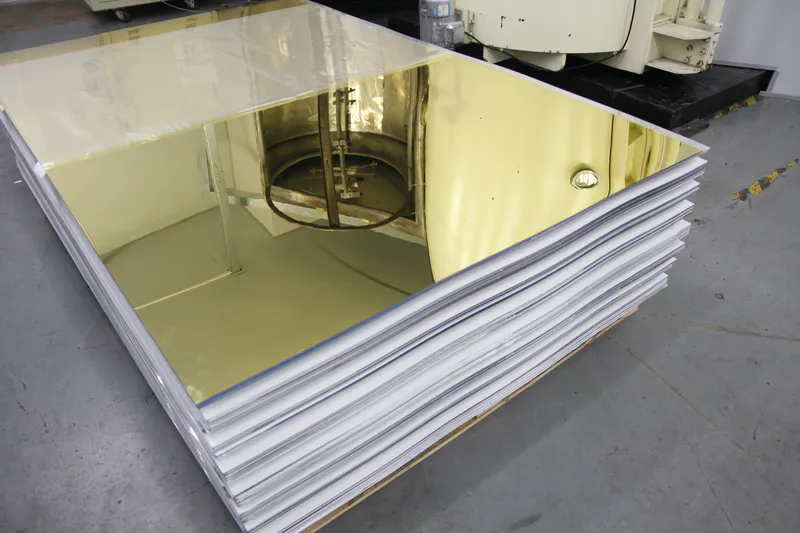
The structure varies among different manufacturers. Some products use a colored acrylic substrate with a reflective layer added to the back. Others create the color through coatings or attached films. The coating on the back is usually covered with an opaque protective backing and is not designed for use as a two-way mirror.
The gold acrylic mirrors we produce are mainly made by adding pearlescent powder, pigments, and color masterbatch into the PMMA acrylic raw material. Then, a mirror layer is formed on the back through vacuum coating, electroplated film, or metal reflective film. The differences in manufacturing methods lead to differences in cost, which is also why the cost of many gold acrylic mirrors can vary.
In decorative acrylic mirrors, the acrylic protects the coating from the front, while the backing provides protection from the rear.
The term “gold” usually describes the appearance of the sheet. It generally does not mean that the decorative surface is made of pure gold or gold foil. If a project has requirements regarding the coating composition, material specifications should be requested.
Why does gold mirror acrylic look different in photographs?
Most people perceive the color gold differently; it’s not that their perception is wrong, but rather that everyone’s idea of gold varies slightly. This leads to another problem: the color doesn’t look quite right in photos.
There are typically two factors contributing to this problem.
First, the “gold” envisioned by the manufacturer may not align with mainstream perceptions of gold. While production staff may know how to create the material, they may not necessarily understand how it appears in the marketplace.
Second, the mirror surface reflects its surroundings, so its apparent color changes depending on the environment. A gold mirror panel may appear lighter in a white studio, darker in a black display setting, warmer under yellow lighting, and more neutral under cool LED lighting. These are all common challenges encountered when photographing products and require some knowledge of photography. Additionally, the camera’s white balance and screen calibration can further alter the appearance of the photo.
Protective films may also make new panels appear duller or cause slight color variations. The final confirmation should be based on the surface of the finished product, not on photographs.
When a project requires a specific shade of gold, physical samples should be verified under the lighting conditions that will be used during final installation. Supplier photos can help narrow down the selection, but they should not be used as the final color standard for large-scale projects or orders where design color accuracy is critical.
Which gold shade should you choose?
Suppliers use different names for similar colors. Currently, the most common terms are “bright gold,” “champagne gold,” and “antique gold.” These are merely descriptive terms for the products and are not universal standards. Here are some of the differences between them:
| Gold shade | Typical appearance | Common applications | What to check |
|---|---|---|---|
| Bright gold | Strong yellow-gold color | Logos, event signs and awards | May look orange under warm light |
| Pale or champagne gold | Softer and more neutral | Cosmetics displays, interiors and packaging | May look close to silver under cool light |
| Warm or amber gold | Deeper yellow-brown tone | Hospitality and vintage-style decor | Reflected images may appear darker |
| Rose gold | Pink or copper direction | Weddings and beauty displays | Should be approved separately from standard gold |
Bright gold pairs well with black, white, and vibrant brand colors. Champagne gold is easier to pair with stone, cream, beige, and low-saturation interior finishes. Warmer amber gold is suitable for vintage or hospitality projects, but may differ from modern golden sand tones.
If the mirror surface must match printed packaging, painted metal, fabric, or other components, please provide your supplier with a physical reference. Color codes or numerical color values can indicate the target color, but reflective panels will not appear exactly the same as flat printed colors.

How is gold mirror acrylic different from other gold materials?
Some products are described as “gold,” but their surface finishes vary. The most obvious distinction is between glossy and matte finishes, but there are also some definitional differences beyond these two. Here’s how we understand them:
| Material | Surface appearance | Main advantages | Main limitations |
|---|---|---|---|
| Gold mirror acrylic | Clear, warm-tinted reflection | Lightweight and easy to custom cut | Scratches more easily than glass or metal |
| Metallic gold acrylic | Shiny color without a clear reflection | More uniform color | Does not provide a true mirror effect |
| Gold mirror glass | Flatter reflection | Better for large permanent mirrors | Heavy, breakable and difficult to shape |
| Gold-colored metal | Metal surface in polished, satin or brushed finishes | Stronger and more heat resistant | Heavier and harder to cut into detailed shapes |
| Gold leaf or foil | Hand-applied decorative surface | Traditional premium appearance | Labor-intensive and less uniform |
Gold mirror-finish acrylic creates different visual effects depending on the surrounding environment, as it reflects nearby objects and light sources. This adds depth to signs and displays, but it also makes fingerprints, scratches, and uneven installation more noticeable.
Metal is a better choice when the material needs to bear weight, withstand higher temperatures, or be used outdoors for extended periods. Metal can also offer brushed and satin finishes, which differ from the mirror finish. Gold mirror-finish acrylic is best suited for lightweight lettering, hanging decorations, and intricate laser-cut designs.
Where is gold mirror acrylic commonly used?
Colored acrylic mirrors are quite popular on the market. Based on our many years of experience selling these mirrors, we’ve found that they’re commonly used in the following places:
Signs, letters and logos
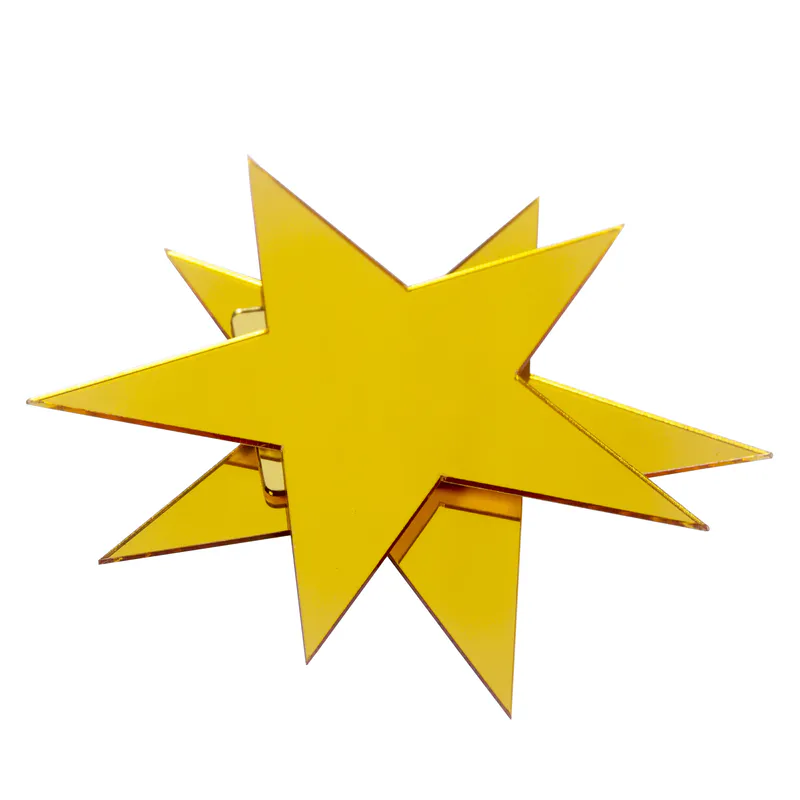
Gold mirror-finish acrylic is typically cut into company names, logos, wall lettering, and 3D signs. Its reflective surface enhances the visual impact of small letters more effectively than ordinary gold-colored plastic, and its lighter weight makes the finished signs easier to install.
Interestingly, most customers prioritize the quality of the edges over the color itself. The edges typically reveal the acrylic and part of the backing layer, rather than a solid gold metallic appearance. When the edges remain visible, trimming, edge painting, or a layered sign structure may be required.
Retail and product displays
Cosmetics display racks, jewelry displays, perfume counters, and brand display fixtures often feature small accents of gold-mirrored surfaces. Carefully selected reflective areas can draw attention to the products without making the entire display appear visually cluttered.
For best results, test the panels under the actual display lighting conditions. Warm-toned mirrors may make certain packaging and jewelry appear more luxurious, but they may also alter their perceived color.
Weddings and event decor
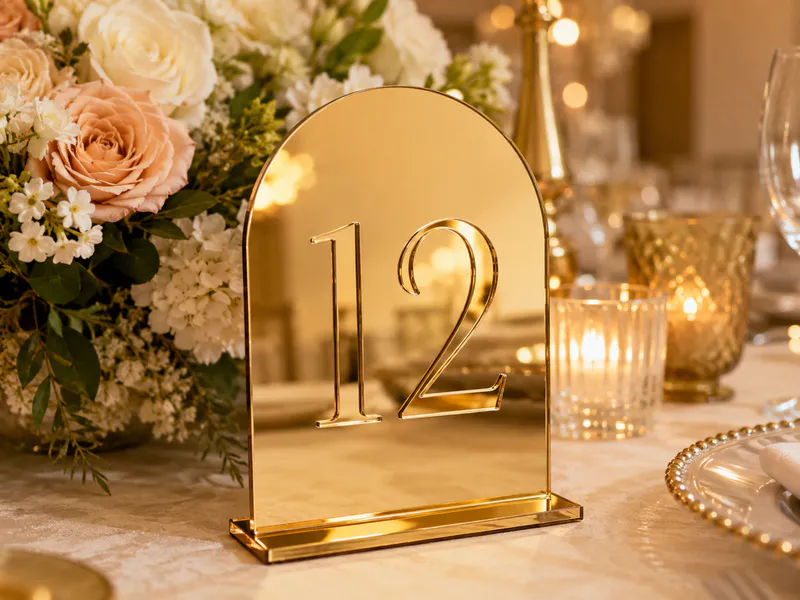
Table numbers, welcome signs, place cards, menus, cake toppers, and hanging decorations are all common applications. Gold mirror-finish acrylic can be cut into complex shapes and is safer to transport than thin glass panels.
However, some weddings may require larger mirrors for decoration; in such cases, we generally do not recommend that customers use acrylic mirrors. If the mirror panel is supported at only a few points, it may warp and produce distorted reflections.
Awards, packaging and presentation products
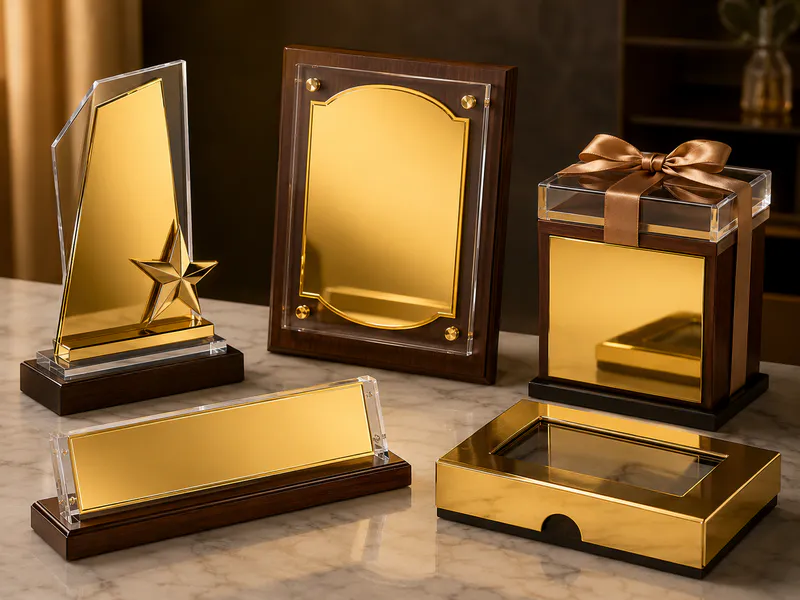
Gold mirror acrylic can be used as a face layer on awards, plaques, nameplates, presentation boxes and premium packaging displays. It is often combined with clear acrylic, wood or colored plastic in a layered construction.
The mirror layer is decorative. A rigid base or backing should provide the structural support for a larger product.
Interior accents and furniture details
Small panels can be used for cabinet inserts, wall shapes, shelving accents, hospitality signage and furniture trim. Acrylic is easier to shape than glass and reduces the weight of the finished component.
Large wall areas require more caution. Acrylic follows irregularities in the wall or backing and can create a wavy reflection. Thicker material and rigid support improve the result but do not make a large acrylic panel behave exactly like glass. Our large acrylic mirror guide explains this limitation in more detail.
Crafts, jewelry and small products
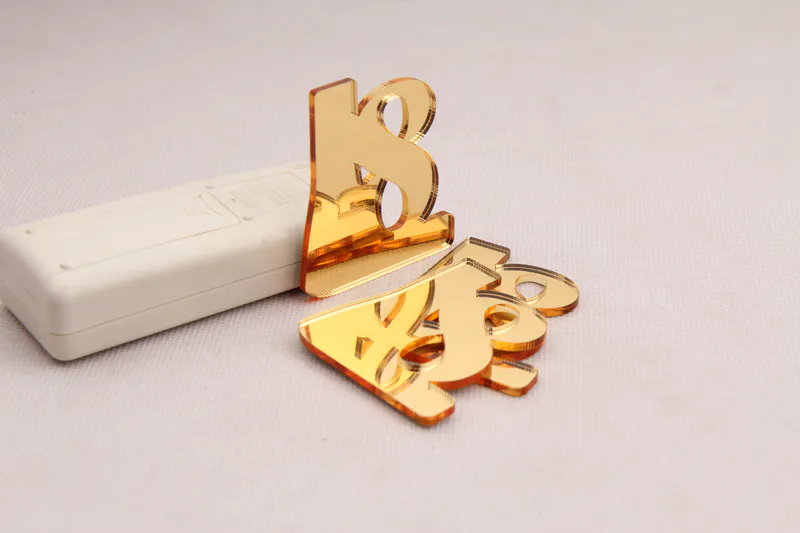
Earrings, pendants, ornaments, bag tags, and decorative accessories can effectively utilize the reflective properties of their surfaces. Small components also avoid most of the distortion issues commonly associated with large mirrored panels. When designing, ensure that sufficient material is left around holes and narrow sections. Fine, sharp corners may break during handling, and holes placed too close to the edge may crack during installation.
Which thickness and size should you order?
This section is primarily intended to answer questions for those who need large sheets of gold acrylic mirror! If you need a full sheet of mirrored material, the thickness should be selected based on the finished component, not just the sheet dimensions.
1.5mm to 2mm is typically used for small decorative items, layered signs, jewelry, and crafts. These sheets are relatively lightweight but become more flexible as the component size increases.
3mm is the standard starting thickness for signs, display components, event props, and general decorative work. Wider panels still require flat support.
5mm to 6mm provides greater rigidity for larger letters, freestanding components, and designs requiring thicker edges. Increasing the thickness can reduce bending, but it cannot eliminate warping in large panels.
Availability varies by supplier and color. Some suppliers may offer silver mirror sheets in a variety of thicknesses, but gold is available only in select sizes. If the sheet needs to be installed into a frame, a slot, or a machined component, please confirm the actual thickness. Our Acrylic Mirror Thickness Guide explains how thickness affects rigidity, weight, and installation methods.
For custom parts, please provide the finished dimensions, hole locations, cutouts, and fillet radii. Our Acrylic Mirror Custom Cutting Guide lists the information needed to create production drawings.
When color consistency is important, please order adjacent panels and repeat parts from the same production batch. Subtle differences between batches may become noticeable when parts are installed side by side.
How can gold mirror acrylic be cut and engraved?
Gold-mirrored acrylic can be laser-cut, CNC-engraved, sawed, and drilled using methods suitable for PMMA. The appropriate processing method depends on the material thickness, the complexity of the details, the edge requirements, and the order quantity.
Trotec’s Acrylic Laser Cutting Guide lists signs, displays, lettering, and jewelry as common applications for acrylic and explains that both cast and extruded acrylic can be processed using CO₂ lasers. Its Laser Material Guide also lists mirror-finish acrylic as one of the acrylic materials used for signs, displays, and accessories.
Mirrored acrylic requires additional testing, as excessive heat may cause the back coating near the cut area to discolor or peel. Parameters set for clear acrylic should first be tested on actual gold-mirrored sheets before proceeding to full-scale production.
The protective film on the mirror surface should be left in place during cutting and handling. Reverse engraving is typically performed from the back to keep the front surface smooth. Artwork must be mirrored before engraving, and a sample should be verified, as this process removes or alters the back coating.
Cut edges typically expose the acrylic substrate and backing plate rather than a continuous metallic gold finish. If the edges are also required to have a gold appearance, incorporate paint, edging, or other material layers into the design.
Our Acrylic Mirror Surface Laser Cutting Guide provides more detailed information on masking, test cuts, and coating protection.
How should gold mirror acrylic be installed?
Gold mirror panels work best when mounted on a flat, sturdy backing surface. An uneven backing surface or applying adhesive only in certain areas may cause the reflective surface to appear wavy.
Common installation methods include: using a compatible, flat backing panel; edge mounting; installing support posts through pre-drilled holes; using clamps that evenly distribute pressure; or, for small components, using tested, mirror-safe adhesives.
Do not assume that general-purpose construction adhesives are necessarily compatible with the backing panel. Certain adhesives and solvents may damage the coating or reflective layer and leave marks visible from the front. The complete combination of the mirror, backing panel, and adhesive should be tested before full-scale production.
Screws and support columns should not be overtightened. Acrylic requires space to accommodate normal thermal expansion and contraction; if fasteners apply continuous pressure, cracks may form around the holes.
Unless the supplier confirms that it is structural-grade and suitable for outdoor use, gold-mirrored acrylic should be considered an interior decorative material. Moisture, UV exposure, temperature fluctuations, and unsealed edges can all damage the backing panel over time.
What are the most common ordering mistakes?
Q: Choosing the shade from one photograph.
- A: Lighting and reflections can change the apparent color. Approve a physical sample for color-sensitive work.
Q: Assuming every supplier uses the same gold.
- A: Gold names are not standardized. Compare the actual material rather than the description alone.
Q: Splitting one project across different batches.
- A: Small color differences may be visible between adjoining pieces.
Q: Ignoring the cut edge.
- A: The edge normally shows acrylic and backing rather than a solid gold appearance.
Q: Using an untested adhesive.
- A: An incompatible product can damage the backing or create visible marks.
Q: Expecting a large functional mirror.
- A: Gold mirror acrylic is primarily decorative. Large unsupported panels can distort, and the warm tint changes reflected colors.
Q: Using an indoor product outdoors.
- A: Confirm exterior suitability instead of assuming that all acrylic mirror grades are weather resistant.
What should you confirm before ordering?
Please provide the supplier with the following:
- An approved gold sample or physical color reference;
- Finished product dimensions and total quantity;
- Required thickness and acceptable tolerances;
- All hole locations, openings, and fillet radii;
- Cutting method and desired edge finish;
- Backplate, frame, adhesive, or mechanical mounting methods;
- Viewing distance and required reflectance;
- Application environment (indoor, wet areas, or outdoor);
- Required packaging for the finished product;
- Single-batch production requirements.
When an order includes custom color shades, reverse engraving, visible edges, or unfamiliar adhesives, it is helpful to produce a production sample. This allows the buyer to confirm the color and structure before the entire batch is processed.